
Intrinsically safe Ethernet
New standards for intrinsically safe Ethernet
Industrial Ethernet plays a key role in process automation. End-to-end solutions for IP communication from the control room to field level are already available today, including hazardous areas in the process industry. With regard to uniform, interoperable standards, manufacturers and organizations are driving forward the development of intrinsically safe Ethernet concepts.

The growing volume of data in process automation requires higher bandwidths and faster transmission rates in order to monitor and control processes in real time wherever possible. Additional requirements arise from the increasing demand for diagnostic data and device information. This increases the importance of integrated Ethernet networking of entire industrial plants. With EtherNet/IP, HART-IP and Profinet, various standards for IP communication have become established in process technology. Industrial Ethernet is characterized, among other things, by deterministic data transmission and robust components with extended temperature resistance and increased IP protection. In the process industry, the use of Ethernet is subject to additional conditions. In addition to long operating cycles of process control systems, field devices and installed infrastructure, this also includes practicable explosion protection in order to implement networking down to field level, including areas designated as potentially explosive atmospheres.
Installation options up to zone 1
CAT copper cables can also be installed in potentially explosive areas if appropriate protective measures are taken. The required explosion protection is ensured by electromechanical protective measures in accordance with the requirements of increased safety "e". As standard RJ45 plugs are not suitable for applications in Zone 1 and the cable entry into flameproof Ex d housings involves a great deal of effort, "Ex e" terminals with tension clamp technology specially approved for Zone 1 are used for this purpose. This allows Ethernet cables with up to eight cores and transmission rates of up to 1 Gbit/s as well as PoE (Power over Ethernet) to be installed in a remote, easily accessible "Ex e" connection compartment.
For networking even remote hazardous areas via Ethernet, the connection via fiber optic cable (FO) is the ideal solution. The interference-free fiber optic cabling requires neither complex earthing nor shielding and enables data exchange between sensors and actuators, remote I/O systems, control and monitoring cameras over distances of several kilometers. Potential ignition hazards are prevented in accordance with the "op is" type of protection to DIN EN 60079-28 by limiting the optical energy of the light beam to a non-ignitable level. Installations protected in this way also allow optical rings with convenient diagnostic and signaling functions to be set up in hazardous areas. Corresponding media converters and switches for Zone 1 and 2 are available for this purpose.
Intrinsically safe Ethernet sets new standards
Although fiber optic cables with "op is" have been used for a long time, applications and users often require the use of copper cables in potentially explosive atmospheres. For example, the NAMUR recommendation NE168 "Requirements for an Ethernet communication system for the field level" specifies the use of two-core cables for connecting field devices. The "intrinsically safe" type of protection has proven itself in the process industry and has become globally established. Standards for interoperable intrinsically safe Ethernet networking of field devices and systems open up new possibilities for digital process automation. According to DIN EN 60079-11, device protection through intrinsic safety requires the amount of energy in a circuit to be limited to a non-incendive level so that sparks and thermal effects cannot act as ignition sources. Intrinsically safe fieldbus systems such as Profibus DP via RS485-IS have long been used for networking remote I/Os, operating terminals and analysis devices. Today, intrinsically safe 2-wire fieldbus installations with Profibus PA and Foundation fieldbus H1 are often used for digital communication up to the field device.
The decisive advantages of the intrinsic safety type of protection lie in the uncomplicated and convenient handling of intrinsically safe devices, as conversion and maintenance work can be carried out on intrinsically safe circuits or devices in potentially explosive atmospheres. As there is no need for enclosure encapsulation, there is no need for more complex protective measures such as the use of d or p enclosures. Extensions or repairs can be carried out under voltage (hot work) and devices can be added or disconnected (hot swap) without completely switching off systems or system components. The high level of flexibility also makes the intrinsic safety type of protection attractive for Ethernet networking in hazardous areas. In order to develop future-proof solutions for interoperable and intrinsically safe Ethernet, R. Stahl has joined forces with other manufacturers in two working groups. Both working groups - the Advanced Physical Layer (APL) Project and the Intrinsically Safe Ethernet Working Group - are currently developing international standards for intrinsically safe Ethernet based on 10BASE-T1L and 100BASE-TX technology.
Field networking up to zone 0
Ethernet-APL will be available at Achema 2021 as a dedicated solution for the use of intrinsically safe 2-wire field devices in process automation. The technology is based on the physical layer of Single Pair Ethernet (SPE) 10BASE T1L in accordance with the IEEE Std 802.3cg-2019 specification. SPE uses 2-wire cables to bridge distances of up to 1,000 m at transmission rates of 10 Mbit/s and optionally supply connected devices via PoDL (Power over Data Line). Ethernet-APL is compatible with SPE, but uses a supply concept for field devices that differs from PoDL in order to enable the use of the intrinsic safety type of protection. Other connectors and terminal connections are also expected to be used in order to meet the requirements of process automation. In addition to manufacturers, leading industry organizations are also involved in the development of Ethernet-APL in order to ensure compatibility with the communication protocols HART-IP (FieldComm Group, FCG), EtherNet/IP (ODVA) and Profinet (Profibus and Profinet International, PI).
Based on the FISCO concept (Fieldbus Intrinsically Safe Concept, see IEC 60079-11 and -25) and designed together with Dekra Exam, the 2-WISE explosion protection (2-Wire Intrinsically Safe Ethernet) for intrinsically safe 2-wire fieldbus systems enables field use up to Zone 0 in accordance with ATEX and IECEx as well as DIV 1 for installations in the NEC area of application. Thanks to standardized Ex i parameters, Ethernet-APL devices from different manufacturers can be interconnected within the specified boundary conditions of Ethernet-APL or 2-WISE without an intrinsic safety verification calculation and without taking cable parameters into account. In order to make the migration of existing fieldbus installations as simple as possible, Ex i parameters compatible with FISCO are specified for 2-WISE and type A fieldbus cables can still be used. The 2-WISE concept is currently being prepared for standardization by the IEC project team PT 60079-47. A technical specification as IEC TS 60079-47 "Equipment protection by 2-Wire Intrinsically Safe Ethernet concept (2-WISE)" should be available by 2021 so that Ethernet-APL devices can be certified as soon as possible.
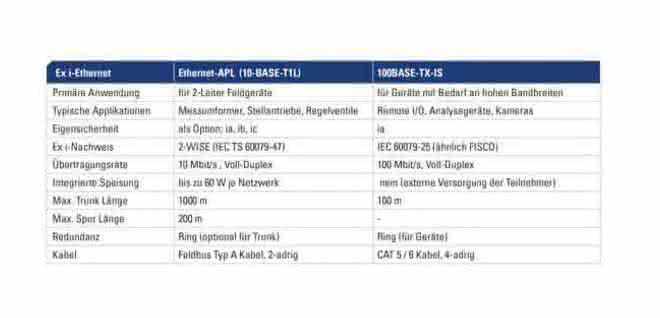
Ethernet APL allows different installation concepts. For example, an APL power switch supplies the network (trunk) with up to 60 W of power. APL Field Switches installed in the field and fed by the trunk convert the supplied energy into intrinsically safe energy and distribute it to several outgoing circuits (spurs). The field devices, which can be installed as ia, ib or ic circuits in zones 0, 1 or 2 depending on their configuration, are operated on these Ex i tracks, which can be up to 200 m long. By cascading the APL field switches, a total of around 50 Ex i field devices can be operated per APL network. Externally powered Ethernet APL switches with a connection to other Ethernet networks such as 100BASE-TX are also possible. Without the "hot-swap" or "hot-work" properties of intrinsic safety, Ethernet-APL also supports field devices with types of protection such as flameproof enclosure "d" or encapsulation "m".
High bandwidths with great compatibility
For IP networking of operating terminals, analysis devices or remote I/O systems that require higher bandwidths and more energy, R. Stahl is working in the Intrinsically Safe Ethernet Working Group on an intrinsically safe variant of the widely used 100BASE-TX Ethernet, also known as Fast Ethernet. The new 100BASE-TX-IS standard provides high data rates of 100 Mbit/s for process control, data acquisition and evaluation. The explosion-proof 4-wire Ethernet is fully interoperable with the IEEE 802.3 industry standard and, in conjunction with an intrinsically safe front end and galvanic isolation where necessary, enables the connection of conventional industrial electronics with the continued use of Media Access Control (MAC) and PHY. In contrast to Ethernet-APL, 100BASE-TX IS does not offer power supply via the network. In addition, the transmission path via CAT cable is limited to the standard Ethernet distance of 100 m. For significantly greater distances of up to 30 km, 100BASE-TX IS switches and media converters with additional fiber optic interfaces, for example with "op is" type of protection, are currently being developed. Similar to Ethernet-APL, 100BASE-TX-IS does not require complex verification of intrinsic safety. A comparison of the participants for conformity with the underlying standard is sufficient. As the boundary parameters of a 100BASE-TX-IS installation are known - exactly two subscribers (thus two energy sources) in a point-to-point connection via CAT 5/6/7 cable and a maximum distance of 100 m - a generally valid intrinsic safety verification can be carried out on the basis of IEC 60079-25 "Intrinsically safe systems". This has already been carried out and documented as an example by PTB using the ISpark tool. This means that no calculations by the planner are required and the proof of intrinsic safety is limited to the documentation or the required explosion protection document for the installation.
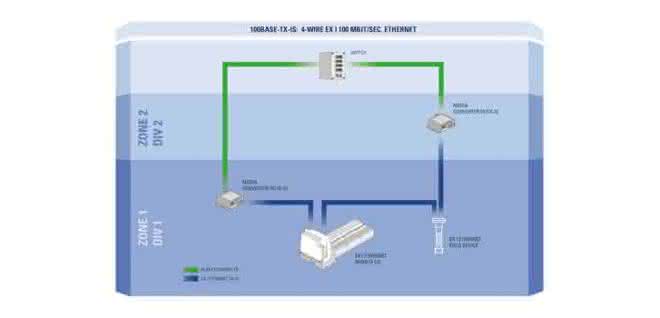
100BASE-TX-IS is to be integrated into the IEC 61158-2 "Industrial communication networks - Fieldbuses - Part 2: Specification and service definitions of the physical layer (physical layer)" and IEC 61784 "Industrial communication networks" series of standards, similar to the intrinsically safe RS485-IS fieldbus, which is frequently used when installing Profibus DP networks in potentially explosive atmospheres. The first 100BASE-TX-IS devices could be launched on the market as early as 2020, as the "Ex i conversion" of 100BASE-TX interfaces and the associated EU type examination certificate can be carried out with manageable effort.
Advancing standards
Digitalization is changing entire industries and determining their future competitiveness. Proven solutions for high-bandwidth IP networking in hazardous areas are already available to the process industry today. With Ethernet-APL and 100BASE-TX-IS, companies are working with industrial organizations to drive the development of new standards for intrinsically safe Ethernet. Both solutions are completely transparent in terms of communication protocols, support EtherNet/IP, Profinet and HART-IP and can be combined in a variety of ways. For example, intrinsically safe 2-wire Ethernet field devices can be connected via field switches and connected to remote I/O systems and the control system from an intrinsically safe 100BASE-TX-IS backbone.
According to documents from R. Stahl / ag


You might also be interested in
Helu makes its first trade fair appearance under a new brand name
Helu Kabel will be presenting itself as Helu for the first time at Hannover Messe 2026, showcasing system solutions, Heluchain cables and new industrial luminaires.
 read more...
Strategic realignment with brand relaunch
In future, Helukabel will trade as Helu
The Helukabel Group is parting with part of its name: in future, the company will only operate under the Helu brand. With this step, the specialist for electrical connection technology is underlining its strategic development from a classic cable...
read more...Modular plant construction for corrugated board
Insight into the production of corrugators at BHS Corrugated: Automated, modular and equipped with Helukabel components.
read more...Best quality for the steel
Conditions in the steel industry are harsh and inhospitable. The machines used must be able to withstand the demanding environmental conditions in order to deliver the best quality at all times.
read more...If the standard cable is not sufficient
Lapp offers cables for countless applications - but not for all of them. From time to time, the developers have to modify a standard cable or develop a special cable.
read more...Slight decline in sales, strong investments
The Lapp Group has not been spared from the weakening global economy. However, the company only recorded a slight loss in the past 2024 financial year.
read more...Electrical connection technology
Cables and wires for industrial automation
Heukabel offers system solutions for cable routing from a single source. The subsidiary EKD Systems specializes in tailor-made cable drag chains made of steel, stainless steel and plastic, which are used in moving machines and systems as well as in...
read more...Lapp relies on Ultramid from BASF
Mobile charging of electric vehicles
The automotive industry is currently undergoing the biggest transformation in its history. The boom in battery electric vehicles in particular is presenting the industry with major challenges. Lapp, as a supplier of cables and connection...
read more...Cable handling application
At this year's Motek, ArtiMinds Robotics is showcasing a robot-based automation solution for the sensor-assisted assembly of flexible cables in connector housings.
read more...