
Digitalization in mechanical engineering
VDMA honors four up-and-coming AI talents
At the "Digitalization in Mechanical Engineering" research day, the VDMA awarded prizes to four final theses from the fields of engineering and computer science. The award-winning projects show applications of AI in test processes, production quality, analysis of solar wafers and project management.
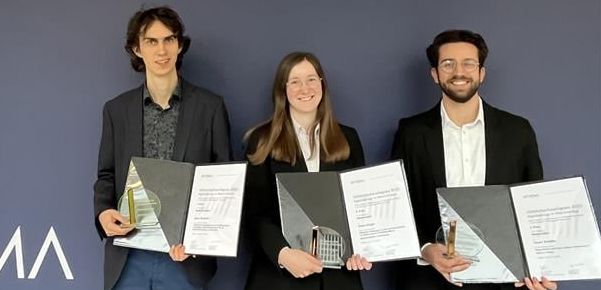
At the VDMA's "Digitalization in Mechanical Engineering: Research and Industry in Dialogue" research day in Frankfurt, universities and industry discussed the opportunities presented by digital technologies. 24 projects were nominated for the "Digitalization in Mechanical Engineering" young talent award. The jury recognized practice-oriented results in production and quality assurance. "In addition to practice-oriented AI applications, the solutions for increasing product and process quality were particularly impressive this year," said Guido Reimann, Deputy Managing Director of VDMA Software and Digitalization.
According to the VDMA, the theses from the fields of engineering and computer science show that young talent is indispensable for progress and competitiveness in mechanical engineering. The theses combine theory and practice and provide forward-looking impetus for the further digitalization of the industry. "Close cooperation between universities and industrial companies is an important building block for the development of new practical solutions and the strengthening of innovation in companies," emphasized Reimann.
The award winners
Tanaro Schädler (University of Ulm) was awarded 1st prize in the Master's category. In collaboration with Uhlmann Pac-Systeme and under the supervision of Prof. Dr. Friedhelm Schwenker from the Institute of Neuroinformatics, he developed an AI framework that prioritizes test cases for machine control systems and predicts error types. This reduces the number of meaningless test runs, speeds up error detection and increases product quality while using fewer resources.
The 2nd prize in the 'Master's thesis' category went to Alessa Seeger (Center for Advanced Studies DHBW). In cooperation with Harro Höfliger Verpackungsmaschinen from Allmersbach im Tal and under the supervision of Prof. Dr. Holger Hofmann, she developed a modular software system that detects good and bad parts in pharmaceutical production. AI analysis and an OPC UA connection make it possible to detect deviations at an early stage and avoid downtime. At the same time, it shows ways in which missing data can be systematically supplemented
Jonas Grajetzki (TH Mittelhessen) won first prize in the 'Bachelor thesis' category for an LED-supported measuring system for the non-destructive inline analysis of solar wafers. His solution, which he developed together with Lucas instruments from Jena and Leibnitz IPHT (Jena) as part of a research project funded by the "Central Innovation Program for SMEs" (ZIM) and under the supervision of Prof. Dr. Uwe Probst, combines UI and EQE measurements and enables rapid quality assessment.
The 2nd prize in this category went to Neele Kuhlmann (PHWT Vechta/Diepholz). In her analysis of composite projects at Broetje-Automation in Rastede, she identified typical weaknesses in planning and control. Her evaluation tool systematically classifies composite projects and recommends suitable management methods; the thesis was supervised by Prof. Dr.-Ing.


You might also be interested in
Fraunhofer IOSB Opens Humanoid Robots Lab
The Fraunhofer IOSB is opening a Humanoid Robots Experience Lab in Karlsruhe, Lemgo, and Ilmenau. Companies and organizations can use these facilities to test potential applications for humanoid robots and develop pilot projects.
 read more...
Artificial Intelligence in Manufacturing
Trumpf and IPAI Are Expanding a European AI Network for Industry
The high-tech company Trumpf is an official partner of the IPAI AI network in Heilbronn. Together, the partners aim to exchange experiences, develop new AI applications for industrial use, and advance the development of artificial intelligence in...
read more...The AKIMI Research Project at WZL
Agent-Based AI Aims to Simplify Robotics for Small and Medium-Sized Businesses
The AKIMI research project is developing an agent-based AI designed to significantly simplify the setup, programming, and reconfiguration of robotic systems for small and medium-sized enterprises. The goal is to make robotics more flexible and...
read more...Joachim Bürkle is the new managing director of the AI Quality & Testing Hub
The AI Quality & Testing Hub (AIQ) is getting new leadership: Joachim Bürkle is taking over as managing director of the AI competence center run by VDE and the State of Hesse.
read more...Cybus Brings in Siemens Executive Stefan Schwab to Lead the Company
The Hamburg-based software provider Cybus will have a dual leadership structure going forward: Stefan Schwab will join co-founder Peter Sorowka as co-CEO.
read more...Industrial AI and Manufacturing
Siemens and IFS Bridge the Gap Between Planning and Operations
Siemens and IFS are collaborating to use industrial AI to enable a closed-loop digital twin across the entire plant lifecycle. The goal is to more closely link design data with real-world operational information and optimize industrial processes.
read more...5 Challenges for AI Projects in Manufacturing
Manufacturing companies have high hopes for AI. IFS highlights the five most common reasons why AI projects fail.
read more...Record funding for accelerated development of a physical AI platform
Neura Robotics has announced a Series C funding round worth up to $1.4 billion. This will help the company accelerate its mission to build the world’s leading physical AI platform.
read more...Vertiv and Nvidia link physical infrastructure with digital twins
Digital twins instead of a flood of documents: Vertiv integrates 'SmartRun' into 'Nvidia Omniverse DSX' to accelerate the planning and implementation of AI factories.
read more...