
Neura Robotics
Record funding for accelerated development of a physical AI platform
Neura Robotics has announced a Series C funding round worth up to $1.4 billion. This will help the company accelerate its mission to build the world’s leading physical AI platform.
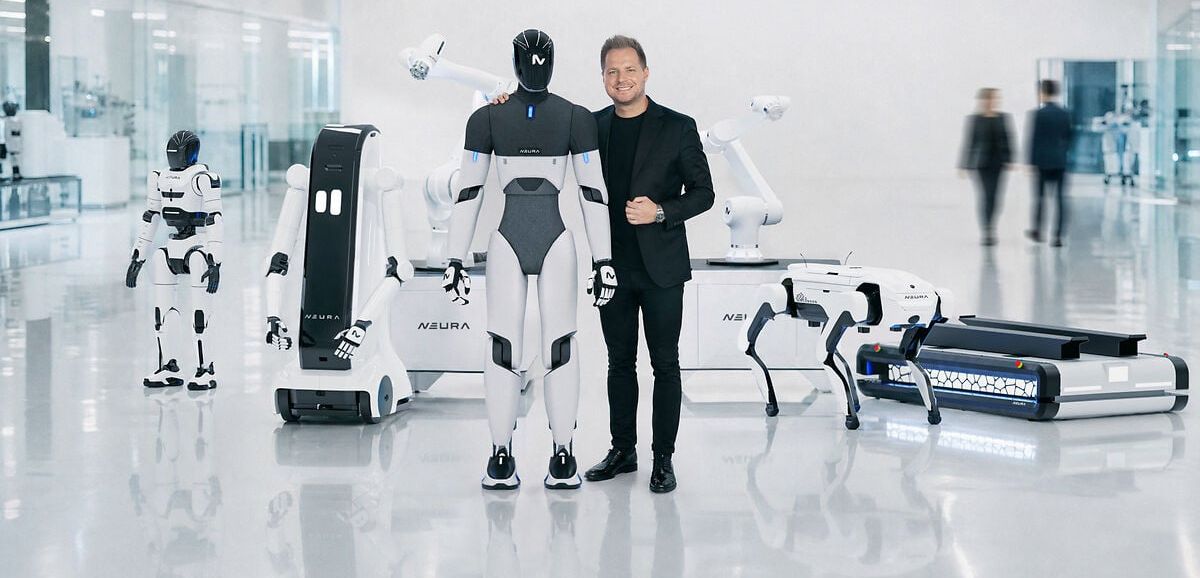
Investors include global companies in the fields of AI, robotics, computing infrastructure, manufacturing, and industrial automation—including Tether, Qualcomm Technologies, Amazon, Nvidia, imec.xpand, Bosch, Schaeffler, the European Investment Bank, Lingotto Horizon, and InterAlpen Partners.
Neura is creating a new category of AI infrastructure in which cognitive robots continuously learn, collaborate, and operate in real-world environments on a shared, intelligent platform (Neuraverse). Unlike traditional robotics companies, which rely on isolated machines or limited industrial automation, Neura combines robotics, AI, sensor technology, edge computing, and large-scale learning infrastructure into a unified platform architecture that can be deployed worldwide.
“The future of AI won’t just be confined to screens,” says David Reger, founder and CEO of Neura Robotics. “It will move, interact, learn, and work alongside us in the real world. We are convinced that Physical AI and cognitive robotics will lead to one of the greatest technological leaps of the coming decades. They will fundamentally transform entire industries, from manufacturing and logistics to healthcare, services, and household robotics.”
The new funding will accelerate the global deployment of cognitive and humanoid robots, the expansion of the Neuraverse platform, the rollout of "Neura Gyms," large-scale training environments for cognitive robots in real-world settings, the establishment of production and scaling capabilities, and the development of the next generation of Physical AI systems.
Neura Robotics’ strategic partnerships include leading industrial and AI companies, such as Bosch, Schaeffler, Kawasaki, Qualcomm Technologies, Amazon, and Nvidia, positioning the company at the intersection of robotics, industrial automation, and artificial intelligence. The company’s current order backlog and strategic deployment pipeline exceed one billion U.S. dollars. With the advent of AI in the physical world, Neura sees the next decisive competitive advantage in combining intelligence with real-world interaction, sensor technology, and scalable infrastructure. “In the future, people will no longer ask what AI can tell them,” said Reger. “They will ask what AI can physically do.”
To shape this transformation, Neura is building the Neuraverse, one of the world’s first open physical-AI ecosystems, where robots continuously exchange skills, competencies, and real-world learning experiences. At the same time, the company is expanding its global network of Neura Gyms—specialized training environments that combine real-world sensor data, simulation, and multimodal learning processes, thereby building one of the world’s largest real-world robotics data infrastructures.
As part of its long-term strategy, Neura is working with strategic infrastructure partners to develop decentralized AI architectures, edge intelligence, and machine-based economic systems. The company believes that open, trustworthy, and interoperable robotics ecosystems will become increasingly important as AI systems become more prevalent in factories, logistics centers, healthcare facilities, and eventually in private households.


You might also be interested in
Development Collaboration for Humanoid Robotic Hands Launched
Schunk is entering into a new development partnership with Robert Bosch Robotics. Their shared goal is to develop an industrial-grade robotic hand that can be integrated into various humanoid robot systems.
 read more...
Robot-controlled packaging of rolls
Koch Robotersysteme, a company specializing in the integration of robotic systems, has developed a complete, automated packaging line for packaging rolls based on Tentoma’s RoRo StretchPack packaging machine.
read more...Highly Automated Injection Molding
Six-axis robots automate the entire handling process
From part handoff to loading and unloading the injection molding machine to quality inspection: Yaskawa six-axis robots automate the entire handling process in a highly integrated production line for safety-critical sight domes.
read more...International Federation of Robotics
The 2026 IERA Award was presented
The 2026 “Award for Innovation and Entrepreneurship in Robotics & Automation” (IERA) goes to the Swiss deep-tech company Verity for its fully autonomous indoor drone system. The flying robots support the logistics and retail sectors by...
read more...Humanoid robotics from Germany
Igus launches service robots for everyday industrial use
Humanoid robotics: With the Iggy Rob Home, igus presents a service robot for industry and everyday life. What's behind it.
read more...New sales and service unit in Gurugram
Yamaha Motor expands robotics business in India
Yamaha Motor is opening a new Robotics Business Support Division in India to strengthen sales and service in the growing robotics market. The unit will support SMT systems and industrial robots, among other things, and will be complemented by a...
read more...Robotics and autonomous order picking
Locus Robotics acquires Nexera Robotics and expands autonomous warehouse logistics
Locus Robotics takes over Nexera Robotics and may have taken a decisive step towards truly universal warehouse automation. A new gripping technology should now make possible what was previously considered difficult to automate.
read more...Factory planning without compressed air...
How vacuum becomes mobile
Modular factories, mobile robotics and rising energy prices are fundamentally changing automation. One solution: into the future without compressed air. Electric vacuum systems reduce costs, save energy and support flexible manufacturing and...
read more...A robot for all occasions
Industrial robots take on many tasks. Even milling with accuracies in the sub-millimeter range is now possible.
read more...