
AI factories
Vertiv and Nvidia link physical infrastructure with digital twins
The infrastructure provider Vertiv is integrating a new digital twin function into 'Nvidia Omniverse DSX'. The aim is to make the planning, simulation and deployment of AI factories faster and more reliable.
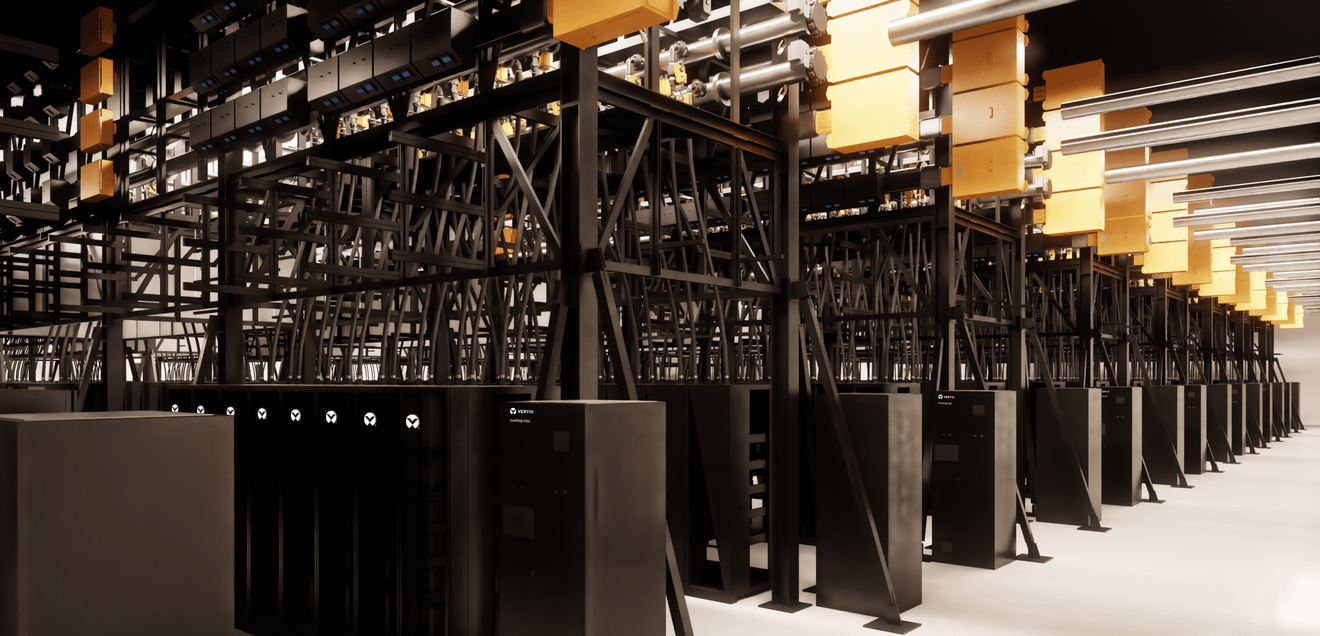
The development of AI systems is currently progressing faster than the expansion of the necessary physical infrastructure. While computing power is growing in ever shorter cycles, data center operators are faced with the challenge of adapting power supply, cooling and control systems accordingly. The infrastructure provider Vertiv now wants to close this gap with digital twins.
The company has announced progress on a production-ready digital twin feature for Vertiv SmartRun. The solution will be integrated into the Nvidia Omniverse DSX Blueprint and is designed to help make AI factory infrastructure more configurable, repeatable and simulation-ready.
Planning as a complete digital system
With the increasing power densities of AI applications, traditional planning processes are increasingly reaching their limits, according to Vertiv. Until now, teams for power supply, cooling, control and implementation have often worked with separate documentation and handover processes.
The 'Vertiv SmartRun Digital Twin' is intended to replace this approach with a model-based process. Infrastructure can be designed, simulated and validated as a coherent system before construction. Configurations and dependencies are mapped in a virtual environment so that potential problems become visible at an earlier stage.
According to the company, this reduces design changes in late project phases and integration risks. At the same time, the time to operational readiness is to be shortened and collaboration between different specialist departments improved.
"AI infrastructure can no longer be planned generation by generation," says Scott Armul, Chief Product and Technology Officer at Vertiv. "To deliver more tokens per second per megawatt, power, cooling, control and deployment workflows must be designed as a single, interlocking system. The Vertiv SmartRun Digital Twin helps translate Vertiv's infrastructure expertise into configurable, simulation-ready building blocks that enable faster and safer AI factory planning. By extending this approach to Vertiv OneCore Rubin DSX, Vertiv is helping customers translate future compute requirements into deployable physical infrastructure before those requirements reach full deployment scale."
Part of a larger roadmap
According to the company, SmartRun's digital twin is the first step in a multi-stage strategy for digital twins of AI factories. The aim is to maintain the technical logic of a system throughout its entire life cycle - from configuration and simulation to commissioning and subsequent optimization.
In future, digital models will not only be used as planning tools, but will also form the basis for the operation and further development of complex infrastructure.
Nvidia relies on full-stack co-design
Integration into Nvidia Omniverse DSX is a central component of the concept. The platform is intended to enable digital twins of AI factories on a gigawatt scale and bring together different simulation models.
"AI factories require full-stack co-design across compute and physical infrastructure," said Vladimir Troy, Vice President of AI Infrastructure at Nvidia . "Nvidia Omniverse DSX Blueprint helps the ecosystem create, simulate and optimize digital twins for gigawatt-scale AI factories using OpenUSD, SimReady assets, and power, thermal and operational simulations. Incorporating Vertiv SmartRun into this workflow can help customers evaluate infrastructure decisions earlier and prepare for multiple generations of accelerated computing power."
Demonstration at Computex
Vertiv wants to show what such an approach can look like in practice at Computex Taipei 2026. SmartRun will be presented there both as a physical infrastructure system and as a configurable digital twin.
The demonstrator is based on Dassault Systèmes' model-based system engineering capabilities on the '3DEXPERIENCE' platform and is connected to Nvidia Omniverse DSX workflows. The goal is a common digital foundation for configuration, simulation, validation and subsequent optimization of the infrastructure.
"Digital twins make it possible to represent complex infrastructure systems with the intelligence of their configuration rules, dependencies and technical intent," said Stéphane Sireau, vice president of the high-tech industry at Dassault Systèmes. "At Computex, Vertiv, Dassault and Nvidia will demonstrate how Vertiv's AI factory infrastructure is evolving from document-based design workflows to an industrialized, model-based systems engineering approach optimized for speed, quality and system-level performance."
Infrastructure becomes a bottleneck
The push shows how much attention in the AI industry is now shifting to the physical infrastructure. While new generations of chips and AI models regularly make the headlines, the provision of energy, cooling and data center capacity is increasingly becoming a decisive factor. Digital twins should help to plan and test these systems more quickly and adapt them to the growing requirements of future AI factories.


You might also be interested in
Keba Expands Its Business in France Through the Acquisition of Transtechnik
With the acquisition of the French company Transtechnik, Keba is expanding its presence in the French automation market and strengthening its support for industrial customers.
 read more...
Force Sensors for Precise Measurement Applications in the Automotive and Mechanical Engineering Industries
GTM introduces its K-Series force transducers for measuring tensile and compressive forces in test stands, production processes, and applications in the automotive and mechanical engineering industries.
read more...Software-Defined Manufacturing Enters Industrial Practice
More than 100 experts from industry and technology gathered at Xentara Connection Day to discuss software-defined manufacturing, Physical AI, AI, Edge AI, and the modernization of existing production facilities.
read more...Artificial Intelligence in Manufacturing
Trumpf and IPAI Are Expanding a European AI Network for Industry
The high-tech company Trumpf is an official partner of the IPAI AI network in Heilbronn. Together, the partners aim to exchange experiences, develop new AI applications for industrial use, and advance the development of artificial intelligence in...
read more...Case Study: Networked Manufacturing Platform for Toolmaking
Using a networked manufacturing platform, Escha GmbH & Co. KG, a manufacturer of industrial fastening technology, has comprehensively modernized its toolmaking operations.
read more...From ERP System to AI Platform
RNA, based in Aachen, manufactures up to 2,000 custom-designed feeding systems annually and handles all order processing through a central ERP platform.
read more...Predictive Maintenance in the Powertrain: Stöber Is Gradually Expanding Its Approach
Step by step, the company is continuing to develop predictive maintenance: from monitoring to predictive maintenance to smart powertrains.
read more...Eric Goos Appointed to the Board of Sumitomo Drive Technologies
Sumitomo Drive Technologies EMEIA continues to expand its leadership team: Eric Goos has been appointed to the board and will serve as managing director of Cyclo Drive Germany GmbH.
read more...The AKIMI Research Project at WZL
Agent-Based AI Aims to Simplify Robotics for Small and Medium-Sized Businesses
The AKIMI research project is developing an agent-based AI designed to significantly simplify the setup, programming, and reconfiguration of robotic systems for small and medium-sized enterprises. The goal is to make robotics more flexible and...
read more...