

Automation in transition
Change in the network needs structure
Many familiar, traditional structures in industrial automation are currently undergoing change. Information technology (IT) and automation (operational technology, OT) are no longer separate areas, but are gradually merging. Suddenly, printers, surveillance cameras and energy management systems are communicating via the same network as machines and systems. The resulting increase in workload requires a structural rethink.
Two methods are currently emerging to counteract network overload: one approach involves separating TCP/IP communication and Profinet within the machine or system. The other aims to increase the bandwidth in the machine network by installing gigabit infrastructure components.
Both approaches initially appear to be effective because they meet the current performance requirements. However, it is already foreseeable that these solutions will not be able to withstand the rapid increase in data traffic and the increasing degree of networking at the OT level in the long term. Only a general rethink of the network structure, including proactive network management, offers approaches for long-term stable communication despite increasing data volumes.
As a result of several discussions with users from different production areas, it is becoming apparent that a high-performance gigabit communication layer will be introduced between OT and IT. This industrial information technology (IIT) can be used to handle the majority of TCP/IP data traffic as well as machine-to-machine communication. The actual machine network (OT level) is thus considerably relieved and has reserves to meet the ever-increasing demands on machine control in the 100 Mbit range.

Select infrastructure according to performance classes
In addition to planning the network structure and defining the communication levels, another important aspect is selecting the right network infrastructure components for the application. It is not uncommon for switches, for example, to be selected solely on the basis of price. As a result, a large number of unmanaged switches can still be found in machine and plant networks. Of course, there is nothing wrong with this from a functional point of view - but they are completely unsuitable for port-related diagnostic information or a topology scan in the event of servicing.
When selecting managed switches, it is also important to consider which parameters are available for communication between the user and the target in terms of "Quality of Service" (QoS). Typical examples of this are latency, jitter, packet loss, error telegrams and data throughput specifications.
A look at IT shows that components have long been selected according to performance classifications based on the respective application or communication relationship (see table).
|
Layer |
Features/Function |
|
Core Layer |
High data transmission rates, highly redundant forwarding |
|
Distribution layer |
Routing, filtering, QoS guidelines |
|
Access layer |
Connection of end devices and servers |
Performance classifications of infrastructure components at the IT level
If the aforementioned IT classification of switches is transferred to the OT level, it can be seen that the switch used in the machine today is more likely to be assigned to the access layer, although the communication relationships would certainly require a switch from the distribution layer in some places. However, the QoS parameters cannot be fulfilled with access layer infrastructure components. This is another reason why distribution layer infrastructure components are required as a minimum in a high-performance environment.
Infrastructure components of the latest generation
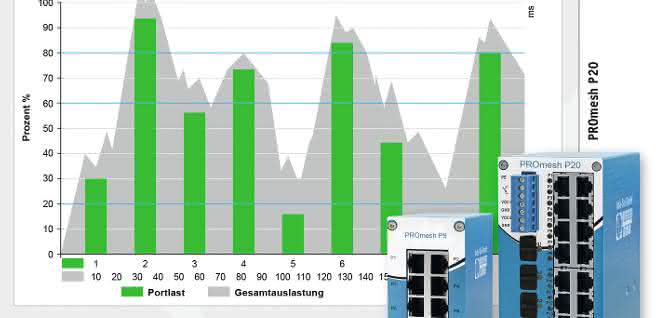
The PROmesh switch family from Indu-Sol joins the access layer with the PROmesh P9 and the distribution layer with the PROmesh P20. In accordance with the certification for Profinet, these devices meet the requirements of "Conformance Class B" and the highest network load class "Netload Class III".
Both switches also have the feature of integrated leakage current monitoring. In industrial machine environments, interference from higher-frequency power electronics can sometimes provoke unwanted currents on the shields of data lines, which is why the load on the equipotential bonding must be permanently monitored. Together with the diagnostic data (port statistics) determined from the network - network load, discards and errors - both switches provide automated, seamless monitoring of the OT networks so that no relevant event is missed and a notification is sent immediately. The PROmesh P20 also has an integrated routing function, which can be used to allow or prohibit individual communication connections between different networks.
Central monitoring as the basis for targeted network management
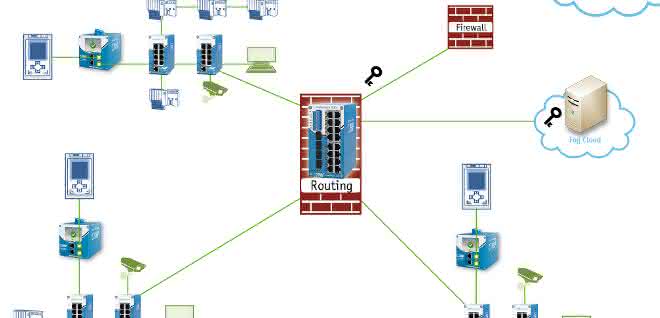
Regardless of which network structure is chosen in industrial automation today, it can be seen that the topic of network monitoring in the OT sector is at best approached casually. While in IT today no network would be put into operation without monitoring and a responsible administrator, this basic attitude often ends at the hall switch. Yet current and historical status data on the network forms the indispensable basis of any network management. The basic task of network monitoring here is to visualize all deviations in the monitoring of processes and thus, for example, to detect network abnormalities in the form of anomalies or network overloads in the form of discards and jitters.
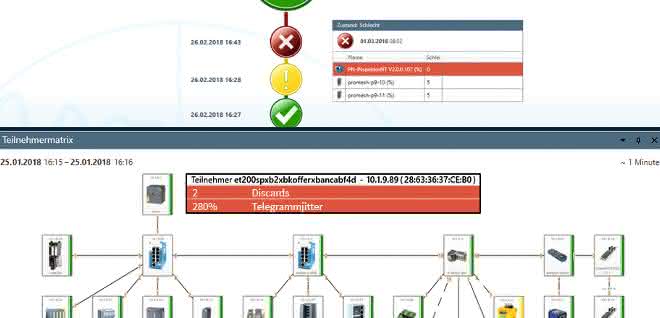
No matter which managed switches are used: The PROmanage NT monitoring software from Indu-Sol automatically and cyclically reads the port statistics of the manageable switches via SNMP query and bundles them at a central point - such as the IIT level - to form an overall status. Events that affect the availability and security of the network are logged with a time stamp and kept available in the database created in this way for up to a year, down to the minute. If events occur in the network, a corresponding warning is sent to the higher-level control system via SNMP trap, e-mail or an OPC interface. If required, in-depth analysis down to the individual device is also possible.
Actively confronting technological change
The demand for data from industrial networks is growing continuously and with it the demands on the technology. This is why Indu-Sol is already thinking about a future-proof network structure. Of course, there is no one-size-fits-all solution or even a template, as individual requirements must always be taken into account. As a manufacturer-independent practical partner, Indu-Sol supports the customer with know-how and services throughout the entire life cycle of the networks. The company also sees itself as a key supplier of a communication infrastructure that is adapted to the changing needs of future-oriented automation.
The first solutions designed with this in mind are already available today. However, intelligent, diagnostic-capable components such as the PROmesh switches can only be the beginning and go hand in hand with appropriate upstream network planning and qualified personnel or service communities that ensure smooth network operation from the very first telegram.
By Karl-Heinz Richter, Managing Director Marketing & Sales and Christian Wiesel, Marketing, both Indu-Sol GmbH.


You might also be interested in
Filtration and sound attenuation in circuits
In liquid or air circuits, filter housings and silencers protect measuring devices, ensure particle-free vacuum and pneumatic systems, keep cooling circuits clean and reduce noise.
 read more...
KSS ultrafine filtration for grinding oils
Modular concept for pure oil
In order to grind economically, reliably and with the highest quality, extremely clean grinding oils are required. Filter manufacturer Vomat offers the metalworking industry high-performance and customized concepts for the filtration of cooling...
read more...Up to 95 percent less flue gas thanks to direct extraction
The requirements for occupational safety measures and safety technology are also constantly increasing in welding technology. The Technical Rules for Hazardous Substances (TRGS) stipulate that welding fumes and harmful substances must be extracted...
read more...Everything accurate in switch cabinet construction
To ensure smooth work processes, tools for processing enclosures and housings must function flawlessly and reliably. Häwa rounds off its punching range with the Multi-Press 500.
read more...Cooling and temperature control units
Hygienic packaging sells safely
In few industries are the requirements for hygiene in the production process as strict as in the food sector - the health of consumers has top priority. This results in enormous challenges for all machines and components involved, especially in...
read more...Efficient and sustainable
Rotary screw compressors are the reliable backbone of industrial compressed air generation. The innovative CSD/CSDX series from Kaeser Kompressoren with its numerous features produces them efficiently and saves energy costs. This also reduces theCO2...
read more...Healthy air during welding
Welding produces fumes and gases that are hazardous to health. Extraction is necessary to comply with the occupational exposure limits and is even mandatory when welding high-alloy steels.
read more...Wire mesh filters in medical technology
In hardly any other industrial development sector are the demands placed on products as high as in medical technology. After all, human lives depend on the performance and reliable quality of medical devices.
read more...Energy efficiency and sustainability in the smallest of spaces
With the StingR ultra-fine filter system, Lehmann-UMT has created a solution for the energy-efficient and precise treatment of fluids during tool grinding for extended tool life and high tool quality.
read more...