
Agile workplace concepts
Between concentration and idea ping-pong
Companies with flexible working arrangements are up to three times more effective. This is the result of a study by The Economist. Schmalz is therefore exploring alternative ways of organizing work. The aim is to increase employee satisfaction and productivity at the same time. However, rethinking workspaces also requires a rethink on the part of employees and employers.

The competition between companies for skilled workers is in full swing. J. Schmalz, a specialist in vacuum technology from Glatten in the Black Forest, is therefore developing various concepts to attract, promote and retain employees. One component is a modern working environment that relies more on networks and interdisciplinary, international project groups. The idea behind this: More personal responsibility and greater flexibility in the choice of working environment increase employee motivation. "Flexibility is essential for a sustainable HR strategy, and we see this particularly among younger applicants," explains Daniel Just, Head of Human Resources at Schmalz. "Because for them, time, work-life balance and self-determination are important arguments when deciding on a future job."
In order to meet these demands, it is important to create an appropriate working environment on the one hand and to offer alternative working time models on the other. In the new 3,500 m² office building, the vacuum expert has implemented a needs-oriented interior design. There are 160 workstations spread over five levels: The areas are designed in such a way that they can be arranged to suit the situation and quickly adapted to current needs. A meeting zone forms the center of each floor, around which open work landscapes are grouped. "Instead of always heading for their fixed desk, employees choose the workstation that best suits their daily tasks, needs or working methods each morning," Just explains. Personal work equipment such as laptops and headsets are locked away in the evening or placed in the appropriate charging station. The principle behind this is called desk sharing and is only made possible by the digital way of working because data has to be stored centrally and accessed decentrally. "A positive side effect: the desk is always tidy at the start of work - less distraction means more attention and an unstructured paper chaos cannot arise in the first place," explains the HR manager.

Function as a role model
In addition to traditional desk groups, there are separable project rooms for group work, think tanks - separate individual workstations that can be occupied for a limited time - as well as modules for creative meetings, video conferences or lightning meetings. "Employees decide for themselves whether they want to work sitting or standing, creatively and communicatively as part of a team or concentrated on their own," says Just.
Before the spatial restructuring, Schmalz tried out "working outside" in a test phase - and the results spoke for themselves. "Up to 20 percent of working time can now be done outside the company if the task allows it," reports Just. Even if this is not possible in every function, a fundamental change is taking place here from a culture of presence to a culture of performance. Both sides bear responsibility for a positive outcome: The company, by empowering employees digitally, training them and creating optimal conditions. The employees, by being prepared to embrace and adopt new methods.
Skepticism and opportunity
In order to identify and solve potential problems with desk sharing in advance, Schmalz carried out extensive tests and workshops on a pilot level of an older office building. Here, purely organizational issues such as alternative options in the event of full occupancy or the creation of storage space could be addressed, as could the definition of technical requirements. Schmalz took the concern that the best seats would be taken by early arrivals just as seriously as the questions of whether an attendance overview was needed and how colleagues could be found quickly. "We all had to leave our comfort zone to a certain extent when implementing the new concept," admits Just. But he is convinced that both the company and the employees will benefit from it.
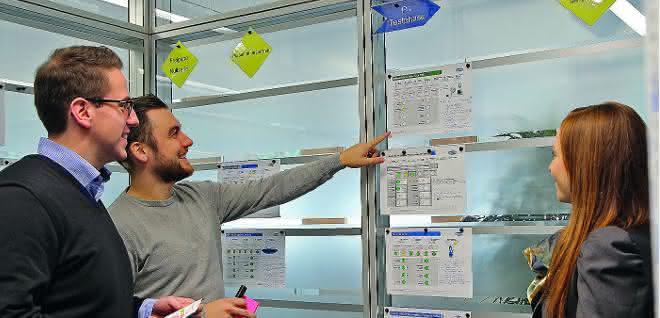
The new concept with its open structures brings movement into the office - both mentally and physically, which is another advantage of the new working environment in terms of ergonomics. Above all, however, it promotes communication and networking - across hierarchies and departments - and thus improves the flow of information. These are precisely the basic prerequisites for agile collaboration: teams work independently, products can be brought to market faster and in higher quality. And that in turn makes Schmalz attractive for new employees. Because young engineers appreciate it when their opinion counts, when they can actively help shape tasks and processes.

A flexible project organization, diverse tasks, self-managing teams, but also new working approaches such as design thinking to develop new ideas - the corporate culture must also be able to keep pace with this dynamic. The role of the manager is therefore also changing: "Intercultural competence will become even more important in the future, as will the management of project teams - often across national borders and from a distance," explains the HR manager. It is clear that the path to a modern working world requires a fundamental rethink across all hierarchical levels and must be implemented step by step. If this succeeds, everyone benefits: employees identify more strongly with their tasks and are more self-motivated, and the company can offer the customer the desired solutions even faster, better and more cost-effectively.
According to documents from Schmalz / ag


You might also be interested in
More ease in logistics
When every minute counts in outgoing goods and parcels have to be prepared for dispatch every minute, ergonomics make all the difference when it comes to efficiency. Modern lifting technology makes all the difference in day-to-day work.
 read more...
Clever solutions for sensitive gripping
Innovative systems and exciting world premieres? That's what visitors will find at productronica in Munich from November 18 to 21. In Hall B3 at Stand 301, vacuum specialist Schmalz will be showcasing efficient and future-oriented handling systems -...
read more...Johannes Schmalz becomes a member of the Management Board
With immediate effect, Dr. Johannes Schmalz becomes the third member of the management board. The vacuum specialist from Glatten in the northern Black Forest is thus securing its long-term future as a family-run company in its fourth generation.
read more...Busch Group celebrates opening of vacuum competence center
The Busch Group is celebrating the expansion of its activities in Austria: The vacuum competence center in Korneuburg is the new headquarters of Busch Vacuum Solutions and Pfeiffer Vacuum.
read more...Pfeiffer Vacuum at the Achema 2024
Safe pumps for potentially explosive atmospheres
Pfeiffer Vacuum will be presenting innovative vacuum solutions at Achema 2024 in Frankfurt am Main. This year, the company is placing a special focus on safe vacuum generation in potentially explosive environments and the evacuation of explosive...
read more...Josko relies on vacuum technology from Schmalz
Lifting 80 kilograms 80 times in 8 hours: Vacuum expert Schmalz has developed a solution for the highly automated industrial company Josko that solves this task in the blink of an eye with the help of a suction spider.
read more...Chancellor visits Schmalz
On Monday afternoon, Federal Chancellor Olaf Scholz visited the Schmalz company in Glatten. The head of government was given a tour of the family-run company, spoke to the management and then answered questions from employees.
read more...SCTMi mini compact terminal is a lightweight
Use directly on the gripper
Short cycle times, low space requirements, simple installation - the requirements for vacuum technology are clearly defined. The new SCTMi mini-compact terminals from Schmalz meet the needs of operators and also offer a high degree of flexibility....
read more...Adaptable bell
SMC recommends the ZP3M series vacuum cup for handling delicate workpieces. Thanks to its diagonal inner ribs, which are arranged radially, it prevents slipping even with oily workpieces.
read more...