
Handling solution
Josko relies on vacuum technology from Schmalz
Higher degree of automation possible
Josko was looking for an alternative because there were no longer any spare parts for the old, so-called turner on the sanding machine. "The new system should relieve our skilled workers and increase the degree of automation," emphasizes Rainer Plöckinger, Interior Doors Plant Manager at the Kopfing site. As Schmalz is already represented in production with numerous products, Josko turned to the vacuum experts once again.
Together with the industrial company, Schmalz Austria set about developing a suitable system. Another of Josko's requirements was that the new system should no longer require manual programming. "The Weber KSF sanding machine, two Kuka robots and our handling solution therefore work together fully automatically," says Christian Prießner, Managing Director of Schmalz Austria.
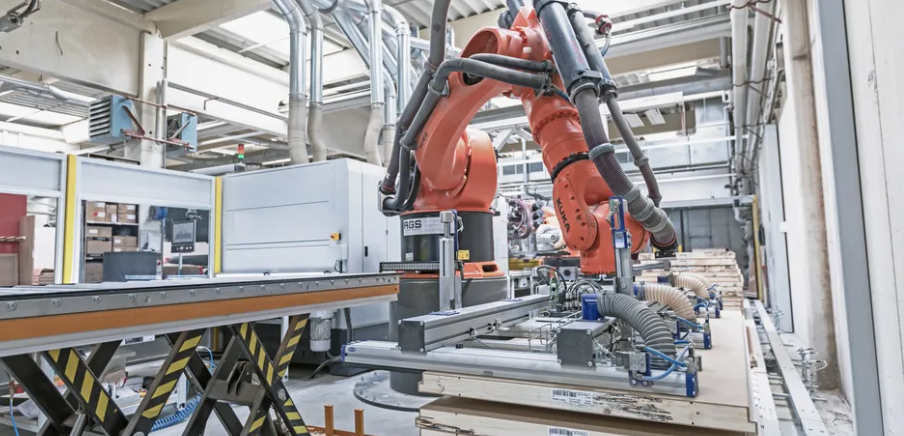
Protected behind bars, the first robot picks up a blank from the stack and places it on a conveyor belt in front of the machine. The door leaf travels through the machine, which calibrates and grinds the surface. On the other side, the second robot picks up the blank and places it from above on a rack located between the two machines. The first robot picks it up again from below, turns the door leaf and places it in front of the sanding machine again - with the reverse side facing upwards. On the second pass through the machine, the other half now also receives its finish. As soon as the processing of the front and back has been completed, the second robot places the door on the "finished" stack.
A powerful grip
A suction spider from Schmalz provides a secure grip. With significantly larger dimensions than the crawling animal and designed by the vacuum experts to meet Josko's exact requirements, one of these grippers sits on each robot arm. The low weight of the basic components made of aluminum profiles enables fast cycles, and the FMP-S gripper system with sealing foam is perfect for handling heavy and rough workpieces such as door leaves. Vacuum is generated via a connection to the compressed air network and is controlled by valves. Thanks to the integrated system monitoring and sensor technology, the suction spiders work with absolute process reliability.
The interaction between the robot and gripper moves around 70 to 80 door leaves per day, which pass through the workstation in an eight-hour shift. Since commissioning in 2020, the system has processed around 50,000 blanks - fully automatically and ergonomically, without burdening employees with strenuous activities such as moving the heavy elements. "We are more than satisfied with the solution," emphasizes Plöckinger. "Only if the power goes out, the machine comes to a standstill," he says with a wink. But fortunately, that hasn't happened yet. The highlight for the staff: individual dimensions are stored in the system for different blanks, which the specialists simply select via the display. Manual programming is finally a thing of the past. "We have also eliminated a potential source of errors," adds Plöckinger happily.


You might also be interested in
Conveyor systems that adapt
Modern conveyor systems must reliably transport different product sizes, shapes and materials. The new modular product system from Kipp offers flexible, modular solutions for this: Adjustable side guides ensure precise alignment and gentle...
 read more...
Handling and production logistics
Speed beats planning
Unpredictable fluctuations in demand pose new challenges for fulfillment logistics. Viral trends, political decisions and changing customer behavior are making traditional planning models obsolete.
read more...Loading and unloading machines
Artificial intelligence and ergonomic lifting
Loading and unloading machines ergonomically and efficiently - Schmalz supports metalworking companies in this. At Euroblech, the company will be presenting solutions for intelligent and ergonomic handling with vacuum.
read more...Products of the year 2025: the competition starts again
The INDUSTRIAL Production Products of the Year are entering a new round. This year, our readers can vote in eight categories. We are also awarding a special prize.
read more...Interview with Dietmar Schlenker from Indeva
"Logimat is our in-house exhibition"
Indeva presents its latest products at Logimat 2024. However, Managing Director Dietmar Schlenker also looks further into the future in an interview.
read more...Efficient palletizing and depalletizing of KLT boxes
At Logimat 2024, the company from Gescher-Hochmoor in Münsterland will be demonstrating the palletizing and depalletizing of KLT containers within a line.
read more...INDUSTRIAL Production Products of the year...
3rd place, metalworking category: Schmalz
Schmalz automates sheet metal handling with the ivOS Sheet Metal Solution Kit. Companies can use it to automate the loading of machines - simply, flexibly and economically. The kit was awarded 3rd place in the metalworking category.
read more...Chancellor visits Schmalz
On Monday afternoon, Federal Chancellor Olaf Scholz visited the Schmalz company in Glatten. The head of government was given a tour of the family-run company, spoke to the management and then answered questions from employees.
read more...SCTMi mini compact terminal is a lightweight
Use directly on the gripper
Short cycle times, low space requirements, simple installation - the requirements for vacuum technology are clearly defined. The new SCTMi mini-compact terminals from Schmalz meet the needs of operators and also offer a high degree of flexibility....
read more...