
Dashboards in field service management
The most important key figures at a glance
Data forms the basis of the smart factory. It helps to optimize processes and make decisions. It is important not to lose sight of the essentials.

Digitalization in technical service and maintenance has meant that a lot of different types of information are now available in electronic form. This includes, for example, data on the condition of systems and machines, the status of orders, the performance of technicians or even spare parts costs. This valuable data from field service management applications provides industry-specific indicators and thus forms the basis for decisions and improvements that can influence the future of companies. However, it is important not to lose sight of the essentials when evaluating the data. Dashboards help with this.
Dashboards in field service management can contain strategic, tactical or historical data. Depending on the user's requirements, these can include real-time data over a short period of one or a few days or provide a review over a longer period as well as future forecasts.
Dashboards in field service management
The graphical representation of dashboards is usually similar to the displays and control elements of an aircraft cockpit. For example, tachometer illustrations with color coding of the different areas of a key figure are often used. Representations in the form of bar, column or pie charts are also suitable for field service management dashboards.
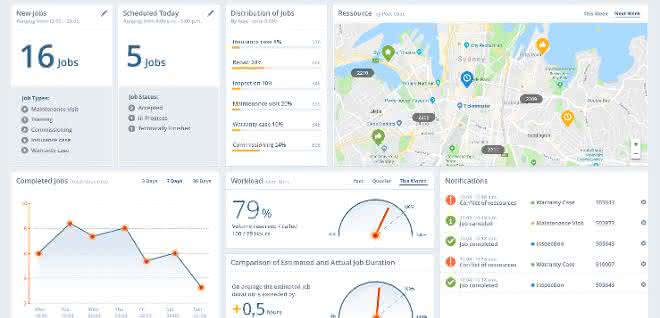
While traditional reports, evaluations or forecasts provide a comprehensive, detailed analysis or description of the current situation, the purpose of dashboards is to provide an overview of the most important key figures at a glance. A good dashboard should be intuitive to use and flexible. Filters and drilldowns can be used to adapt data to the user's requirements. The display should also adapt responsively to any end device.
Dashboards offer analyses of the most important performance parameters that cover all company requirements - regardless of industry, size, location or corporate strategy. They can be used for different purposes in service and maintenance. The decisive factor here is always the user and their needs.
Dashboards are particularly interesting for technicians in service or maintenance when it comes to recording their working hours. For example, they can use their mobile solution or app for order processing to display the hours they have worked, whether order-related or not. Breaks and travel times can also be displayed.
It is critical for dispatchers to have a real-time overview of their technicians and orders. A dashboard with the most important key figures in their scheduling software is essential for them to be able to optimally fulfill their planning, management and control tasks. It is particularly important to keep an eye on customer SLAs and intervene quickly if necessary. In an analysis cockpit, dispatchers can display the most important KPIs (key performance indicators) for them in real time.
While dispatchers tend to focus on their team's real-time data, dashboards support service, maintenance or regional managers in gaining an overview of an entire department or region over a longer period of time. This can be used, for example, to create evaluations of the profitability and quality of an area. Decision-makers can then use this data to carry out trend analyses and capacity planning. The change compared to a previous period always plays an important role in all these evaluations.
The benefits of dashboards in service and maintenance naturally lie first and foremost in a better overview and in the transparency of key figures. This results in a faster response time, especially for dispatchers, and a better ability to provide information to superiors and customers. From the analysis of data, decision-makers can then make deductions with regard to improvements in processes, employee utilization and turnover. Dashboards can therefore help to save costs, improve customer satisfaction and thus increase competitiveness.
The prerequisite for dashboards is, of course, the digital database for the analyses. Depending on the industry, it may be that data for analyses is either not yet available in digital form or has to be recorded manually before it can be transferred to a digital system. By using mobile solutions and apps in service and maintenance, all order-related data is recorded by the technician directly on site and flows directly into the backend system. This can then be used to create dashboard evaluations in real time. However, the more data is available, the greater the temptation to display a large number of key figures in a dashboard. Users should therefore avoid overloading dashboards with too many key figures in order to maintain an overview and focus on the essentials.
A target group-oriented presentation is just as important as comprehensive authorization and access control for accessing analyses or dashboards. This is usually based on the profile or function of users. The protection of personal data must also be taken into account, especially when it comes to comparing the performance of technicians.
The dashboards of the future
By combining data from field service management systems with artificial intelligence and predictive analytics, dashboards will offer even more intelligent and relevant evaluations for technical customer service and the maintenance of systems and machines in the future. Particularly in the area of predictive planning, data evaluations can help to reduce the number of malfunctions and thus enable virtually smooth operation of systems and machines.
Hannes Heckner, founder and CEO of mobileX AG / ag


You might also be interested in
Filtration and sound attenuation in circuits
In liquid or air circuits, filter housings and silencers protect measuring devices, ensure particle-free vacuum and pneumatic systems, keep cooling circuits clean and reduce noise.
 read more...
KSS ultrafine filtration for grinding oils
Modular concept for pure oil
In order to grind economically, reliably and with the highest quality, extremely clean grinding oils are required. Filter manufacturer Vomat offers the metalworking industry high-performance and customized concepts for the filtration of cooling...
read more...Up to 95 percent less flue gas thanks to direct extraction
The requirements for occupational safety measures and safety technology are also constantly increasing in welding technology. The Technical Rules for Hazardous Substances (TRGS) stipulate that welding fumes and harmful substances must be extracted...
read more...Everything accurate in switch cabinet construction
To ensure smooth work processes, tools for processing enclosures and housings must function flawlessly and reliably. Häwa rounds off its punching range with the Multi-Press 500.
read more...Cooling and temperature control units
Hygienic packaging sells safely
In few industries are the requirements for hygiene in the production process as strict as in the food sector - the health of consumers has top priority. This results in enormous challenges for all machines and components involved, especially in...
read more...Efficient and sustainable
Rotary screw compressors are the reliable backbone of industrial compressed air generation. The innovative CSD/CSDX series from Kaeser Kompressoren with its numerous features produces them efficiently and saves energy costs. This also reduces theCO2...
read more...Healthy air during welding
Welding produces fumes and gases that are hazardous to health. Extraction is necessary to comply with the occupational exposure limits and is even mandatory when welding high-alloy steels.
read more...Wire mesh filters in medical technology
In hardly any other industrial development sector are the demands placed on products as high as in medical technology. After all, human lives depend on the performance and reliable quality of medical devices.
read more...Energy efficiency and sustainability in the smallest of spaces
With the StingR ultra-fine filter system, Lehmann-UMT has created a solution for the energy-efficient and precise treatment of fluids during tool grinding for extended tool life and high tool quality.
read more...