
3D printer for concrete components
Robots in construction
The start-up Aeditive has developed a process for 3D printing concrete components using robots. Kuka is researching the further automation of construction.
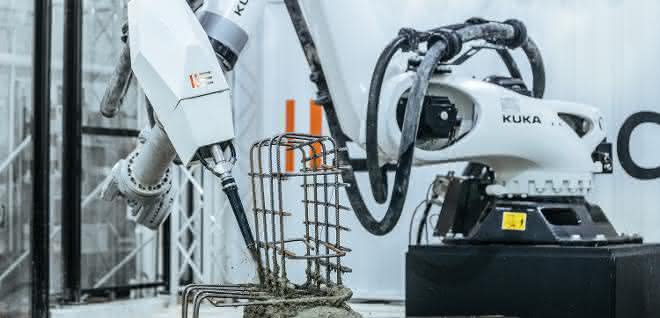
The construction industry not only has to deal with the current challenges of the coronavirus pandemic. The increasing shortage of skilled workers and the need to catch up when it comes to digitalization are also causing the industry problems - for example in digital planning or automated production techniques. The start-up Aeditive has developed a robot-based process with Kuka technology to change this.
"Structural deficiencies and outdated working methods are omnipresent in the construction industry," says Alois Buchstab, Vice President Advanced Robotic Applications at Kuka. Communication between architects, clients and designers is often characterized by silo thinking. In addition, the industry is threatened by a shortage of skilled workers like no other. Digitization and robotics are the keys to solving these challenges. The construction industry has some catching up to do here; the potential for automation is considerable.
The start-up Aeditive proves that robotics can already be used effectively in the construction industry today. The Hamburg-based company has developed the "Concrete Aeditor" - a type of construction container in which concrete components are additively manufactured layer by layer with the help of two Kuka robots using a spraying process. Customers are no longer reliant on expensive and time-consuming formwork; the degree of automation and sustainability of production can be increased in this way, says Alexander Türk, CEO and one of four founders of Aeditive.
The "Concrete Aeditor" is to be used in precast plants in the first stage and directly on construction sites in the second stage. "The construction industry is at the very beginning of its digitalization and automation process. Robots will play a major role in this. As a solution provider, we want to be ready at an early stage," says Alexander Türk.
Kuka attaches great importance to tapping into new sectors such as the construction industry. "Robots could be used in the production of building components in the future. Their use on construction sites is also conceivable," says Alois Buchstab. This could result in increased productivity, which in turn would benefit the constantly growing demand for living space.
Kuka has been involved in the "Internet of Construction" project at RWTH Aachen University for some time now. The project deals with digitalization, digital building models and the networking of companies along the value chain and aims, among other things, to increase adherence to deadlines and construction quality in the construction industry with the help of a continuous flow of information. pb


You might also be interested in
New Resin Opens Up 3D Printing for the Optics Industry
With BMF Clear, Boston Micro Fabrication has introduced an optically transparent photopolymer resin for micro-precision 3D printing that achieves a light transmittance of over 90 percent at layer heights of 10 micrometers or more and is suitable for...
 read more...
3D Printing in the Defense Sector
Formnext Launches 2026 Defense Summit
Formnext is expanding its program to include the security and defense sector and will host the first Formnext Defense Summit in 2026. The event will focus on the potential of additive manufacturing for resilient supply chains, industrial...
read more...UltiMaker Doubles Speed in Industrial 3D Printing
With the Factor 4 Plus, UltiMaker is introducing a new version of its industrial desktop 3D printing platform, which operates at up to twice the print speed of the standard model. The platform is designed for use in manufacturing and defense...
read more...Stratasys takes over MarkForged
Stratasys is acquiring MarkForged from Nano Dimension for USD 42.5 million, thereby expanding its portfolio in the field of fiber-reinforced composites. The acquisition also strengthens the company's software and materials expertise in industrial 3D...
read more...Timo Göbel, Head of BMW Additive Manufacturing
"Clearly on course for broad industrialization"
The BMW Group's Additive Manufacturing Campus (AMC) is setting the course for the next stage of industrialization. Under the leadership of Timo Göbel, additive manufacturing is being further integrated into all stages of the vehicle life cycle. In...
read more...Real-time control to make recycling materials economical
The Fraunhofer IAPT is researching AI-based closed-loop processes for industrial 3D printing with recycled plastics. The aim is to achieve less waste, greater process stability and profitable printer farms.
read more...Forum Solutions 4AMIndustry shows ways into industrial application
Additive manufacturing has developed dynamically in recent years and has long outgrown its status as a purely innovative technology in many industries. Nevertheless, companies still face the challenge of integrating AM into their production...
read more...Alliance aims to drive forward industrial 3D printing
Machine components, electrostatically shielded transport containers, large components for the automotive, rail and aviation industries or specific medical products straight from the printer - the potential applications of additive manufacturing are...
read more...Photonic microchips with 3D connector
How a 3D system makes photonic chips industrially viable
A research team from Heidelberg is developing a 3D-printed "connector" for photonic microchips. The solution promises a low-loss, standardized coupling of glass fibre and chip - and could fundamentally simplify the production of photonic integrated...
read more...