
Industrial 3D printing
Real-time control to make recycling materials economical
The Fraunhofer Research Institution for Additive Production Technologies IAPT wants to make recycling in additive manufacturing economically viable and is launching a research project on profitability and recycling in additive production. The project aims to develop recycled materials as a resource for the industrial 3D printing of high-quality components.
AI to reduce rejects and reworking
Currently, additive production with recycled raw materials often generates waste or high post-processing costs. A new Fraunhofer IAPT project is laying the foundations for the profitable use of recycled thermoplastics in additive manufacturing and the expansion of production environments into industrial printer farms. Intelligent in-process control (IPC), digital twins and other applications of artificial intelligence (AI) are intended to stabilize 3D printing with recycled raw materials and ensure cost-effectiveness.
Recycled polymers offer cost savings and more sustainable production. However, the recycled materials differ from batch to batch, thereby increasing two challenges of additive production. Until now, most 3D printers have followed a static G-code. After starting a job, the machine executes a defined toolpath and a series of fixed parameters without taking into account what is happening in the printing process. At the same time, the flow behavior, moisture content and purity of the recycled raw materials vary - and therefore also the print result.
In addition, there are differences due to the individual wear and tear of the machines. According to Fraunhofer IAPT, nozzle wear, contamination and other machine-specific properties lead to unstable extrusion and dimensional deviations. The lack of consideration for the variance of recycled materials and the differences between individual machines increases reject rates. When scaling the production environment, the negative effect of static processes on efficiency is further exacerbated.
Digital twins make 3D printers capable of learning
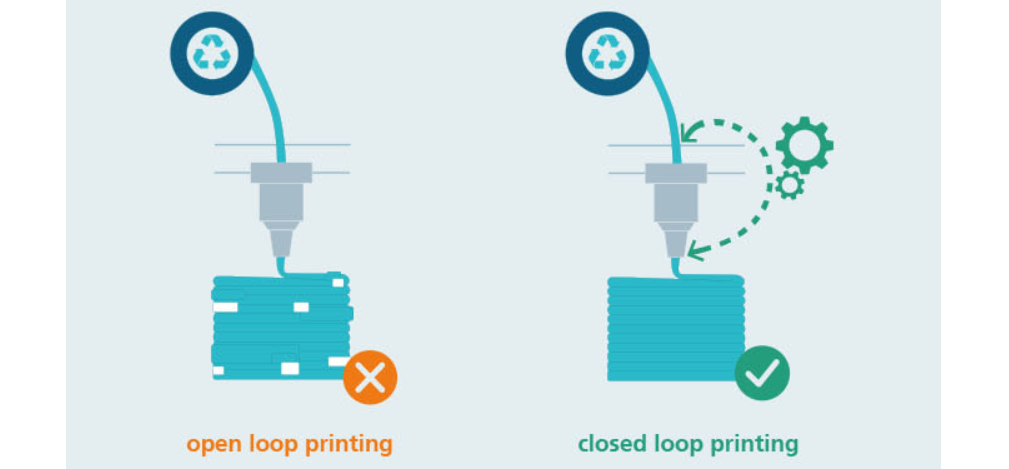
In the new AI project on sustainability and profitability in industrial 3D printing, the experts at Fraunhofer IAPT are combining expertise in virtualization, digital twins and industrial AI. The aim is to change from an open loop without taking the printing process into account to a closed loop.
In this closed loop, observations on material quality or wear-related deviations in the behavior of the machines flow into the printing process in real time. Closed-loop printing uses the recorded data and adapts the process parameters within a print layer to the quality of the recycled material.
On the way to "closed-loop printing", researchers at the Fraunhofer IAPT are equipping 3D printers with sensors and computer vision. The systems monitor the print in real time and record layer height, bead width, vibration and extrusion behavior, among other things. AI algorithms analyze the data during production and adjust parameters such as extrusion rate, speed, temperature or laser power. In closed-loop printing, the 3D printer processes analysis results during the ongoing production process and continuously compensates for deviations - such as worn nozzles, environmental influences or material fluctuations in recycled raw materials.
Another project goal is to develop the 3D printers into learning systems. Digital twins of machines or machine parts are to identify the optimum parameter combinations for certain geometries, different material qualities and machine conditions during operation. Intelligent data management links the process data, geometry information, slicing parameters and quality metrics collected in the digital twin.
Unlike isolated data in separate files, such as .stl, G-code or logs, intelligent bookkeeping transforms every print - whether successful or not - into training data. The learning systems thus go beyond the direct reaction to deviations in "closed-loop printing", building up knowledge and using it for future construction projects.
Recycled materials as a building block for sustainable AM production
With a view to long-term profitability and seamless scaling, the Fraunhofer IAPT team is designing the project's control strategies and data framework directly for use in large printer farms. Edge devices on each machine take over local monitoring and control, while a central platform aggregates the data from all systems. This allows, for example, the knowledge gained by a 3D printer about a specific recycling material to be transferred to numerous other machines. Continuous optimization should therefore not only be possible for individual 3D printers, but also at fleet level.
According to the Fraunhofer IAPT, the concept of the current AI project provides companies with entry points for the use of recycled materials and more sustainable production, regardless of the size of their production environment. The combination of real-time control, virtual process understanding and structured data is intended to establish recycled materials as an integral part of industrial additive manufacturing across the entire AM chain.
Dr. Matthias Brück comments on the starting point of the project: "Today, recycling in additive manufacturing does not fail due to material availability, but due to process uncertainty. With adaptive, data-based control, we are transforming previous uncertainties into controllable variables. Sustainable 3D printing becomes plannable, certifiable and economically viable."


You might also be interested in
UltiMaker Doubles Speed in Industrial 3D Printing
With the Factor 4 Plus, UltiMaker is introducing a new version of its industrial desktop 3D printing platform, which operates at up to twice the print speed of the standard model. The platform is designed for use in manufacturing and defense...
 read more...
In-house exhibition Bielefeld 2026
How DMG Mori thinks about the factory of the future
DMG Mori will be showcasing turning and milling expertise, automation solutions and additive manufacturing along the Machining Transformation (MX) at the Bielefeld 2026 in-house exhibition.
read more...Stratasys takes over MarkForged
Stratasys is acquiring MarkForged from Nano Dimension for USD 42.5 million, thereby expanding its portfolio in the field of fiber-reinforced composites. The acquisition also strengthens the company's software and materials expertise in industrial 3D...
read more...Timo Göbel, Head of BMW Additive Manufacturing
"Clearly on course for broad industrialization"
The BMW Group's Additive Manufacturing Campus (AMC) is setting the course for the next stage of industrialization. Under the leadership of Timo Göbel, additive manufacturing is being further integrated into all stages of the vehicle life cycle. In...
read more...Forum Solutions 4AMIndustry shows ways into industrial application
Additive manufacturing has developed dynamically in recent years and has long outgrown its status as a purely innovative technology in many industries. Nevertheless, companies still face the challenge of integrating AM into their production...
read more...Alliance aims to drive forward industrial 3D printing
Machine components, electrostatically shielded transport containers, large components for the automotive, rail and aviation industries or specific medical products straight from the printer - the potential applications of additive manufacturing are...
read more...Stratasys simplifies post-processing for 3D printing
Stratasys has launched a partner program for post-processing solutions to facilitate the creation of end-to-end AM workflows. The first partner is PostProcess Technologies, whose automated systems for FDM, PolyJet, SLA and P3 can now be purchased...
read more...Formnext 2026 puts UK and key industries in the spotlight
Formnext 2026 will focus on the United Kingdom as the official partner country. At the same time, the leading trade fair for additive manufacturing is further expanding its involvement in key user industries, including orthopaedics, aerospace and...
read more...Machines, automation and production technologies
From March 17-20, 2026, Grob is hosting an in-house exhibition for trade visitors in the field of production technology. Over 40 machines from universal machining centers, machining technology, electromobility and additive manufacturing will be on...
read more...