
3D Printing in the Defense Sector
Formnext Launches 2026 Defense Summit
Formnext is expanding its program to include the security and defense sector and will host the first Formnext Defense Summit in 2026. The event will focus on the potential of additive manufacturing for resilient supply chains, industrial applications, and collaboration between industry, government, research, and the military.
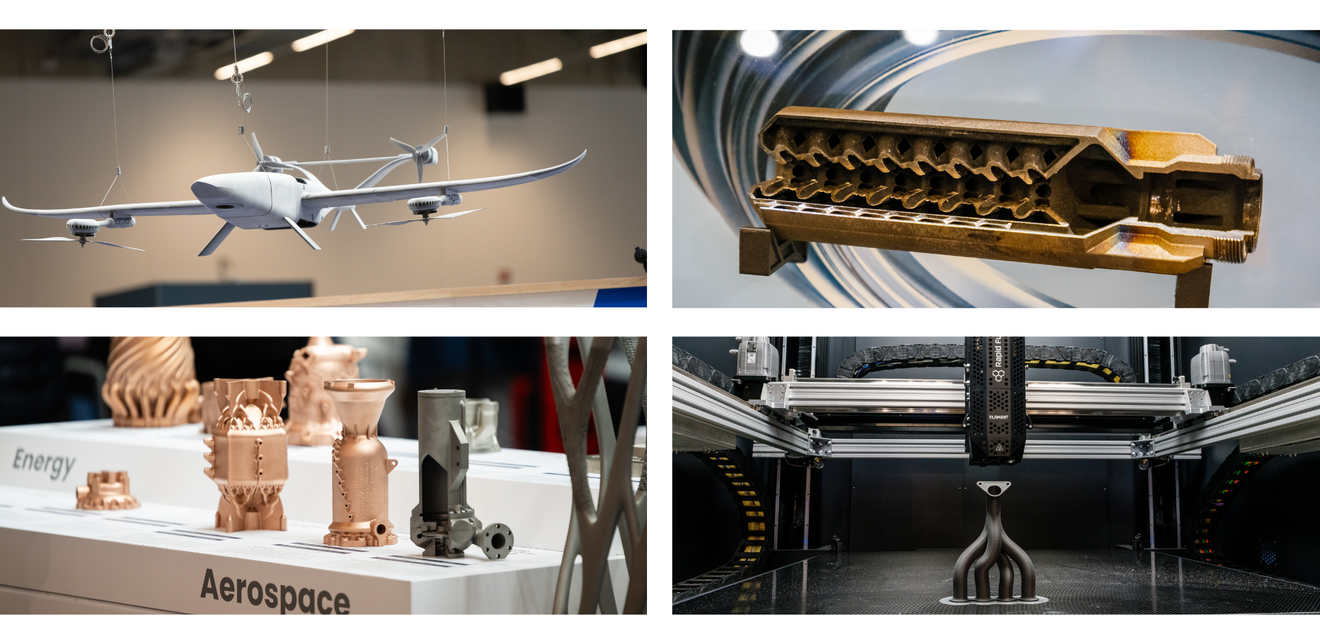
Formnext is expanding its range of topics: Starting in 2026, the additive manufacturing (AM) trade show will place greater emphasis on the importance of additive manufacturing for the security and defense sectors. The focus will be on the potential of industrial 3D printing to create more resilient supply and value chains, as well as to enable flexible and decentralized production within the European security sector.
A key element of the new direction is the Formnext Defense Summit, which will take place for the first time on November 17, 2026, in Frankfurt am Main, concurrently with the trade show. The event format is being developed and organized in collaboration with the Additive Manufacturing Defense Network (AMDefNet).
From the initiators' perspective, additive manufacturing can play an important role in making supply chains more resilient, shortening response times, and making production processes more flexible. As a result, the technology is becoming increasingly important for safety-critical applications.
The Defense Summit is designed to bring together representatives from the military, politics, industry, and research. The focus will be on topics such as supply chain management, procurement, logistics, training, standardization, as well as digitalization and data management. In terms of content, the event will focus on industrial applications as well as system and supplier structures in the security and defense sectors.
According to the organizers, the summit is intended to promote dialogue among industry representatives, technology providers, policymakers, and military stakeholders. The goal is to discuss common requirements and further develop topics such as quality standards, cybersecurity, and resilient supply chains. The program includes keynote speeches, technical presentations, a panel discussion, and thematic experience areas.


You might also be interested in
UltiMaker Doubles Speed in Industrial 3D Printing
With the Factor 4 Plus, UltiMaker is introducing a new version of its industrial desktop 3D printing platform, which operates at up to twice the print speed of the standard model. The platform is designed for use in manufacturing and defense...
 read more...
Stratasys takes over MarkForged
Stratasys is acquiring MarkForged from Nano Dimension for USD 42.5 million, thereby expanding its portfolio in the field of fiber-reinforced composites. The acquisition also strengthens the company's software and materials expertise in industrial 3D...
read more...Timo Göbel, Head of BMW Additive Manufacturing
"Clearly on course for broad industrialization"
The BMW Group's Additive Manufacturing Campus (AMC) is setting the course for the next stage of industrialization. Under the leadership of Timo Göbel, additive manufacturing is being further integrated into all stages of the vehicle life cycle. In...
read more...Real-time control to make recycling materials economical
The Fraunhofer IAPT is researching AI-based closed-loop processes for industrial 3D printing with recycled plastics. The aim is to achieve less waste, greater process stability and profitable printer farms.
read more...Forum Solutions 4AMIndustry shows ways into industrial application
Additive manufacturing has developed dynamically in recent years and has long outgrown its status as a purely innovative technology in many industries. Nevertheless, companies still face the challenge of integrating AM into their production...
read more...Alliance aims to drive forward industrial 3D printing
Machine components, electrostatically shielded transport containers, large components for the automotive, rail and aviation industries or specific medical products straight from the printer - the potential applications of additive manufacturing are...
read more...Photonic microchips with 3D connector
How a 3D system makes photonic chips industrially viable
A research team from Heidelberg is developing a 3D-printed "connector" for photonic microchips. The solution promises a low-loss, standardized coupling of glass fibre and chip - and could fundamentally simplify the production of photonic integrated...
read more...Stratasys simplifies post-processing for 3D printing
Stratasys has launched a partner program for post-processing solutions to facilitate the creation of end-to-end AM workflows. The first partner is PostProcess Technologies, whose automated systems for FDM, PolyJet, SLA and P3 can now be purchased...
read more...Formnext 2026 puts UK and key industries in the spotlight
Formnext 2026 will focus on the United Kingdom as the official partner country. At the same time, the leading trade fair for additive manufacturing is further expanding its involvement in key user industries, including orthopaedics, aerospace and...
read more...