
IFR Yearbook World Robotics 2020
Robot use: Germany in first place in Europe
With 221,500 industrial robots, Germany is the most automated economy in the EU, reports the IFR in its yearbook. Also on the rise: the use of cobots.
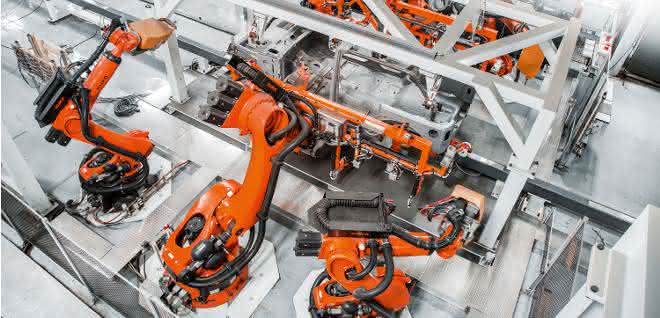
The number of industrial robots in Germany rose by three percent (2019). This means that there are around three times as many industrial robots in use in German factories as in Italy (74,400 units), around five times as many as in France (42,000 units) and around ten times as many as in the UK (21,700 units). This was reported by the International Federation of Robotics (IFR ) with the publication of the World Robotics 2020 yearbook.
"The use of industrial robots in Europe has reached an all-time high of around 580,000 units - a seven percent increase on the previous year," says Milton Guerry, President of the International Federation of Robotics.
Germany's share of the European robot population is 38%. This puts the country in fifth place worldwide after China, Japan, Korea and the USA. This also applies to the annual sales figures in 2019. The German economy has been operating at a very high level of around 20,000 units per year for many years (2014 - 2017) - with 20,400 robots sold, this mark was reached again in 2019. According to the IFR report, the record result in 2018 with around 27,000 industrial robots sold was due to a very dynamic special economic situation, mainly triggered by investments in the automotive industry.
"The consequences of the coronavirus pandemic for the economy cannot yet be fully assessed," continues Milton Guerry. "The 2020 financial year will be characterized by the industry first adapting to the 'new normality'. A strong boost from major orders is unlikely in the current financial year. China may be an exception. This is because the coronavirus was first identified in the Chinese city of Wuhan in December 2019 and the country was already able to recover economically in the second quarter. Other economies reached an economic turning point much later. It will therefore take a few more months for positive trends to be reflected in new automation projects and demand for robots. We expect a recovery in 2021 - but it could take until 2022 or 2023 to reach pre-crisis levels".
Asia, Europe and America - overview
Asia remains the largest market for industrial robots - the stock of the largest regional customer, China, increased by 21% and reached around 783,000 units in 2019. Japan is in second place with around 355,000 units - an increase of 12%, followed by South Korea with 319,000 units and an increase of 6%. India is a rising star in the region with a new record of around 26,300 units - an increase of 15 percent. This means that the number of industrial robots in Indian factories has doubled within five years.
The share of newly installed robots in Asia accounted for around two thirds of global sales in 2019. In China, sales of around 140,500 new robots were down on the record years of 2018 and 2017, but more than doubled compared to the sales figures five years ago (2014: 57,000 units). In the top 3 Asian markets, new installations slowed down in 2019 - in China (minus nine percent), Japan (minus ten percent) and the Republic of Korea (minus 26 percent).
In China, the vast majority (71%) of new robots come from foreign suppliers. Chinese manufacturers continue to mainly serve the domestic market, where they are increasingly gaining market share. Foreign manufacturers sell around 29% of their units in the automotive industry - Chinese suppliers only have a share of around 12% in this segment. For this reason, foreign suppliers are more affected by the decline in business in the Chinese automotive industry than their domestic competitors.
USA, Canada, Mexico
The USA is the largest user of industrial robots on the American continent and set a new record in 2019 with around 293,200 units - an increase of seven percent. Mexico is in second place with 40,300 units - an increase of eleven percent - followed by Canada with around 28,600 units and an increase of two percent.
New installations in the United States slowed by 17% compared to the record year of 2018. Nevertheless, sales in 2019 remained at a very high level with 33,300 units delivered, achieving the second strongest result ever. Most robots are imported to the USA from Japan, Korea and Europe. Although the number of US robot manufacturers is small, there are many important system integrators for robotics and automation. Mexico ranks second in North America with around 4,600 units sold - where sales slowed by 20 percent. Sales in Canada rose by one percent and reached a new record with around 3,600 units delivered.
Global trend: human-robot collaboration
The use of collaborative robots (cobots), which can work hand-in-hand with humans without a safety fence, is on the rise. Sales of cobots rose by eleven percent in 2019 - in stark contrast to the trend for traditional industrial robots. As more and more manufacturers are offering collaborative robots and the range of applications is expanding at the same time, the market share rose to 4.8% in 2019. Despite this dynamic development, the market is still in its infancy. Of the 373,000 industrial robots sold to date, only around 18,000 units are cobots.
The global Covid-19 pandemic will have a major impact on business development in 2020 - but also offers opportunities for recovery with modernization and digitalization in production. The advantages of robotics and automation also remain unchanged in the long term: Being able to speed up manufacturing and deliver customized products at competitive prices are the main incentives. For manufacturers in developed economies, automation enables them to cost-effectively maintain - or repurpose - production in domestic locations. In addition, the range of industrial robots is constantly expanding and includes traditional industrial robots that can handle all payloads quickly and accurately, as well as new collaborative robots that work safely alongside humans and can be fully integrated into the workbench.


You might also be interested in
The AKIMI Research Project at WZL
Agent-Based AI Aims to Simplify Robotics for Small and Medium-Sized Businesses
The AKIMI research project is developing an agent-based AI designed to significantly simplify the setup, programming, and reconfiguration of robotic systems for small and medium-sized enterprises. The goal is to make robotics more flexible and...
 read more...
BS Rollen Strengthens Its Presence in North Rhine-Westphalia
With the groundbreaking ceremony, BS Rollen is launching the construction of a new company facility in Hückeswagen. The new building will house administrative offices, an assembly line, and a high-bay warehouse, and is intended to facilitate further...
read more...Intelligent brownfield networking
Many industrial companies are struggling with established plant structures and proprietary interfaces. Stefan Klaus' presentation will show in a practical way how brownfield environments can be efficiently networked with open technologies and made...
read more...Factory-X in practice
How can set-up processes in highly variant production be automated efficiently? Markus Benndorff from soffico shows how Factory-X, industrial data rooms and modular architectures create new possibilities for flexible production concepts.
read more...Mechanical engineering | Case study
Cordless in brush production
The machine manufacturer Wöhler Bohemia is integrating wireless HMI panels from Keba into its brush production systems. The background to this is the need for flexibility, robotics integration and new market strategies.
read more...International product approvals as a strategic competitive advantage in the global market
Which certificates are valid worldwide? Christian Latte, Head of Technical Compliance and Approval Officer at Hummel AG, explains this in an interview. He provides insights into product approvals and explains why early approval strategies shorten...
read more...Foundry modernizes plant park with continuous wire belt shot blasting system
The Spanish foundry Funosa is modernizing its equipment fleet with an RDGE 1250 wire belt continuous shot blasting machine from Rösler. Focus: sand removal from heavy iron castings, energy efficiency, ease of maintenance and ESG strategy.
read more...How bridging steps, stairs and catwalks are changing processes in production and logistics
At Logimat 2026, Munk Günzburger Steigtechnik will be showcasing modular bridging steps, stairs, platform and walkway systems for production, warehousing and logistics. With online configurators, distances can be efficiently shortened, processes...
read more...Drilling cycles optimized
A new replaceable head drill from Walter can reduce machining time in series production thanks to its patented interface and screwless design.
read more...