
Inspection solutions
Solutions for aviation 4.0
Today's aircraft production and maintenance is time-consuming, labor-intensive and costly. The start-up 3D.aero is making the industry fit for the fourth industrial revolution with new automation solutions.
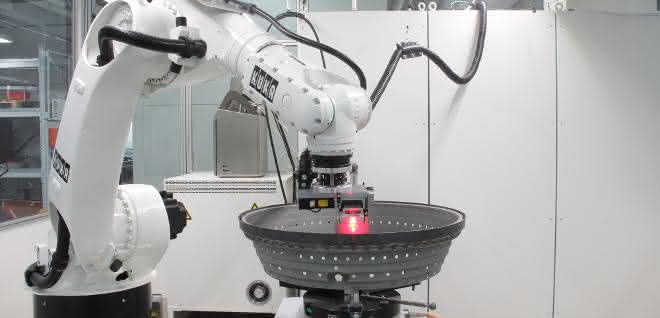
Small quantities, large structures and high safety requirements are the special features of the aviation industry that limit the efficiency of production and maintenance. Since 2010, the Institute of Aircraft Production Technology (IFPT) at TU Hamburg has therefore been focusing its research on robot-assisted automation and the development of intelligent, hybrid and mobile systems in the aviation sector. One of the most successful projects to date is the development of a system for the automatic crack inspection of engine combustion chambers using white light interferometry, which is now used by project partner Lufthansa Technik (LHT) under the name "AutoInspect".
Building on the project and the development team from IFPT, LHT founded the joint venture 3D.aero together with the German sensor manufacturer Pepperl+Fuchs in December 2017. "AutoInspect was the first door opener for further process automation at Lufthansa Technik," says Dr. Tomas Domaschke today. As a former research assistant at the IFPT, he was one of the founders of 3D.aero. "We succeeded in developing a technology that digitally maps the entire geometry of engine components, including complex damage detection in the micrometer range."
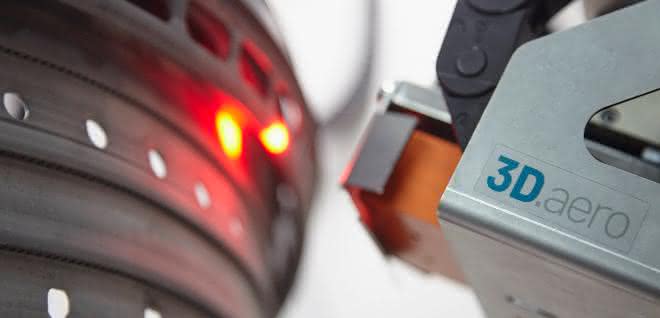
But beyond the white light interferometry solution marketed as "360° Inspection", the start-up is also playing a decisive role in shaping the aviation industry's path towards Industry 4.0. As a development partner for sophisticated inspection and image processing applications, 3D.aero supports its customers from the research stage through to the development of its own holistic technological solution. Proven automation approaches are combined with aviation-specific expertise and innovations such as artificial intelligence.
Under the name "Shop Floor Robotics", the Hamburg-based company now also offers automation solutions with collaborative robots to optimize production, assembly and logistics processes. With "Mobile MRO Tools", 3D.aero has created mobile inspection solutions with applications ranging from flexible damage detection and classification on a tablet to the inspection of hard-to-reach areas using high-resolution and miniaturized camera systems.
As numerous research and industry projects have allowed the team to grow significantly over the last few years, a second, larger main site was only opened in Hamburg Innovation Port in February 2020 in addition to the site at the Center for Applied Aeronautical Research in Hamburg (ZAL). With the outbreak of the coronavirus pandemic and the resulting recession in the aviation industry, research projects from the German Federal Ministry for Economic Affairs and Energy's aviation research program (LuFo) once again became more of a focus for 3D.aero. "In a recently commissioned LuFo project, the team will be working on the next development stage of white light interferometry, so-called line interferometry," reports Michael Ernst, one of the founders of 3D.aero alongside Tomas Domaschke and Sönke Bahr. As in many research projects, the company is also relying on intensive collaboration with the IFPT. Because, according to Ernst: "University research and technology transfer are essential for the seamless implementation of an aviation automation solution, from the foundation to the application."
Prof. Dr.-Ing. Thorsten Schüppstuhl, Head of the IFPT, is delighted with the good networking. "By working with 3D.aero, we can see our research results through to market maturity and make them available to a wider customer base." For the IFPT and 3D.aero, this does not lie exclusively in aviation. The application fields of large structures, small series, lightweight construction and long service life also include wind turbine manufacturers, shipbuilding, the automotive industry and medical technology. Despite the challenging times, it is still possible to develop automation concepts for the future and drive digitalization a step further. And its importance for the aviation industry is currently greater than ever. D. Kotlerova, M. Ernst, J.-E. Rath/as


You might also be interested in
Basler acquires 76% of Indian image processor
Basler, supplier of image processing components for computer vision solutions, has acquired 76% of the Indian sales partner Alpha TechSys Automation.
 read more...
Process monitoring and fault detection
Cameras ensure quality during laser melting
Powder bed-based laser melting (PBF-LB/M) opens up new possibilities in additive manufacturing. Modern camera systems provide crucial process data to further increase quality and efficiency.
read more...Vision Sensor is three times faster than its predecessor
The 'CS-62' vision sensor from di-soric is around three times faster than its predecessor, the 'CS-60'. In combination with the 'nVision-i 25.1' software, it enables image processing solutions that were previously reserved for smart cameras.
read more...Thermal imaging cameras for quality control
Automated thermal imaging cameras are often suitable for quality control applications where temperature plays a role. However, while there are various solutions on the market for slow processes, it is challenging to select a camera that reliably...
read more...Easy entry into industrial VGA thermography
Reliable temperature measurement is a prerequisite for the success of many industrial processes. Berlin-based manufacturer Optris presents the Xi 640 infrared camera, a new member of its Compact Line, which enables non-contact temperature...
read more...Powder bed-based laser melting optimized
Aconity3D has set itself the goal of optimizing the stability of the manufacturing method of powder bed-based laser melting and thereby promoting its use in a wide range of industries. By using high-speed industrial cameras from SVS-Vistek, the...
read more...INDUSTRIAL Production Products of the year...
2nd place, category handling, assembly and production logistics: SICK
safeVisionary2 is the first 3D time-of-flight camera with Performance Level c safety certification. It enables safe three-dimensional environmental detection and won 2nd place in the competition for Product of the Year 2024 in the handling, assembly...
read more...Nomination Products of the Year 2024
SICK: Camera systems safeVisionary2
safeVisionary2 is the first 3D time-of-flight camera with Performance Level c safety certification. It enables safe three-dimensional environmental detection and has been nominated in the 2024 Product of the Year competition in the handling,...
read more...AI vision brings additional opportunities
The seamless integration of AI into the consumer sector has helped to improve our quality of life and make interactions with technology more efficient. In industry, AI vision with machine learning opens up new possibilities that are not covered by...
read more...