

Secure data transmission
Data transmission with light
Light Fidelity. Transmitting data with light via optical fibers is a long-established technology, but it can also be done wirelessly. Light fidelity or LiFi technology has the potential to gain market share in industry in the coming years.

In addition to the widespread standards for wired and wireless communication, light is available as an alternative for data transmission over short distances, as is often required for the Industrial Internet of Things (IIoT), which can also achieve a very high data throughput. The term LiFi for Light Fidelity (sometimes also referred to as VLC Visible Light Communication) was coined in 2015 by German scientist Harald Haas, Professor at the University of Edinburgh. It is phonetically reminiscent of the well-known WiFi, as both solutions compete at close range. Developed in 2005, LiFi now has great market potential - but has not yet been able to establish itself. Organizations such as the Light Communications Alliance (LCA) aim to change this. The Fraunhofer Institutes for Photonic Microsystems (IPMS) in Dresden, for Optronics, System Technologies and Image Exploitation (IOSB) in Lemgo and for Telecommunications, Heinrich Hertz Institute (HHI) in Berlin are among the leading research institutions in this field. For years, solutions have been developed for extremely short distances in the centimeter range, but also for longer distances in the lower, 2-digit meter range. Apple was the pioneer of this technology. However, data transmission by light, or light Morse code, has been common practice in the maritime industry since the 19th century.
Optical data transmission
Data is transmitted using light waves in the 400 and 800 terahertz range. This requires clear visual contact between the transmitter (light emitter) and receiver. The light pulses are indistinguishable to the eye, and the human eye is presented with an apparently uniformly illuminated source. Compared to radio technology, visible light allows higher data rates because it has a greater bandwidth in the 200 to 1600 nanometer range. LiFi is also unregulated and there are no license fees. Real-time capable systems can be implemented more reliably. Integration costs and susceptibility to wear and tear are reduced. LiFi is also more robust against electromagnetic interference. Data rates of over 10 gigabits per second can be achieved over short distances of less than 10 centimetres.
Monochromatic, visible and also infrared light is modulated as a broadband information carrier. Up to now, data transmission has been attenuated via optical fibers made of plastic or glass fibers. The new type of direct transmission at the speed of light (up to 200 gigabytes per second is possible, provided that there are no influences such as rain, fog, haze or visual obstacles.
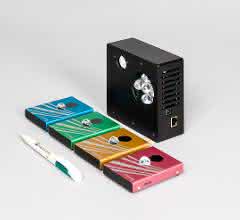
Basics and how it works
An optical system consists of a transmitter and receiver, which are connected directly via the atmosphere instead of an optical fiber. The radiation is generated as an electrical-optical converter (e/o) by the luminescent diode (LED) or, for more sophisticated solutions, the laser diode (LD). A transmitter optic concentrates the beam onto the receiver, where it is detected by a detector, an o/e converter consisting of PIN or more sensitive avalanche diodes, and converted back into an electrical signal. Focusing optics are located at this point. This eliminates interference from extraneous light. If communication units contain both transmitters and receivers, a transceiver is created for bidirectional traffic. To process analog signals, A/D converters must be connected upstream and downstream of the input and output.
LiFi has a whole range of advantages over the established WiFi/WLAN networks: it offers greater transmission security and a continuous data stream. It is highly energy-efficient and can simply use the lighting connections already installed in existing systems.
However, the most important advantage lies in the area of security: LiFi does not emit uncontrolled radiation like WiFi, so it cannot be intercepted as long as there is no visual contact with the LED. For the same reason, LiFi networks are also largely insensitive to electromagnetic interference. Data transmission cells can be closer together. Independent data streams can be transmitted from one access point to several users using the parallel room multiplex method. Conversely, a user can also communicate with different access points.
Applications
LiFi will probably be the first to establish itself in special areas, especially where electromagnetic radiation must be avoided: be it in the security sector, in hospitals or in aviation. In salt water, it could enable the wireless control of diving robots over short distances. But there are also countless applications in industrial use: For example, for controlling mobile and stationary robots using light signals, as well as driverless transport systems in intralogistics. In offices and private homes, optical links connect end devices such as PCs, IP telephones and the like to the network via ceiling or table lamps (LiFi hotspot). The smallest cells are possible here, as light does not penetrate a partition wall. Li-Fi is also suitable for a conference environment. Participants connect their devices to the organizer's network, for example for projectors or displays. Li-Fi transceiver modules can be easily integrated into devices via plug and play. Further possibilities are offered by driverless cars that communicate with each other via front and rear lights, possibly supported by the local network of LiFi street lamps. In any case, the potential and maturity of LiFi technology means that exciting applications can be expected in the coming years. dsc


You might also be interested in
Error-free data transmission in the smart factory
Machines, logistics and products communicate in modern industrial plants. At INDUSTRIAL production + handling, Fraunhofer IPMS will be presenting solutions for industrial communication in the technology fields of Li-Fi, RFID sensors and...
 read more...
Real-time communication via light
Fraunhofer IPMS develops wireless TSN via Li-Fi
In automation technology, messages often have to be transmitted in the microsecond range, for example to synchronize machines or drives with each other. Fraunhofer IPMS has combined Li-Fi and Time Sensitive Networking to enable real-time capable and...
read more...Fraunhofer IPMS: TSN IP Core for real-time capable Ethernet
Time Sensitive Networking (TSN) is a standard that allows time-controlled and prioritized transmission of real-time critical messages via standard Ethernet hardware for the first time. With the TSN IP Core, developers at Fraunhofer IPMS offer system...
read more...Li-Fi for wireless communication in industrial environments
At Embedded World from February 27 to March 1, 2018 in Nuremberg, Fraunhofer IPMS in Dresden will be presenting Li-Fi communication modules that compete with WLAN solutions in industry. In comparison, wireless optical technology promises faster,...
read more...Li-Fi for wireless communication in industrial environments
At Embedded World from February 27 to March 1, 2018 in Nuremberg, Fraunhofer IPMS in Dresden will be presenting Li-Fi communication modules that compete with WLAN solutions in industry. In comparison, wireless optical technology promises faster,...
read more..."As rebar gets thicker, automation has to keep up."
Larger wire diameters, greater performance, higher efficiency: How can rebar processing machines be adapted to changing market requirements using new drive technology and an open automation architecture? A user report.
read more..."Implementation often takes too long"
IT and OT are growing together. Martin Ruskowski, CEO of the SmartFactory-KL technology initiative, explains in an interview why Germany is lagging behind despite good concepts and how real projects are paving the way to the smart factory.
read more...Spectra Launches 5G RedCap Router for Industrial IoT Applications
With its new 5G RedCap routers, Spectra is expanding its portfolio to include a mobile communication technology for industrial applications designed to bridge the gap between traditional 5G and established IoT standards such as LTE-M and NB-IoT.
read more...Software at the heart of modern production
In an interview with Andreas Mühlbauer, Ulrich Huggenberger, Managing Director and CEO of Xitaso, explains why software architectures, modular control systems and networked data models are crucial for the production of the future. He explains the...
read more...