
Interview
"Implementation often takes too long"
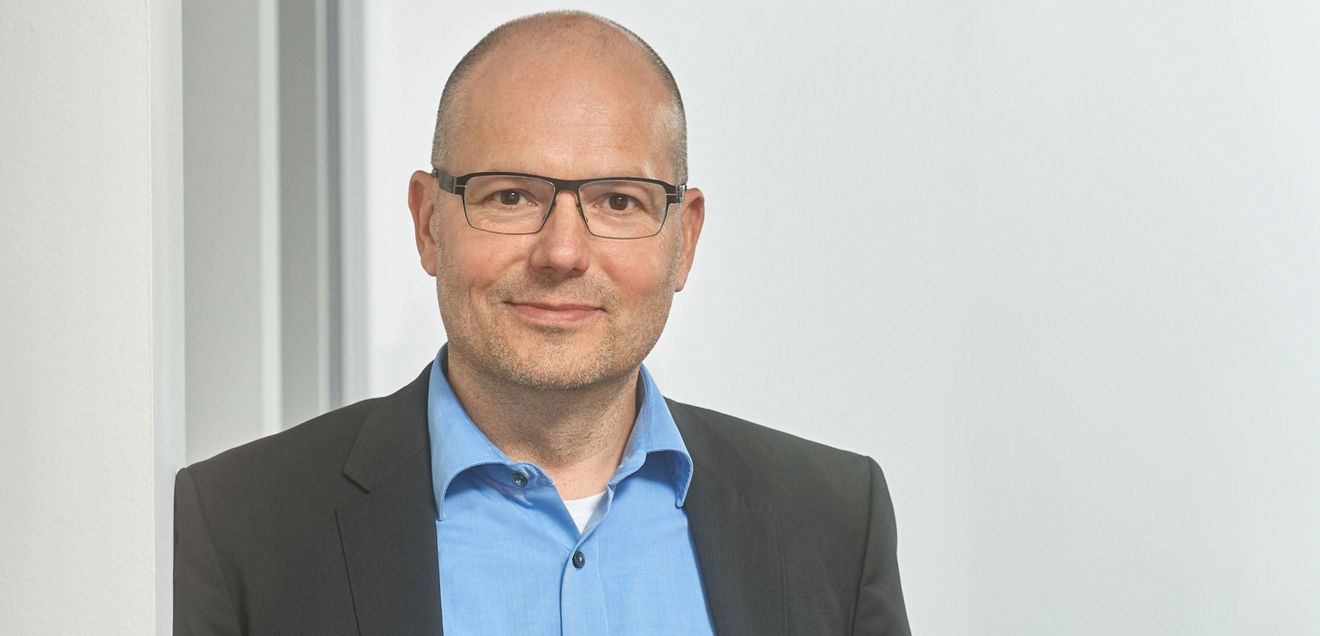
IT and OT are growing together - but a lack of data, skilled workers and speed are slowing down practice. In an interview with Andreas Mühlbauer, Prof. Dr.-Ing. Martin Ruskowski, Chairman of the Board of the SmartFactory-KL technology initiative, explains why Germany is lagging behind despite good concepts and how real projects are paving the way to the smart factory.
IT and OT are growing together. Where are the biggest obstacles in practice today?
The most important factor for me is time. IT/OT convergence does not happen overnight, it is a process. And it still presents companies with a number of challenges: On the one hand, we have OT, which stands for stability and real-time capability, but is essentially based on classic electrical design. On the other hand, there is IT, which stands for flexibility and scalability based on modern software concepts. Bringing these two worlds together naturally leads to certain frictional losses.
There are also other typical challenges such as cyber security and data protection, a poor or incomplete data basis, as well as a shortage of skilled workers and the know-how gap among existing specialists. The differences in the profiles of employees at OT level and in IT are sometimes very large. As a result, there is a lack of awareness at field level of the benefits of IT concepts and vice versa. We still need to raise awareness here.
Germany is considered an Industry 4.0 pioneer. Are we still ahead in IT/OT convergence?
As with so many processes, Germany also has the problem with IT/OT convergence that we are too sluggish. We develop concepts, standardize and plan, but often take too long to implement them. We need to take action now and roll out the concepts across the board. After all, good concepts already exist. At SmartFactory-KL in particular, we have been working intensively in recent years on how companies can merge the IT and OT worlds and build their own smart factory. The result is our Open SmartFactory Architecture, which provides a clear orientation framework; in principle, a blueprint of how the smart factory works. Instead of monolithic systems, it relies on a modular principle based on open standards that enables flexible and scalable production IT. If companies follow our architecture, they can master IT/OT convergence.
In June, you are organizing the IT/OT Integration Summit together with INDUSTRIAL Production. What kind of impulses on IT/OT integration can participants expect?
The special thing about our joint conference is the focus on real projects from mechanical engineering and production. We want to present real, tried-and-tested integration approaches, not glossy demos with nothing behind them. In other words, we will look at real projects, discuss cross-manufacturer approaches and present our architecture, which companies can use to move towards the smart factory. Participants will experience how IT/OT integration actually works in practice.


You might also be interested in
From Theory to the Factory Floor
IT and OT are converging, thereby laying the foundation for the smart factory. Only through seamless data integration can AI, digital twins, and flexible production processes become a reality. Why IT/OT convergence is becoming a competitive...
 read more...
Spectra Launches 5G RedCap Router for Industrial IoT Applications
With its new 5G RedCap routers, Spectra is expanding its portfolio to include a mobile communication technology for industrial applications designed to bridge the gap between traditional 5G and established IoT standards such as LTE-M and NB-IoT.
read more...Integration Meets Reality
OT meets IT – the two worlds are meant to converge, data is meant to flow, and production is meant to become smart. Yet the reality in industry often remains stubbornly contradictory: while systems have long been technically interconnected, they...
read more...Software at the heart of modern production
In an interview with Andreas Mühlbauer, Ulrich Huggenberger, Managing Director and CEO of Xitaso, explains why software architectures, modular control systems and networked data models are crucial for the production of the future. He explains the...
read more...How measured values are turned into decisions
Systems constantly generate measured values - but many of them disappear into systems that nobody actively uses. The problem is not the amount of data, but how it is collected. Only when information is available without detours and converges in a...
read more...AI-supported smart factory and energy...
Key drivers of the industrial transformation
Delta is showcasing at Hannover Messe how its AI-powered smart manufacturing, digital twin technologies and integrated energy infrastructure solutions are accelerating the transformation of industrial operations. At its press conference, the company...
read more...Use data consistently and uniformly
New connectors and an app solution for the IIoT framework from PLCnext Technology make it easier to collect data from controllers, sensors and field devices - especially in existing systems.
read more...Interview with Jumo Managing Director Dimitrios Charisiadis
Ahead of Hannover Messe 2026, Dimitrios Charisiadis, Managing Director of Jumo, talks about the company's return after a seven-year break, the strategic importance of the trade fair and the technological focus of this year's appearance.
read more...Switch makes network status transparent
Gigabit Ethernet is becoming increasingly important in mechanical engineering. The scalable infrastructure enables a step-by-step approach in which the backbone is first implemented on Gigabit.
read more...