
Connection technology
Pilot for Industry 4.0
Data is the raw material of the 21st century. To keep it moving, it needs a powerful infrastructure. This is what users get from Lapp - customized and with the right advice, promises Georg Stawowy, Lapp Board Member for Technology and Innovation.
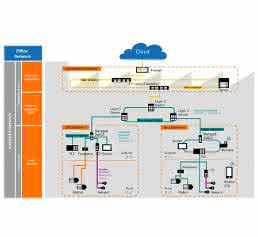
The introduction of the steam engine at the end of the 18th century, electrified mass production a hundred years later, computer-aided automation since the 1970s - when people talk about Industry 4.0, they often think of previous industrial revolutions and look for similarities. There are: they have all revolutionized the way we work and produce goods and multiplied productivity. And they have opened up new "raw materials": Steam power, electrical energy, electrical signals. With Industry 4.0, another big step is about to be taken: Data is the new raw material of the 21st century. The physical world is merging with the digital world, while at the same time networking is increasing - every machine, every "thing" exchanges information with others.
Infrastructure without hierarchies
This has consequences for the organization in manufacturing companies, especially with regard to the flow of data. The classic automation pyramid with the corporate (ERP) level at the top, the control level in the middle and the field level at the bottom will dissolve into an infrastructure without hierarchies. Analyzing and visualizing, making decisions and translating them into physical movements as well as capturing information in a digital twin will take place continuously and simultaneously and will be mutually dependent.
The revolution on the factory floor is also having an impact on Lapp's business - and probably only a positive one. Because if everyone communicates with everyone else, the number of connections will explode. "Lapp creates connections in factories, for machines, for every industrial activity," says Georg Stawowy, CEO of Lapp Holding for Technology and Innovation. Even if the automation pyramid dissolves, the lower level with the basic infrastructure that transports the raw material data will always be necessary.
Connection technologies are becoming more important
Connection technologies are therefore becoming even more important. This applies not only to their number, but also to the requirements for their quality, durability and availability. In terms of investment, connection technology is only a subordinate position in an automated factory, but if it fails, it can quickly incur horrendous costs, for example if an assembly line in an automotive factory comes to a standstill. "In the minds of some users, a cable or a connector may be a C-part, but in terms of their importance, they are A-parts," explains Stawowy.
And they are parts that contain a lot of know-how. The demands on connection technologies themselves and their diversity are increasing and it is becoming increasingly difficult for many users to keep track of which products and combinations are suitable for their specific requirements. There are two options: You rely on your experience and order parts that are likely to meet the requirements. Or you can seek advice from experts, which is recommended in view of the increasingly complex nature of the subject matter.
What is important here is a holistic understanding that goes beyond pure product expertise. "We describe ourselves as a customer expert and guide," says Stawowy. This means that Lapp tailors the solution for the customer. This includes the right products, including custom-made products if necessary, as well as ready-to-install assembly and engineering. Stawowy: "This also includes providing customers with the latest knowledge, for example via webinars or explanatory videos." These training activities are to be expanded in the future, for example on the basics of automation technology.
Lapp has also built up its portfolio according to these principles. It contains all the important components that a user needs to design their factory according to the principles of Industry 4.0, including a large selection of data cables for different standards such as Profinet or CC-Link, and more recently also switches for distributing data in harsh environments. Further additions will follow. To this end, experts are specifically examining the communication lines in customer applications to determine what exactly the requirements are and what an ideal solution should look like. The portfolio is then developed accordingly on this basis. The attractiveness for a customer results more from the portfolio than from an individual product.
Industrial Data Communications division grows
These activities are also reflected in Lapp's turnover. The Industrial Data Communications division is currently growing by over 20 percent every year, with Ethernet-related business in particular growing strongly. Strategically, the industrial data communications sector will grow in relation to the classic oil-flex connection cable - but only in relative terms, as this part of the business is also growing in absolute terms. This is not surprising, because in addition to networking, electrification is also continuing to increase, and with electrification, the demand for cables is also growing. Drives, lighting and air conditioning all need electricity.
Threat from wireless?
One of the most frequently asked questions is: Why use cables when you can transmit data via WLAN, Bluetooth or other wireless technologies? This is true in principle, but wireless technologies have various disadvantages in the harsh factory environment, from connection stability to latency times that make real-time applications difficult. Wireless therefore does not mean the end of cables, but is a sensible solution in special applications in a rapidly growing market. Lapp also offers wireless connection solutions with partners. Here too, the company plans to add further components to its portfolio as required.
Forecasts are difficult, especially when they concern the future - Mark Twain already knew that. That's why we should be careful when speculating on how the industry will develop in a few decades' time. However, according to Georg Stawowy, the next ten years are quite predictable: "We will see networked value creation architectures, and the relationships between companies, customers and users will no longer be defined by their location or their affiliation to a company, but by which digital ecosystems they connect to." Bernd Müller/as


You might also be interested in
Helu makes its first trade fair appearance under a new brand name
Helu Kabel will be presenting itself as Helu for the first time at Hannover Messe 2026, showcasing system solutions, Heluchain cables and new industrial luminaires.
 read more...
Strategic realignment with brand relaunch
In future, Helukabel will trade as Helu
The Helukabel Group is parting with part of its name: in future, the company will only operate under the Helu brand. With this step, the specialist for electrical connection technology is underlining its strategic development from a classic cable...
read more...Modular plant construction for corrugated board
Insight into the production of corrugators at BHS Corrugated: Automated, modular and equipped with Helukabel components.
read more...Best quality for the steel
Conditions in the steel industry are harsh and inhospitable. The machines used must be able to withstand the demanding environmental conditions in order to deliver the best quality at all times.
read more...If the standard cable is not sufficient
Lapp offers cables for countless applications - but not for all of them. From time to time, the developers have to modify a standard cable or develop a special cable.
read more...Slight decline in sales, strong investments
The Lapp Group has not been spared from the weakening global economy. However, the company only recorded a slight loss in the past 2024 financial year.
read more...Electrical connection technology
Cables and wires for industrial automation
Heukabel offers system solutions for cable routing from a single source. The subsidiary EKD Systems specializes in tailor-made cable drag chains made of steel, stainless steel and plastic, which are used in moving machines and systems as well as in...
read more...Lapp relies on Ultramid from BASF
Mobile charging of electric vehicles
The automotive industry is currently undergoing the biggest transformation in its history. The boom in battery electric vehicles in particular is presenting the industry with major challenges. Lapp, as a supplier of cables and connection...
read more...Cable handling application
At this year's Motek, ArtiMinds Robotics is showcasing a robot-based automation solution for the sensor-assisted assembly of flexible cables in connector housings.
read more...