
Switches
New data traffic controllers
Lapp has also had switches in its range for two years. The company has now expanded its range of active components for SPS 2019 to include additional switches for industry.
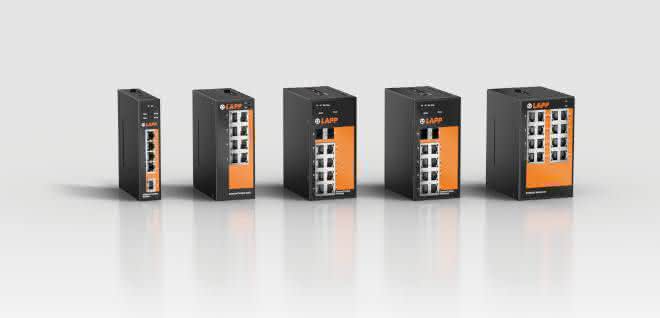
Communication in industry is increasingly taking place via Ethernet networks - they are the nerve pathways of the smart factory. The performance of the data connection depends not only on the cables but also on the peripherals, above all on the switches, the controllers of the data traffic. To ensure that both interact optimally, Lapp has switches in its range that have been expanded to include PLCs.
The new Etherline Access Switches are available in different versions with four to 16 ports, also in combination with ports for fiber optics and as a variant with Power over Ethernet. All switches have robust metal housings and are designed for DIN rail mounting. Special highlights are the smallest Profinet switches on the market.
No one is smaller
Decentralized control cabinets in production are cramped, sometimes you can't even close the door when they are full of switches and cables. The new PNF04T, PNF08T and PNF16T Profinet switches with four, eight and 16 ports are now available for such cases. According to the manufacturer, they are the smallest on the market - compact, flat and can be installed on the DIN rail in no time at all. Nevertheless, there are a lot of useful functions in the small housings. The switches fulfill Conformance Class B and can be configured via a web interface. They are temperature-resistant from minus 40 to plus 75 degrees Celsius and are therefore also suitable for harsh industrial environments.
Broker between IP networks
The NF04T NAT/Firewallis used where there are conflicts due to multiple IP addresses. It has three LAN ports and a WAN port that connects the switch to a higher-level company network. The NAT functionality translates the same IP addresses at machine level into different IP addresses at company level. Or the switch translates different external IP addresses into a different address range for the network at machine level. Port forwarding and routing mode are also on board. All of this is contained in the same ultra-compact housing as the Profinet switches mentioned above, and temperatures of minus 40 to plus 75 degrees Celsius are also permitted here.
Further with light
When high transmission rates over long distances are required, there is no way around fiber optic cables. In addition to the eight RJ45 ports, the two managed switches M08T02SFP and M08T02GSFP each have two SFP ports for connecting fiber optic cables, the latter for fast Gigabit Ethernet. Lapp attaches great importance to robustness. These switches can also withstand temperatures between minus 40 and plus 75 degrees Celsius, they are protected against the ingress of foreign bodies in accordance with IP40, and they can be supplied with power redundantly. The appropriate SFP standard modules for converting the light signal into electrical signals are also available. The SFPs are available in four variants: for 100 Mbit/s or 1 Gbit/s and each for single-mode or multi-mode transmission.
Networking made easy
In addition to the managed switches mentioned above, Lapp is also offering new unmanaged switches for the fast creation of Ethernet networks. The U16T has 16 RJ45 ports for data rates of up to 100 Mbit/s, while the eight ports of the U08GT even achieve gigabit speeds. Both are housed in compact and robust metal housings, with DIN rail connection and redundant power supply.
Power over the line
A useful feature of Ethernet cables is that they can transmit electrical energy as well as data. Although the performance is low, it is sufficient to supply cameras in quality monitoring or Wi-Fi access points, for example, and a separate power supply can then be dispensed with. The unmanaged switch U04TP01T has four RJ45 ports with Power over Ethernet to supply power to the connected peripherals and one port for Fast Ethernet. Such switches are often used in the vicinity of machines where they are exposed to extreme temperatures. This model has therefore also been designed for temperatures from minus 40 to plus 75 degrees Celsius. as


You might also be interested in
ebm-papst is growing again thanks to AI and data centers
ebm-papst returned to a growth trajectory in fiscal year 2025/26. Air Technology, data center applications, and artificial intelligence are driving revenue and investment.
 read more...
SPE on the Verge of a Market Breakthrough
Single Pair Ethernet (SPE) has moved beyond the conceptual phase and is increasingly being implemented in industrial settings. The focus here is not only on higher data rates and simplified cabling, but above all on the issue of system integration...
read more...More than 900 exhibitors already registered
Around six months before the start of the trade fair, more than 900 companies have registered for SPS 2026 in Nuremberg. The trade fair focuses on industrial AI, cyber security and digital transformation.
read more...Virtual PLCs in practice: How vPLCs make production systems more flexible and scalable
The increasing networking of IT and OT is fundamentally changing industrial automation. The IT/OT Integration Summit shows how modern technologies can make production environments more efficient, flexible and future-proof. The event will focus on...
read more...Sales growth in a turbulent market environment
Thanks to innovations and a focus on strategic industrial markets, Sick was able to moderately increase its sales in the 2025 financial year. In a turbulent market environment, the company was able to maintain its position and gain market share with...
read more...Siemens presents new AI agent
Siemens is launching 'Eigen Engineering Agent', an AI for automation technology. The solution is integrated into the TIA Portal, has been tested with over 100 companies and is designed to significantly accelerate engineering processes.
read more...Schaeffler keeps sales almost stable
Schaeffler generated revenue of EUR 23.5 billion in 2025 and increased EBIT before special items to EUR 936 million. At 266 million euros, free cash flow was significantly above the prior year and forecast. Net income remained negative due to high...
read more...Advancing artificial intelligence together
Helukabel is stepping up its activities in the field of artificial intelligence and is now a member of the IPAI. The innovation and collaboration platform for companies, research facilities, institutions and administration has set itself the goal of...
read more...New impetus for ifm sales
Two new positions were filled at ifm at the start of 2026: Markus Wolf becomes Managing Director Sales Germany, Sven Quant takes over the position of Central Managing Director in the Process Sensors division within the ifm Group.
read more...