
Labeling and printing technology
Labeling in folded condition
If the product packaging takes place on various lines, it can make sense to bundle the labeling of the folding boxes in a special system beforehand. Kraus Maschinenbau has developed the "FK Codingline" for a Polish manufacturer of vehicle filters and uses labeling and printing technology from Bluhm Systeme.
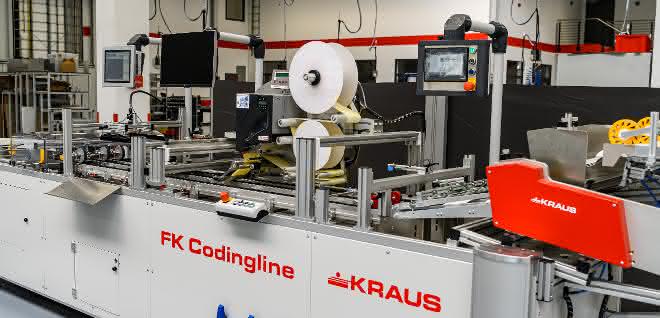
Folding cartons can be labeled at various stages in the production process. They are often printed or labeled immediately before or after filling. However, marking is also possible in the folded "original state". Kraus Maschinenbau, the specialist for feeding and separating systems for paper and flat products, offers the "FK Codingline", a special machine concept for coding folding boxes in a wide range of formats. Thanks to its modular design, the Codingline can be equipped with different coding technology and adapted to customer requirements.
Kraus has developed a high-speed system with labeling technology from Bluhm Systeme for a Polish filter manufacturer. Two labelers and two large-format thermal inkjet printers are integrated into the line. As the folding boxes are dispensed onto a suction belt via a friction feeder and transported further by means of a vacuum system, coding is possible at any point on the products.
Initially, labeling is carried out by two Legi-Air 4050AC label pressure dispensers. These systems apply labels without compressed air; they are robust and suitable for round-the-clock use. The proven dispenser technology comes from the Alpha series, which Bluhm has been developing for decades. Most of the parts used are standardized parts from mass production. Depending on the version, the dispensers can simultaneously label products from above and below at a speed of 50 meters per minute. They process label sizes from 14 by 20 to 148 by 210 millimetres. Depending on the format, application of up to 600 labels per minute is possible.
Printing with thermal transfer or direct thermal printing process possible
The dispensers use print module technology from leading global manufacturers. The two FK Codingline systems are equipped with Novexx print modules. These "Print Engine Modules" are particularly suitable for cardboard and plastic adhesive materials. They print using either thermal transfer or direct thermal printing at a maximum resolution of 300 dpi and achieve speeds of up to 400 millimetres per second. As the printing speed exceeds the dispensing speed, the pre-printed labels run into a so-called buffer loop, from which they can be further processed without any time delay.
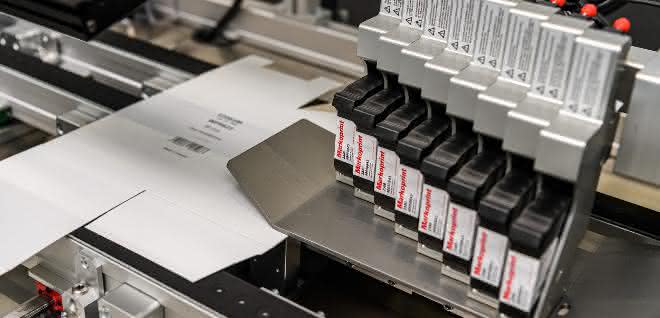
After labeling, the products are printed with plain text and barcodes. In this specific case, the end customer wanted a print width of 100 millimetres and a high resolution of 600 dpi. Kraus Maschinenbau therefore integrated two Markoprint XB8JET thermal inkjet printing systems into the FK Codingline. They can each control up to eight print heads, which together produce a print image up to 100 millimetres wide. The print heads are fitted with cartridges from ink manufacturer HP; they contain a solvent-based ink that enables the print to dry quickly on non-absorbent surfaces. With a resolution of 600 dpi, the XB8JETs print the desired layout onto the lacquered folding boxes in razor-sharp detail.
In addition to thermal inkjet, print heads that use piezo inkjet technology can also be used. This achieves a resolution of 300 dpi and a height of up to 100 millimetres per print head. With eight print heads, print images up to 800 millimeters high would be possible. In the Kraus system, the eight print heads create a joint print image. With the XB8JET, it would also be possible to distribute the print heads in pairs to different lines, allowing up to four different print images to be applied simultaneously from one control unit.
The print heads are controlled via a unit in the FK Codingline control cabinet. After labeling, the labeled and printed codes are checked by a camera system and managed in databases. The Codingline automatically ejects products with unreadable codes into a collection box. All other folding boxes are transferred to a delivery conveyor and removed manually. From here, the various packaging systems can be conveniently loaded.


You might also be interested in
Filtration and sound attenuation in circuits
In liquid or air circuits, filter housings and silencers protect measuring devices, ensure particle-free vacuum and pneumatic systems, keep cooling circuits clean and reduce noise.
 read more...
KSS ultrafine filtration for grinding oils
Modular concept for pure oil
In order to grind economically, reliably and with the highest quality, extremely clean grinding oils are required. Filter manufacturer Vomat offers the metalworking industry high-performance and customized concepts for the filtration of cooling...
read more...Up to 95 percent less flue gas thanks to direct extraction
The requirements for occupational safety measures and safety technology are also constantly increasing in welding technology. The Technical Rules for Hazardous Substances (TRGS) stipulate that welding fumes and harmful substances must be extracted...
read more...Everything accurate in switch cabinet construction
To ensure smooth work processes, tools for processing enclosures and housings must function flawlessly and reliably. Häwa rounds off its punching range with the Multi-Press 500.
read more...Cooling and temperature control units
Hygienic packaging sells safely
In few industries are the requirements for hygiene in the production process as strict as in the food sector - the health of consumers has top priority. This results in enormous challenges for all machines and components involved, especially in...
read more...Efficient and sustainable
Rotary screw compressors are the reliable backbone of industrial compressed air generation. The innovative CSD/CSDX series from Kaeser Kompressoren with its numerous features produces them efficiently and saves energy costs. This also reduces theCO2...
read more...Healthy air during welding
Welding produces fumes and gases that are hazardous to health. Extraction is necessary to comply with the occupational exposure limits and is even mandatory when welding high-alloy steels.
read more...Wire mesh filters in medical technology
In hardly any other industrial development sector are the demands placed on products as high as in medical technology. After all, human lives depend on the performance and reliable quality of medical devices.
read more...Energy efficiency and sustainability in the smallest of spaces
With the StingR ultra-fine filter system, Lehmann-UMT has created a solution for the energy-efficient and precise treatment of fluids during tool grinding for extended tool life and high tool quality.
read more...