
Spare and maintenance parts
Is the original spare part worth it?
At first glance, the situation seems clear: costs can be saved with a generic replacement or maintenance part for the compressor. But the supposedly cheaper alternative quickly turns out to be a cost trap.
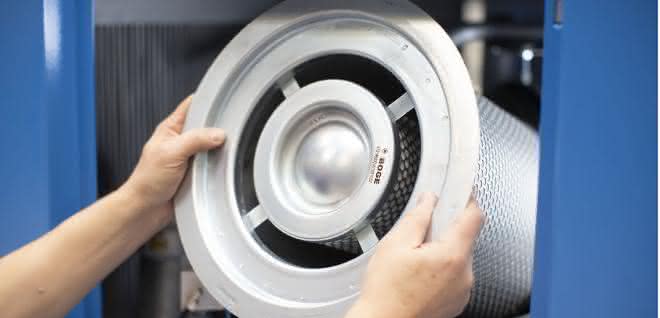
If you look at the costs of a compressor over its entire life cycle, energy costs account for around 75 percent of the total costs - the larger the system and the more operating hours, the higher this proportion. In contrast, the costs for purchase, maintenance and spare parts are hardly significant.
In order for a compressor to maintain its efficiency and thus its energy consumption, all components must be optimally matched and replaced regularly. Spare and wear parts that do not exactly meet the manufacturer's specifications can, for example, increase the differential pressure, which then has to be compensated for by increasing the energy consumption of the compressor. This also has a negative impact on its service life, maintenance intervals and reliability. Only original parts that have been tested and approved by the manufacturer will ensure the long-term efficiency of the compressor. Original filters, separator cartridges or lubricants are verified by a large number of tests and several thousand hours of continuous operation before they are approved. Pirate parts may appear to be the cheaper alternative at first glance. However, problems often occur during operation.
The most important maintenance parts are the oil separator, oil filter and air filter.
The oil-air mixture produced during the compression process first enters a pressure vessel for pre-separation. The oil droplets still contained in the compressed air are combined into larger droplets by the oil separator elements (or spin-on separators), then collected and fed back into the oil circuit. This minimizes the oil consumption of the compressor and the oil input into the compressed air network.
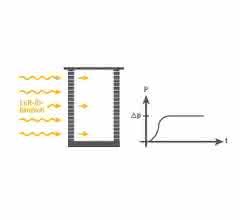
In oil separators, filter material that is too dense ensures high separation rates, but also high pressure losses. As a result, a lot of energy is lost. If, on the other hand, the filter material is of poor quality or too thin, the separation is too weak and the oil transfer into the compressed air network is correspondingly high. In the case of internal oil separators, there is a further requirement: good earthing of the element prevents static charging and thus the risk of ignition. Only original oil separators ensure minimal oil transfer, consistent separation rates and minimized pressure loss over the service life.
Air to work with
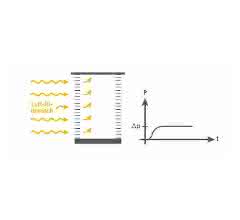
The ambient air contains many millions of particles, dust and pollen that can have a negative impact on the performance of a compressed air system. If these mostly microscopic particles are not removed by an intake filter, damage can occur to bearings and rotors, and the service life of downstream oil filters and oil separators is reduced. The filter elements absorb the dirt and must therefore be replaced regularly. The material used, the size and the differential pressure also play a decisive role in the intake filter. Only original parts guarantee a high-quality filter material with a high dirt holding capacity and a constantly low differential pressure. In addition, they provide an optimum seal between the filter housing and element so that no unfiltered air flows into the machine.
In oil-lubricated compressors, the oil has a variety of tasks: sealing, cooling, lubricating and removing dirt. The oil filter removes the dirt particles and abrasion absorbed by the oil from the oil circuit and retains them in the filter material. It is constantly exposed to pressure fluctuations, vibrations and high temperatures. Poor filter material results in poor filtration, which leads to a contaminated oil circuit and, in the worst case, clogging of the filter. If the oil filter is not changed regularly, the filter material becomes clogged. If the filter is completely sealed, the bypass valve installed in the original filter is used. This opens so that the lubricating film does not break off and the compressor stage continues to be supplied with oil. However, all accumulated particles are returned to the oil circuit unfiltered. This can lead to costly damage to the compressor and other components or even complete machine failure. Regular, timely filter replacement is therefore essential.
The compressor oil
As mentioned above, the oils used in a compressor must meet the highest standards. The oil should cool the components in the compressor and seal the gaps between the rotors or pistons and cylinders. It removes deposits before they can impair the function of the compressor. Above all, it lubricates all components. To fulfill all these functions, additives are added to the oil to create the required properties. The most important properties influenced by additives are foaming, water separation, viscosity and corrosion protection.
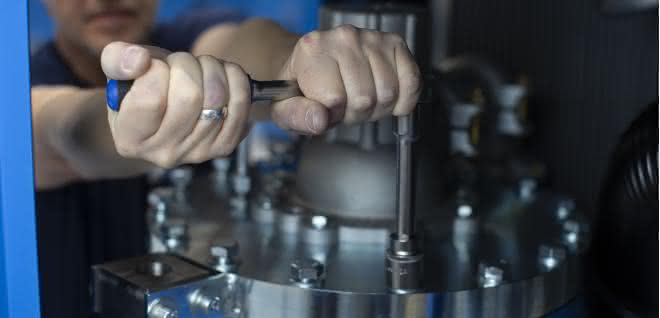
Low foaming leads to a reduced residual oil content, while at the same time the lubricating properties of the oil are retained. Good water separation prevents corrosion and the combination of oil and condensate. Constant viscosity in turn prevents clogging and insufficient lubrication in cold conditions as well as the oil film breaking off at high temperatures. Corrosion protection and low oxidation have the advantage that no acid forms, bare metal parts do not corrode and no oil sludge is produced.
Which oil is used depends on the requirements and the compressor type. The most common types of oil are mineral and synthetic oils. There are also special oils for the food sector. The change intervals vary greatly depending on the oil type and ambient conditions. One indicator of oil ageing is oxidation. However, the oxidation number of the oil, which can be determined by a test, is only a snapshot. It remains constant over a long period of time and then suddenly increases exponentially. For this reason, the change intervals specified by the manufacturer should not be exceeded. The consequences could be oil sludge deposits, acid formation and thus corrosion as well as clogged filters or valves.
Only at first glance do oils appear to be interchangeable with similar-sounding types. However, before a manufacturer releases an oil for its machines, it undergoes a monitored test with many machines, which lasts several thousand hours and in which all the desired properties are monitored by regular laboratory analyses. The oil is only released if it successfully passes this test.
These considerations show that replacement and maintenance parts are sensitive components. Reproduced parts and lubricants are usually only the cheaper choice at first glance. Original parts, on the other hand, meet the specifications required by the manufacturer and ensure consistently high system efficiency. This reduces the risk of machine failure.
According to documents from Boge Druckluftsysteme / am


You might also be interested in
Filtration and sound attenuation in circuits
In liquid or air circuits, filter housings and silencers protect measuring devices, ensure particle-free vacuum and pneumatic systems, keep cooling circuits clean and reduce noise.
 read more...
KSS ultrafine filtration for grinding oils
Modular concept for pure oil
In order to grind economically, reliably and with the highest quality, extremely clean grinding oils are required. Filter manufacturer Vomat offers the metalworking industry high-performance and customized concepts for the filtration of cooling...
read more...Up to 95 percent less flue gas thanks to direct extraction
The requirements for occupational safety measures and safety technology are also constantly increasing in welding technology. The Technical Rules for Hazardous Substances (TRGS) stipulate that welding fumes and harmful substances must be extracted...
read more...Everything accurate in switch cabinet construction
To ensure smooth work processes, tools for processing enclosures and housings must function flawlessly and reliably. Häwa rounds off its punching range with the Multi-Press 500.
read more...Cooling and temperature control units
Hygienic packaging sells safely
In few industries are the requirements for hygiene in the production process as strict as in the food sector - the health of consumers has top priority. This results in enormous challenges for all machines and components involved, especially in...
read more...Efficient and sustainable
Rotary screw compressors are the reliable backbone of industrial compressed air generation. The innovative CSD/CSDX series from Kaeser Kompressoren with its numerous features produces them efficiently and saves energy costs. This also reduces theCO2...
read more...Healthy air during welding
Welding produces fumes and gases that are hazardous to health. Extraction is necessary to comply with the occupational exposure limits and is even mandatory when welding high-alloy steels.
read more...Wire mesh filters in medical technology
In hardly any other industrial development sector are the demands placed on products as high as in medical technology. After all, human lives depend on the performance and reliable quality of medical devices.
read more...Energy efficiency and sustainability in the smallest of spaces
With the StingR ultra-fine filter system, Lehmann-UMT has created a solution for the energy-efficient and precise treatment of fluids during tool grinding for extended tool life and high tool quality.
read more...