
Pneumatic tools
5 tips for a long life
Pneumatic tools are only really useful if they perform to their full potential over the long term. Rodcraft provides important tips on how to diagnose performance losses and increase service life.
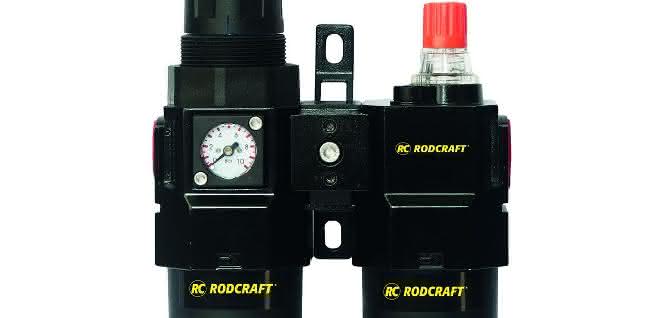
The professional and ambitious screwdriver notices immediately when an air tool loses power or does not work as desired. The result: work can no longer be carried out or can be carried out far too slowly. Annoyance and frustration set in, because who has time to go on a lengthy troubleshooting session while work is piling up in the workshop? Yet in many cases, rectifying a fault is less complicated than you might think. As long as you take a systematic approach and don't just look for the cause in the tool, as is so often the case. The tool specialists at Rodcraft know from experience how to get to the bottom of faults or, even better, how to avoid faults from the outset. Because nothing is more important in workshop operations than a tool that delivers full performance - at all times and for as long as possible.
When the tool runs out of breath
In many cases, the compressed air supply is the problem when tools do not do what they were purchased for. A faulty pressure supply can have various causes: The first check should be on the compressor and whether it can build up sufficient pressure. But be careful. A quick glance at the pressure gauge can be deceptive. For example, if various pneumatic tools are operated in parallel, the delivery volume or the tank volume of the compressor may be too low, meaning that each individual tool is supplied with too little compressed air. A simple addition of the required air volumes of the connected tools can quickly provide information. In addition, insufficient line cross-sections or lines that are too long quickly cause noticeable compressed air problems. Because even if enough compressed air is produced, small cross-sections can reduce the air flow or the natural pressure drop per meter of line can be the cause of the problem. An air flow meter and a comparison with the required air volume of the tools quickly provides information here.
A caress for a long, powerful life
An air tool can only achieve its full performance and service life if it is operated under the best possible conditions. Compressed air treatment with a filter, water separator and compressed air lubricator is of central importance here. Various tools require a certain amount of oil in the compressed air in order to deliver full performance in the long term through lubrication. Others rely on particularly dry air. However, no tool can tolerate dirt particles or condensation from the compressor in the compressed air without damage in the long term. Dirt and dust quickly lead to high wear on the precise mechanics and moisture can quickly lead to corrosion damage in the compressed air motor. This is why a maintenance unit in the compressed air supply is a must for long, high tool performance.
The pipe burst
Defective lines and hoses are common causes of insufficient pressure and noticeable loss of tool performance. In many cases, a leakage is clearly audible when air flows out of a line connection or from a line crack. In particular, the flexible hoses and the plug connections between the tool and the permanently installed line are subject to high mechanical loads. If a leak is not audible, it is worth checking different line or hose sections separately for pressure loss using a pressure gauge.
If the O-ring is a U-ring
Mechanical defects on wearing parts in the compressed air system are normal. These include seals and O-rings in particular. Couplings and plug connections are particularly susceptible to wear and ageing. A worn or even torn O-ring is usually found on moving parts or on frequently used plug connections. This defect is clearly audible due to escaping air and can be quickly rectified with a new seal. Incidentally, couplings with nitrile O-rings have a significantly longer service life than those with standard seals.
Strike of the tool
Once it has been ensured that the compressed air supply is in order, the only thing left to do in the event of a loss of power is to diagnose the compressed air tool. Here too, a systematic approach is required. The first step is to check whether it is supplied with sufficient oil. A maintenance unit continuously supplies the air motor with the required amount of oil and protects it from wear and corrosion. The often recommended daily drop of oil in the compressed air connection is a dangerous option, as the compressed air will have blown out the minimum amount of oil in no time if the tool is used frequently. It is also important to regularly grease various parts according to the maintenance schedule, for example impact mechanisms. If these sources of error, including leaks in the tool's compressed air connection, can be ruled out, external damage may indicate a defect in the internal mechanics. Disassembly and maintenance of the tool is then unavoidable. In this case, an authorized service company should provide rapid assistance.


You might also be interested in
Filtration and sound attenuation in circuits
In liquid or air circuits, filter housings and silencers protect measuring devices, ensure particle-free vacuum and pneumatic systems, keep cooling circuits clean and reduce noise.
 read more...
KSS ultrafine filtration for grinding oils
Modular concept for pure oil
In order to grind economically, reliably and with the highest quality, extremely clean grinding oils are required. Filter manufacturer Vomat offers the metalworking industry high-performance and customized concepts for the filtration of cooling...
read more...Up to 95 percent less flue gas thanks to direct extraction
The requirements for occupational safety measures and safety technology are also constantly increasing in welding technology. The Technical Rules for Hazardous Substances (TRGS) stipulate that welding fumes and harmful substances must be extracted...
read more...Everything accurate in switch cabinet construction
To ensure smooth work processes, tools for processing enclosures and housings must function flawlessly and reliably. Häwa rounds off its punching range with the Multi-Press 500.
read more...Cooling and temperature control units
Hygienic packaging sells safely
In few industries are the requirements for hygiene in the production process as strict as in the food sector - the health of consumers has top priority. This results in enormous challenges for all machines and components involved, especially in...
read more...Efficient and sustainable
Rotary screw compressors are the reliable backbone of industrial compressed air generation. The innovative CSD/CSDX series from Kaeser Kompressoren with its numerous features produces them efficiently and saves energy costs. This also reduces theCO2...
read more...Healthy air during welding
Welding produces fumes and gases that are hazardous to health. Extraction is necessary to comply with the occupational exposure limits and is even mandatory when welding high-alloy steels.
read more...Wire mesh filters in medical technology
In hardly any other industrial development sector are the demands placed on products as high as in medical technology. After all, human lives depend on the performance and reliable quality of medical devices.
read more...Energy efficiency and sustainability in the smallest of spaces
With the StingR ultra-fine filter system, Lehmann-UMT has created a solution for the energy-efficient and precise treatment of fluids during tool grinding for extended tool life and high tool quality.
read more...