
Compressors
Atlas Copco: optimized heat recovery
Metalworking and processing company Prevent TWB in Hagen has installed a heat recovery system in its new compressor station. Five oil-injected screw compressors from Atlas Copco reliably supply compressed air, heat the production hall and premises and also save electricity.
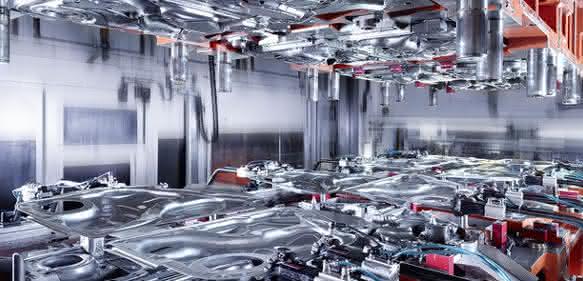
At 9 a.m. on a Friday in November 2016, the compressor station at Prevent TWB in Hagen is on fire. In the middle of the production hall, above the presses and welding machines, the fire department is deployed to extinguish the fire as quickly as possible. But by 11 a.m., it is clear that it is not just a few filters that need replacing, as Rüdiger Schmidt, Head of Maintenance and Production at the pressing plant, had initially hoped: "All the machines were completely unusable, whether compressors or dryers." The oldest compressor, which had been here since the plant was installed in 1996, had to be consigned to the scrap heap, as did the latest acquisition, an Atlas Copco compressor that was only two years old. The task now was to restore the compressed air supply as quickly as possible so that production could continue.
The company manufactures floor panels, gratings and wheelbarrow troughs in Hagen. But above all rear seat backrests for the automotive industry: sheet metal coils are cut, the blanks pressed, welded and dip-coated. TWB also carries out some final assembly work at the site. The car manufacturer completes upholstery, covers and headrests itself. The VW Group takes 42,000 such metal parts per week for its modular transverse matrix alone.
It goes without saying that with such call-off volumes, the company was on fire. Schmidt therefore immediately pulled out all the stops to procure compressed air for production. On the same day if possible. He called the compressor dealer and compressed air specialist Indrutec, the service partner that has been looking after the station for around ten years. Within a very short time, Schmidt had five replacement machines with outputs between 55 and 132 kilowatts in the yard. By 7 p.m., everything was installed and the compressed air supply was restored to 90 percent for the emergency feed.
That same day, it was clear to everyone involved that the installation could not remain as it was and that a new station should not be built at the previous location. A completely new compressed air station had to be planned and built elsewhere on the site. "A fire in the middle of the press shops could have had devastating consequences later on," explains Rüdiger Schmidt. In any case, the previous solution was not ideal because the compressors drew in air from the area around the production machines. Dust particles and oil mist included. "Even if our processes don't require oil-free compressed air, the wear on the compressors is higher and the filters become clogged more quickly."
New station with five compressors
The Hagen-based company and its compressed air consultant came up with something new. They designed a station consisting of five new compressors, all oil-injected GA screw compressors from Atlas Copco, each with an output of 90 kilowatts, two of which were speed-controlled. They were housed in a separate building in the open air, about 50 meters away from the production area on the site. TWB converted the former machine hall into a compressor room, laid steel tiles from its own production on the floor and connected the production facility via insulated pipes and cables.
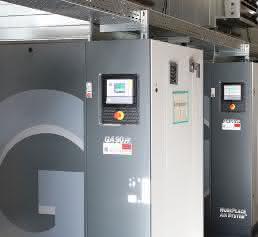
The three GA 90 FF full-load idling compressors run almost around the clock, as the pressing plant operates in three shifts five to six days a week. One of the speed-controlled compressors - type GA 90 VSD FF - is switched on as required via the higher-level ES 16 control system, while the other serves as a redundancy. A refrigeration dryer is installed in all compressors.
"We had good experiences with the compressors and service from Indrutec at our previous station," says Schmidt. "After all, the compressors withstood the poor conditions for years without any unforeseen failures." The new station was therefore planned with the two companies again. In total, there is now 35 kW more available than before to supply the laser welding system, paint shop and assembly with compressed air. Despite this, the electricity bills have fallen.
On the one hand, this is due to the efficiency of the new compressors and the sophisticated control system, but above all to the comprehensive heat recovery system, with which the company utilizes every degree Celsius of compression energy. The Hagen-based company uses the heat from the compressor cooling water in its processes on the one hand and heats the production hall with the warm exhaust air on the other.
Fire protection precautions
Incidentally, TWB has taken precautions in the event of an emergency: Two external smoke detectors are installed in the station; each compressor also has its own smoke detector, and in the event of a fire, the entire station can be separated from the production area in terms of ventilation. An unregulated, older GA 90 compressor from Atlas Copco is located in the cellar below the production area as a reserve compressor. But an emergency is unlikely to occur, as the sheet metal processor has concluded a five-year maintenance contract with Indrutec.
According to documents from Atlas Copco / ee


You might also be interested in
Helu makes its first trade fair appearance under a new brand name
Helu Kabel will be presenting itself as Helu for the first time at Hannover Messe 2026, showcasing system solutions, Heluchain cables and new industrial luminaires.
 read more...
Strategic realignment with brand relaunch
In future, Helukabel will trade as Helu
The Helukabel Group is parting with part of its name: in future, the company will only operate under the Helu brand. With this step, the specialist for electrical connection technology is underlining its strategic development from a classic cable...
read more...Modular plant construction for corrugated board
Insight into the production of corrugators at BHS Corrugated: Automated, modular and equipped with Helukabel components.
read more...Best quality for the steel
Conditions in the steel industry are harsh and inhospitable. The machines used must be able to withstand the demanding environmental conditions in order to deliver the best quality at all times.
read more...If the standard cable is not sufficient
Lapp offers cables for countless applications - but not for all of them. From time to time, the developers have to modify a standard cable or develop a special cable.
read more...Slight decline in sales, strong investments
The Lapp Group has not been spared from the weakening global economy. However, the company only recorded a slight loss in the past 2024 financial year.
read more...Electrical connection technology
Cables and wires for industrial automation
Heukabel offers system solutions for cable routing from a single source. The subsidiary EKD Systems specializes in tailor-made cable drag chains made of steel, stainless steel and plastic, which are used in moving machines and systems as well as in...
read more...Lapp relies on Ultramid from BASF
Mobile charging of electric vehicles
The automotive industry is currently undergoing the biggest transformation in its history. The boom in battery electric vehicles in particular is presenting the industry with major challenges. Lapp, as a supplier of cables and connection...
read more...Cable handling application
At this year's Motek, ArtiMinds Robotics is showcasing a robot-based automation solution for the sensor-assisted assembly of flexible cables in connector housings.
read more...