
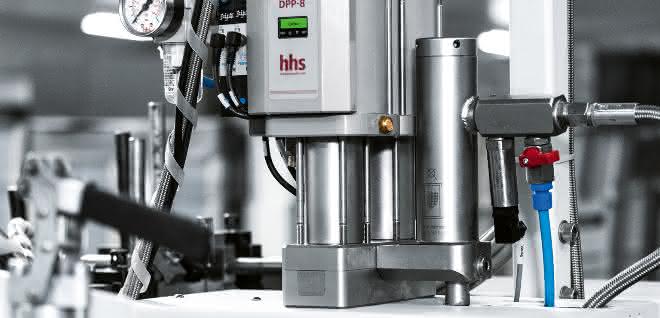
Double piston pump and proportional valve
High-precision gluing of folding boxes
Thanks to their sustainability, cardboard packaging is increasingly replacing plastic packaging. An important production step in the manufacture of folding boxes is the high-precision gluing of cardboard blanks. Baumer hhs specializes in such applications with the DPP double piston pump - supported by the VPPM proportional valve from Festo.
Folding carton gluing machines process carton blanks from a die cutter by folding and gluing them into finished folding cartons. At branded goods or pharmaceutical companies, the folding cartons are later erected and filled in automatic packing machines. Many cartons require various folds in and across the machine's running direction before glue is applied. This prepares them for trouble-free erection.
Speed and precision required
Gluing machines reach speeds of more than 700 m/min and can glue well over 40,000 folding boxes per hour, depending on the size of the packaging. "It is therefore no easy task to apply the adhesive in the right place and in the right quantity," explains Marco Ahler, Technical Manager at Baumer hhs.
Baumer hhs systems ensure millimeter-precise gluing without contact with the blank, even at the highest production speeds. The closed system minimizes cleaning and set-up times. It glues continuously from machine standstill to maximum speed without waste. A modular system consisting of a high-pressure adhesive supply, fast-switching and wear-free electromagnetic application valves and a user-friendly control unit that enables application changes at the touch of a button is used for this purpose.
Power like an eight-cylinder
At the heart of this gluing process is the DPP double piston pump. This pump must provide a defined pressure for the adhesive application. The adhesive application is controlled by air pressure. The pump consists of two single-acting piston pumps, each of which only sucks in liquid on the upstroke and displaces it from the glue cylinder on the downstroke. "You could describe it as a two-cylinder engine with the behavior of an eight-cylinder engine," says Ahler with pride.
The air pressure on the input side is converted into a largely fluctuation-free fluid pressure according to the transmission ratio of the feed pump. This allows the delivery rate to be quickly regulated and adjusted. A pressure sensor on the output side of the DPP pump measures the fluid pressure. A closed-loop control of the pump ensures that automatic readjustment takes place if the actual pressure deviates from the set value.
This is particularly advantageous when the fluid is removed discontinuously. Tests show that the spontaneous pressure drop of the DPP pump when opening a tapping valve is 25 to 50 % lower than with a pump with a downstream material pressure regulator and is intercepted significantly faster and more reliably by the control system. In addition: Critical fluids are less stressed and largely retain their original consistency.
Precision with proportional valve
The DPP piston pump regulates the air inlet pressure instead of the fluid pressure and thus sets the desired fluid pressure. The precise proportional pressure control valve VPPM from Festo controls the air volume on the input side. Its large linear pressure control range is between 0.06 and 6 bar. For a feed pump with a transmission ratio of 8:1, this results in a corresponding, safe fluid pressure control range of 8 to 40 bar. The control starts at 2 bar with minimal loss of control quality.
The advantage of regulating the inlet pressure instead of regulating the fluid pressure on the outlet side is that only as much compressed air is used as the current operating conditions require. The compressed air consumption is proportional to the material pressure. This significantly reduces operating costs on average, especially if the maximum delivery pressure is only rarely required. For Baumer hhs, the matter is clear: "Our designer of the double-piston pump, Maren Pyttel, told me that we could make a lot of changes to the design, but the proportional valve from Festo had to remain part of the pump," explains Ahler.


You might also be interested in
Professional gluing and repairing
The handy Series 3 hot glue guns from Steinel impress with their innovative technology and new design. In addition to the corded Gluematic 3011, the Mobileglue 3011 cordless hot glue gun is suitable for mobile work.
 read more...
Bonding and lubricating - precise dosing
Jet valves from Vieweg lubricate and grease electromechanical switches and bond and seal electronic components. More and more customer-specific solutions are being used.
read more...Cobot-supported automation for everyone
TQ has been offering industry-proven robotics solutions for years. Together with the collaborative robots from Franka Emika, powerful robot-supported automation tools are created for industry, trade and much more.
read more...This is how it becomes a shoe
A young Bavarian company has developed a robot cell for shoe manufacturers using several Schunk quick-change systems.
read more...Efficient and cost-optimized automation of production systems
Hirata offers complete turnkey systems as well as the partial automation of individual production steps: palletizing, assembly, measuring/testing, gluing/potting, laser marking, etc.
read more...Optimum robot programming
Robotics is moving towards simple programming and installation. In practice, there are many alternative methods and approaches.
read more...Efficient and cost-optimized automation of production systems
Hirata offers complete turnkey systems as well as the partial automation of individual production steps: palletizing, assembly, measuring/testing, gluing/potting, laser marking, etc.
read more...Robot technology for railroad applications
Speed into automated production
The completely renewed KR Cybertech nano series from Kuka provides robot technology for railroad applications with high performance in the low payload class.
read more...Cobots are on the right track
Robots in corona times, the acceptance of cobots and the further development of robotics in various environments - Andreas Mühlbauer spoke about these current topics with Dr. Klaus Kluger, General Manager of the Central and Eastern Europe regions at...
read more...