
Covid-19
Robotics industry helps to survive the coronavirus crisis
Robotics and automation specialists are helping to overcome the coronavirus pandemic with new ideas: Robots are retraining for corona test procedures or virtually bringing family members into the care home, and automation specialists are launching respirator mask production.

Robotics, assembly and manufacturing experts are currently converting industrial production lines in a fast-track process. The aim is to help successfully overcome the coronavirus pandemic. New ideas are being implemented in record time: for example, the bottlenecks for face masks are being reduced in-house, test procedures are being made safer or accelerated to robot speed. Wherever possible, the robotics and automation specialists are working to support people with smart machine power.
"Initiatives and new ideas for using automation technology to overcome the coronavirus crisis are coming from all sides. Companies are moving at a breathtaking pace: a strong breeze of entrepreneurial spirit is blowing around our ears right now," says Patrick Schwarzkopf, Managing Director of the VDMA Robotics + Automation Association.
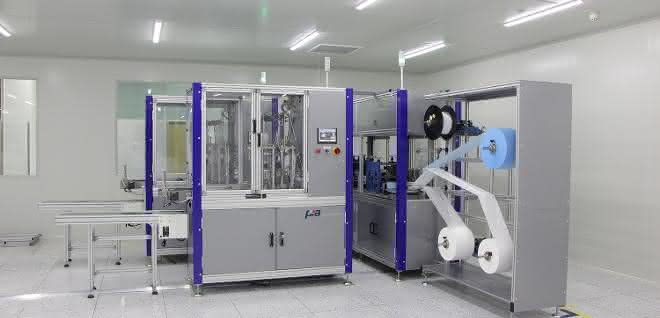
Car assembly builds respiratory protection
These include, for example, the mechanical engineering company Pia Automation from Amberg near Nuremberg. The company normally manufactures fully automated production systems for the automotive industry, but also counts medical technology companies among its customers. Within a few weeks of the outbreak of the crisis, Pia initially put two production lines that had been shut down back into operation at its site in China and converted to the fully automated production of up to 150,000 protective masks per day. With the expertise gained from this pilot project, the Franconian company is now working on numerous follow-up orders and is even manufacturing new assembly lines in Germany for the production of face masks. The first delivery is scheduled for the beginning of May. This will make it possible to produce more than one million face masks per day.
The project is not an isolated case: machine manufacturer Ruhlamat from Marksuhl in Thuringia has developed a production line for disposable surgical masks at enormous speed. The filter material for respiratory protection can be processed flexibly depending on the required safety levels.
Drive-through for corona mass testing
Unlike medical staff, robots are immune to pandemics. A new idea from industrial service provider BoKa Automatisierung from Lower Franconia is taking advantage of this. The fully automated system is reminiscent of the customer experience in a drive-through fast-food restaurant and can be used by any driver for a coronavirus test. Using a tablet, the driver identifies themselves through the side window of their vehicle and a robotic arm hands over the test tube. Video instructions guide the sample collection. The test tube is then automatically taken back. Each test participant is then informed by telephone about the result of a possible coronavirus infection.
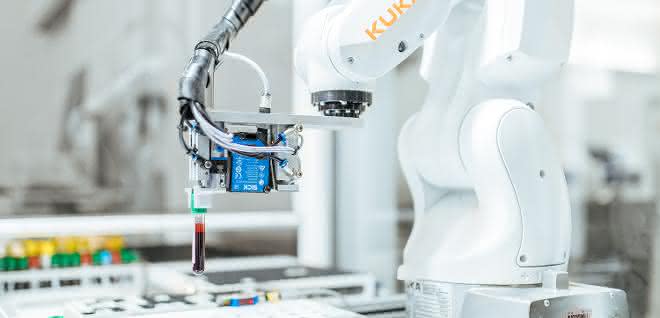
Robot sorts 3,000 blood samples a day
The surge in COVID-19 testing requires numerous blood tests to be carried out. This process is traditionally carried out manually by laboratory technicians in clinics, is very time-consuming and monotonous - making it an ideal process to be automated. Aalborg University Hospital in Denmark already has a laboratory that benefited from automation even before the coronavirus crisis. Every day, up to 3,000 blood samples are carefully sorted by two Kuka robots at the largest hospital in the North Jutland region. The employees are relieved of an enormous amount of work and can concentrate on demanding activities away from the routine.
Robot James helps with visiting bans in retirement homes
RobShare, a Hahn Group Rheinböllen company, helps nursing home residents to keep in touch with family members during visiting bans. James is the name of the friendly communication robot. The robot visits people in the quarantined rooms and simply connects family members via video conference. RobShare offers the robots for rent free of charge. "We don't earn a cent from this campaign, we just have to make sure that we cover most of our own costs," says Konstantin Dick from Hahn. "That's why we've already started looking for sponsors so that the campaign can be offered completely free of charge to the care homes." as


You might also be interested in
Filtration and sound attenuation in circuits
In liquid or air circuits, filter housings and silencers protect measuring devices, ensure particle-free vacuum and pneumatic systems, keep cooling circuits clean and reduce noise.
 read more...
KSS ultrafine filtration for grinding oils
Modular concept for pure oil
In order to grind economically, reliably and with the highest quality, extremely clean grinding oils are required. Filter manufacturer Vomat offers the metalworking industry high-performance and customized concepts for the filtration of cooling...
read more...Up to 95 percent less flue gas thanks to direct extraction
The requirements for occupational safety measures and safety technology are also constantly increasing in welding technology. The Technical Rules for Hazardous Substances (TRGS) stipulate that welding fumes and harmful substances must be extracted...
read more...Everything accurate in switch cabinet construction
To ensure smooth work processes, tools for processing enclosures and housings must function flawlessly and reliably. Häwa rounds off its punching range with the Multi-Press 500.
read more...Cooling and temperature control units
Hygienic packaging sells safely
In few industries are the requirements for hygiene in the production process as strict as in the food sector - the health of consumers has top priority. This results in enormous challenges for all machines and components involved, especially in...
read more...Efficient and sustainable
Rotary screw compressors are the reliable backbone of industrial compressed air generation. The innovative CSD/CSDX series from Kaeser Kompressoren with its numerous features produces them efficiently and saves energy costs. This also reduces theCO2...
read more...Healthy air during welding
Welding produces fumes and gases that are hazardous to health. Extraction is necessary to comply with the occupational exposure limits and is even mandatory when welding high-alloy steels.
read more...Wire mesh filters in medical technology
In hardly any other industrial development sector are the demands placed on products as high as in medical technology. After all, human lives depend on the performance and reliable quality of medical devices.
read more...Energy efficiency and sustainability in the smallest of spaces
With the StingR ultra-fine filter system, Lehmann-UMT has created a solution for the energy-efficient and precise treatment of fluids during tool grinding for extended tool life and high tool quality.
read more...