

Laboratory automation
Kuka robots sort blood samples in hospitals
LT Automation and Intelligent Systems have developed a system for Aalborg University Hospital consisting of a robot system and transport box that automatically checks and sorts blood samples.
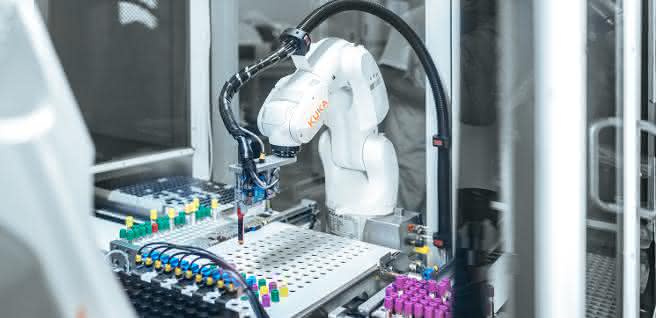
Aalborg University Hospital is the largest hospital in the Danish region of North Jutland. Up to 3,000 blood samples arrive at the laboratory every day. They have to be checked and sorted - a time-consuming and monotonous process that was previously carried out manually. Now the hospital has automated the process: A robot-based system and intelligent transport boxes ensure the quality of the samples - and show how work processes in hospitals can be simplified through automation.
Two local companies were brought in for the implementation: LT Automation designed and implemented the robotic solution. The software developer Intelligent Systems developed the software to monitor the temperature of the blood samples during transportation.
New process relieves employees and optimizes workflows
The manual process used to work like this: Laboratory staff opened the incoming transport boxes, took the blood samples and sorted them for further clinical analysis. Due to the high number of boxes, the hospital staff often complained of tendon and muscle injuries resulting from the repetitive activity. "We wanted to automate this process to reduce the workload for our employees," explains Annebirthe Bo Hansen, Head of Department at Aalborg University Hospital. "We were also looking for a way to better control the quality of the blood samples and their temperature."
Kuka robots and RFID loggers facilitate quality assurance
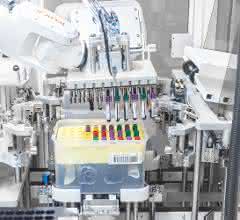
To optimize processes, LT Automation and Intelligent Systems have developed a robot solution and an innovative transport box. Two Kuka robots from the KR Agilus series, one of type KR 3 and one of type KR 10, are installed in the sorting system. "There were several reasons for choosing Kuka robots," explains Lasse Thomsen, CEO at LT Automation: "On the one hand, the robots meet the necessary technical requirements. On the other hand, with their white exterior, they match the look that is expected in a sterile environment." The robots are controlled via the mxAutomation control system. A conveyor belt guides the transport boxes to the robots, which are shielded by Plexiglas walls.
The special feature of the "intelligent transport box" is the integrated RFID data logger, which not only allows the transport route of the individual box to be tracked. The logger also records the temperature inside the box at any given time. A crucial factor, as Annebirthe Bo Hansen explains: "To guarantee the quality of the blood samples, the temperature must be a constant 21 degrees Celsius, plus/minus one degree Celsius." With the introduction of the "intelligent transport box", the hospital was able to determine that this was not always guaranteed in the past. "The new technology has helped us to identify and eliminate sources of error," says Annebirthe Bo Hansen with satisfaction.
Robot automatically sorts incorrectly transported blood samples from
The blood samples travel a long way to the hospital: they are taken from general practitioners' surgeries in the vicinity of the clinic. The doctors place the filled glass tubes in the transparent transport boxes and store them in an appropriate cabinet, which ensures the optimum temperature. On collection, the courier driver scans the boxes so that their route can be tracked. He takes the blood samples to the hospital, where they are scanned and registered on arrival.
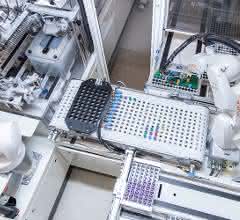
In the laboratory, an employee places the transport boxes on the feed belt of the robot system. At this moment, an RFID scanner mounted in the room reads the data logger. "If the scanner detects that the temperature of a box has deviated from the prescribed temperature at any point during its journey, it automatically sends information to the robot," explains Lasse Thomsen. "The robot ejects the box in question from the system so that it lands on the laboratory employee's workstation." The employee takes a close look at the data stored on the logger and decides whether the blood samples in the box are still usable.
If the data logger does not detect any incorrect temperatures, the first robot opens the box, removes the blood samples and sets them aside for sorting. It then puts the lid back on the box and ejects it so that it can be used for further transportation. Meanwhile, the second robot sorts the unpacked glass tubes according to the color of their lids, which it recognizes using a scanner. The pre-sorted samples are output from the system in such a way that the laboratory employee can carry out the blood test. On average, the system takes 1.5 minutes per box and can process up to forty boxes in an hour.
Process optimization and improvement of the workplace
The new system was tested for the first time in March 2019 and finally went into full operation in August. "We are very satisfied with this solution," sums up Annebirthe Bo Hansen. "It has significantly improved the working environment and processes." The laboratory staff now not only have more time to analyze the blood samples, but also more time for the patients. In addition, automated sorting and permanent monitoring of the temperature in the transport box have reduced potential sources of error. as


You might also be interested in
Sustainability Through Simulation
Digital material selection reduces CO2 emissions by 40 percent
The use of digital material simulations can significantly reduce CO₂ emissions during the development and manufacturing of components. A real-world project by Schunk and Cadfem demonstrates how data-driven material selection can yield savings of up...
 read more...
From ERP System to AI Platform
RNA, based in Aachen, manufactures up to 2,000 custom-designed feeding systems annually and handles all order processing through a central ERP platform.
read more...Cybus Brings in Siemens Executive Stefan Schwab to Lead the Company
The Hamburg-based software provider Cybus will have a dual leadership structure going forward: Stefan Schwab will join co-founder Peter Sorowka as co-CEO.
read more...Artificial Intelligence for the Physical Space
Alibaba Expands Qwen Model Family with a Robotics Suite for Physical AI
Alibaba is expanding its Qwen model family with a robotics suite for Physical AI. The three models—for manipulation, navigation, and simulation—are designed to assist autonomous robots with complex tasks in real-world environments.
read more...5 Challenges for AI Projects in Manufacturing
Manufacturing companies have high hopes for AI. IFS highlights the five most common reasons why AI projects fail.
read more...Implementing Manufacturing Software: 5 Practical Tips
To remain competitive in the market in the future, more and more companies are considering digitizing their CNC manufacturing processes. The right software solutions can make process knowledge transparently accessible and significantly reduce the...
read more...AI automation specialist reorganizes...
Generation change at Insiders Technologies
After almost 30 years at the helm, Werner Weiss is handing over the management of Insiders Technologies. Andree Albrecht takes over the management after a transition phase.
read more...Intelligent brownfield networking
Many industrial companies are struggling with established plant structures and proprietary interfaces. Stefan Klaus' presentation will show in a practical way how brownfield environments can be efficiently networked with open technologies and made...
read more...Factory-X in practice
How can set-up processes in highly variant production be automated efficiently? Markus Benndorff from soffico shows how Factory-X, industrial data rooms and modular architectures create new possibilities for flexible production concepts.
read more...