
Automation
When the robot with the roller pinion
Precise positioning. To optimize robot movements, Mesh equipped a robot transfer system in the medium load capacity range with a roller pinion rack system from Nexen.
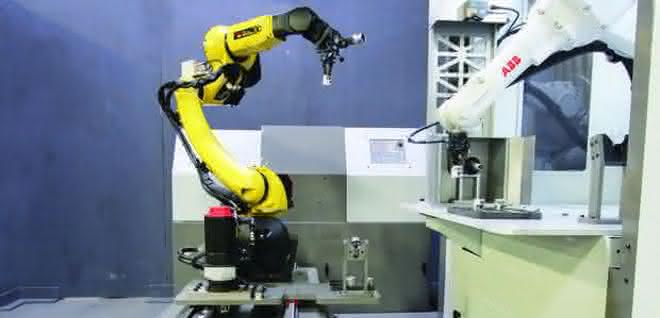
The US company Mesh, based in Dawsonville, Georgia, manufactures customer-specific automation solutions and implements projects of all sizes in the areas of robot production cells, optical inspection systems and system integration. The backbone of the company's systems is a standard range of pre-engineered modules. Mesh uses robots and motion-controlled linear systems to transport raw materials or finished products during manufacturing processes. The systems are often used in dirty environments, such as those found in manufacturing processes like welding and grinding as well as finishing.
The projects also include the implementation of an automation system for welding studs to a sheet metal door. The main challenges here were the formation of weld seams with high tensile strength, the prevention of defects on the back of the door and the maintenance of production speed during the precise positioning of parts.
Six welding guns in the system ensure the tensile strength of the weld seams. Special material was selected to prevent defects on the back. To ensure production speed and positioning accuracy, the designers decided against a six-axis model for this type of system and instead opted to use a Cartesian robot. The achievable speed of the robot is 1.25 meters per second, with a positioning accuracy of around plus/minus 0.075 millimeters. The system has a large working area of 1.2 by 2.4 meters and is suitable for continuous operation in welding environments. Other system features include a mounting plate, linear guides, pneumatic actuators, an illuminated ring and a camera for final assembly inspection.
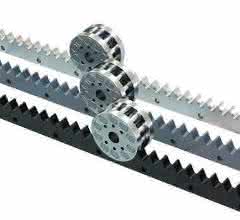
The design of the system focused on how best to manage the movement of the robot within the work envelope. Mesh engineers evaluated a number of rack and pinion and ballscrew systems before turning to their local motion control specialist, Mahx F. Linster (MFL). To optimize robot motion, MFL recommended the use of Nexen's RPS roller pinion rack and pinion system in conjunction with servo motor gear units.
Soon after this project, Mesh developed two modular automation cells (MAC). MAC cells are equipped with either a Cartesian robot (RPS with servo drive) or a six-axis robot as well as manual, semi-automatic or automatic part handling. The frame design allows for easy assembly and repositioning. Other features include built-in LED lighting, a storage facility for tools and aids required in the process and a pneumatic preparation station.
The MiniMAC models have a small Cartesian robot that is operated on a 0.5 or alternatively 0.7 square meter work table and frame. These compact semi-automatic machines are suitable for low throughput applications. Both series are designed for demanding applications for different work processes such as assembly, welding, dispensing, milling, machining, cutting and inspection.
Unlike a conventional rack and pinion system, the RPS has a pinion of ten or twelve needle bearing rollers that engage with the rack profile. The sealed and lubricated rollers move smoothly over the profile and offer zero backlash and 99% efficiency in converting rotary motion into linear motion. The maximum speed is around eleven meters per second and the accuracy is plus/minus 0.03 millimeters. The tooth profile is lubricated with a high-performance light grease during assembly and must be relubricated every six months or after two million pinion revolutions.
"Nexen's application engineering department was extremely professional and flexible, offering a range of solutions and even custom-made products if required," says Mitch Larson, Managing Director of Mesh Automation. "Competitive commercial requirements and the long-term availability of the components were also important to us."
Mesh was able to offer its customers the transfer unit for robots in the medium load capacity range at an attractive and competitive price. The RPS 25 roller pinion rack and pinion system was selected for the majority of applications. Thanks to Nexen's product line and design options, the robot transfer units can easily be designed higher. The system can also be designed for lengths up to twelve meters. It can accommodate robot motors from all manufacturers and has configurable options such as line covers, self-lubrication, system-integrated continuous reloading, welding power supply unit and buffer storage for semi-finished products. as


You might also be interested in
In-house exhibition Bielefeld 2026
How DMG Mori thinks about the factory of the future
DMG Mori will be showcasing turning and milling expertise, automation solutions and additive manufacturing along the Machining Transformation (MX) at the Bielefeld 2026 in-house exhibition.
 read more...
Up to 50 percent higher cutting speeds
The current market situation is putting pressure on companies that rely on carbide tools: Rising raw material costs, volatile supply chains and limited predictability are putting pressure on the industry. Fette Werkzeugtechnik, a member of the LMT...
read more...A robot for all occasions
Industrial robots take on many tasks. Even milling with accuracies in the sub-millimeter range is now possible.
read more...High metal removal rate for high maneuverability
Large module gears for ship drives place high demands on machining. Switching from skiving to 5-axis simultaneous milling with high-feed tools considerably shortens the roughing process. Process parameters and a well thought-out tool selection are...
read more...Schunk shows flexible systems for electronics production
Schunk Electronic Solutions will be exhibiting modular, flexible systems for electronics production at Productronica 2025 - from stand-alone depaneling systems to fully integrated inline solutions.
read more...Hydraulic 4-jaw chuck for automated workpiece clamping
HWR Spanntechnik presents a hydraulically actuated 4-jaw chuck for automated workpiece changing. The clamping device is designed to enable short set-up times, precise clamping and high productivity in automation.
read more...Corner, face and plunge milling
Paul Horn is expanding the DA milling system for corner, face and plunge milling. With the DA65 variant, the system offers a larger cutting insert compared to the existing DA62.
read more...World premieres at the EMO 2025
From September 22 to 26, 2025, Grob will be presenting several innovations at EMO Hannover. The focus of the trade fair appearance will be on the latest 4- and 5-axis universal machining centers and the associated automation solutions.
read more...Flexible and efficient processing
New high-performance CNC series
Fanuc's presentation at EMO will focus on the new FS500i-A CNC series. The new CNC generation offers high user-friendliness, process optimization as well as digital and network technologies.
read more...