
Ability Connected Services
Everything under control
Predictive maintenance. Automotive supplier Koki benefits from ABB's Ability Connected Services. The proactive service portfolio provides information about impending problems at an early stage, inspection and maintenance can be organized more effectively and disruptions to the robots used have been reduced by 25 percent.
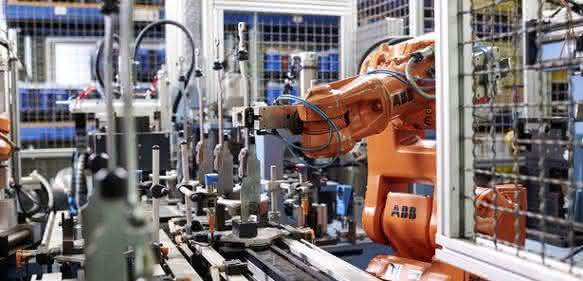
A significant increase in efficiency and reduced costs at the same time: this is the positive result of the global automotive supplier Koki's use of ABB Ability Connected Services. Thanks to ABB's predictive, proactive services, the specialist for switching systems can reduce faults in the robots used in its production by up to 25 percent and response times by 60 percent.
Koki is a production company and supplier for well-known national and international car manufacturers. In order to maintain its leading market position, Koki is constantly scrutinizing every detail of its production arrangements and manufacturing processes. The company's culture of improvement also prompted it to rely on Ability Connected Services in its search for optimized maintenance solutions. "When we are audited by car manufacturers, we are always asked how we can guarantee the safety of the systems. Maintenance, monitoring, service and support for robots play an important role here and are often included in the decision," says Sven Sparmann, Site Manager Maintenance, Repair and Overhaul at Koki.
ABB Ability Connected Services are a further development of the Remote Services for robots. The service portfolio contains five building blocks that are tailored to the individual needs of each customer with flexible robot care service agreements: Condition Monitoring & Diagnostics, Backup Management, Remote Access, Fleet Assessment and Asset Optimization.
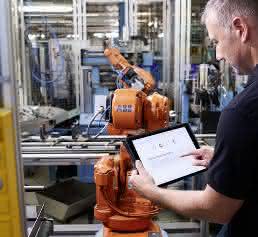
Around 60 robots at Koki now benefit from the networked ecosystem. The data obtained as part of Ability Connected Services can be used to make ABB's annual inspection and maintenance more effective. In addition, the available live data means that even ad-hoc repair work can be planned more quickly and in a more targeted manner. This allows all ongoing activities to be prioritized so that the most important customer processes remain available at all times. "We are informed of impending problems in advance: Fault detection allows us to make adjustments during non-production time without having to interrupt the manufacturing process," reports maintenance specialist Sven Sparmann.
To avoid unnecessary production downtimes, all important information about the networked robots can be viewed by both the user and the ABB service team at any time on an alarm dashboard. Numerous filter options, detailed reports and other helpful features are also available on the secure Myrobot homepage.
"Remote access allows us to see immediately whether it is a robot error or whether other components in the system are critical. We can avoid unnecessary service calls, help customers solve problems more quickly and thus also save costs," explains Andre Dehlan, Area Sales Manager Customer Service at ABB Robotics. This proactive remote service is supplemented by classic support via a 24-hour telephone helpline or on-site support.
Before all robots were connected, the Ability Connected Services were tested on a selected robot. A system that had already caused problems in the past was selected for this at the Glauchau site. "The test phase showed us that Ability Connected Services are a very helpful way of preventing impending system and component failures," explains Sven Sparmann. "It is clear to us that all new robots - including those at the international sites - will be connected to Ability Connected Services."
"Better performance and higher availability of robots are a direct result of the digitalization of the factory. Not only are more services being digitized or provided digitally, but they are also being made available via digital channels," emphasizes Jörg Rommelfanger, Global Product Manager at ABB Robotics. On the MyABB portal, customers can find information on spare parts, technical documentation, performance status reports, device lifecycles, maintenance recommendations and service contracts. "Thanks to these digital tools, a previously reactive approach to robot inventory maintenance is being replaced by a predictive and proactive approach," adds Andre Dehlan. as


You might also be interested in
Filtration and sound attenuation in circuits
In liquid or air circuits, filter housings and silencers protect measuring devices, ensure particle-free vacuum and pneumatic systems, keep cooling circuits clean and reduce noise.
 read more...
KSS ultrafine filtration for grinding oils
Modular concept for pure oil
In order to grind economically, reliably and with the highest quality, extremely clean grinding oils are required. Filter manufacturer Vomat offers the metalworking industry high-performance and customized concepts for the filtration of cooling...
read more...Up to 95 percent less flue gas thanks to direct extraction
The requirements for occupational safety measures and safety technology are also constantly increasing in welding technology. The Technical Rules for Hazardous Substances (TRGS) stipulate that welding fumes and harmful substances must be extracted...
read more...Everything accurate in switch cabinet construction
To ensure smooth work processes, tools for processing enclosures and housings must function flawlessly and reliably. Häwa rounds off its punching range with the Multi-Press 500.
read more...Cooling and temperature control units
Hygienic packaging sells safely
In few industries are the requirements for hygiene in the production process as strict as in the food sector - the health of consumers has top priority. This results in enormous challenges for all machines and components involved, especially in...
read more...Efficient and sustainable
Rotary screw compressors are the reliable backbone of industrial compressed air generation. The innovative CSD/CSDX series from Kaeser Kompressoren with its numerous features produces them efficiently and saves energy costs. This also reduces theCO2...
read more...Healthy air during welding
Welding produces fumes and gases that are hazardous to health. Extraction is necessary to comply with the occupational exposure limits and is even mandatory when welding high-alloy steels.
read more...Wire mesh filters in medical technology
In hardly any other industrial development sector are the demands placed on products as high as in medical technology. After all, human lives depend on the performance and reliable quality of medical devices.
read more...Energy efficiency and sustainability in the smallest of spaces
With the StingR ultra-fine filter system, Lehmann-UMT has created a solution for the energy-efficient and precise treatment of fluids during tool grinding for extended tool life and high tool quality.
read more...