

Robot cell for automated grinding
Automated grinding of turbine blades
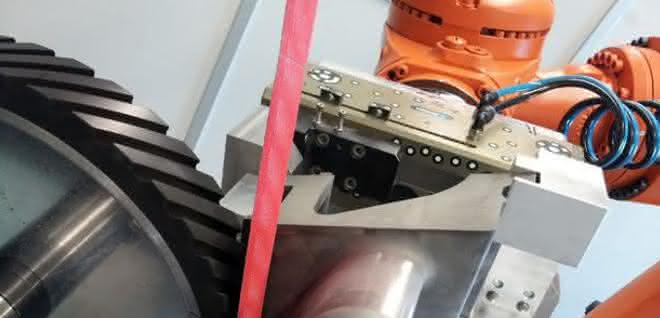
Experts expect demand for components such as turbine and compressor blades to increase in the coming years. This is particularly true in the aviation industry. There is still a demand for weight reduction and an increase in combustion temperature. The components are manufactured from new types of high-performance materials such as titanium aluminides or nickel-based alloys and are produced using a casting process.
Until now, employees have corrected shape deviations in the turbine blade profile manually after production, but this is extremely time-consuming. Stable processes such as milling are out of the question due to the material. Manual reworking is not only strenuous, but also endangers the health of the employees, as grinding high-temperature-resistant turbine blades made of nickel-based alloys such as Inconel 738 produces carcinogenic dust. The development of a robot solution was intended to minimize the impact on employees' health in the long term. In addition, the aim was to improve economic efficiency and process stability through automation.
The research project
The TurboERAS research project has succeeded in developing a prototype robot cell for the automated grinding of cast turbine blades. In addition to SHL AG and the Fraunhofer IPT, ModuleWorks from Aachen, Doncasters Precision Castings-Bochum and Carl Zeiss Optotechnik from Pilsting in Bavaria were on board the project, which was funded by the German Federal Ministry of Education and Research (BMBF). The challenges were clearly defined: The complexity of adaptive machining requires rapid acquisition of the actual geometry and reliable analysis of blade position and form deviations from the target geometry. In addition, the 6-axis production paths had to be created automatically. Carl Zeiss Optotechnik contributed hardware and software components for the optical 3D measurement technology, while ModuleWorks supplied CAM software for efficient programming and subsequent precise, unmanned machining. The suitability of the TurboERAS system was tested on blades produced by the end user Doncasters Precision. The Fraunhofer IPT supported the consortium by developing grinding process and correction algorithms.
Safe clamping on the robot flange
Processing in the cell is workpiece-guided. A Kuka industrial robot first brings the component to a permanently installed 3D measuring system from Carl Zeiss Optotechnik. It then guides the blade to the FKS 250/450 free belt and contact roller grinding machine from SHL for grinding. Any dust produced is immediately extracted. The robot controller regulates the sanding process via the belt and feed speed as well as the contact pressure. The system, which is specially designed for the blade geometry, enables secure clamping on the robot flange. However, due to existing shape deviations on the clamping surfaces of the cast component, this is not reproducible. The blade is therefore referenced using 3D measurement technology.
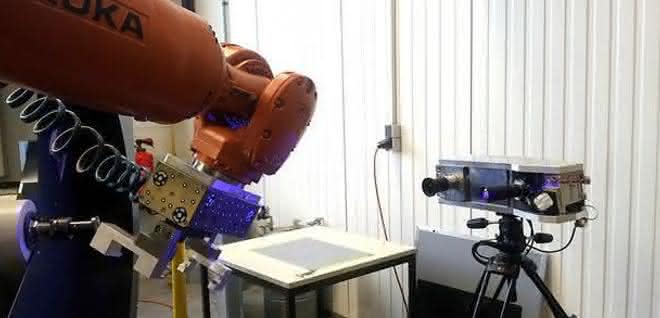
Component measurement is carried out using fringe light projection. This creates three-dimensional images by taking pictures from several directions. Carl Zeiss Optotechnik developed a special system configuration for this purpose. The measurement data is processed using software by automatically combining the 3D point clouds of the individual measurements and transforming them into a triangular mesh. Evaluation software is then used to compare the data with the CAD model of the blade. Deviations are visualized in colour.
To meet the required shape accuracy of the turbine blade, ModuleWorks developed a CAM solution tailored to adaptive grinding. A basic framework was implemented with which the appropriate paths along the blade can be programmed based on a CAD file of the blade. An important component of the CAM software is collision control, which takes the geometry of the pressure wheel and the grinding belt into account during path planning. Among other things, this ensures that the base and the cover belt of the blade do not come into contact with the tool during the process.
Robot-assisted, adaptive sanding
By successfully combining the system components of the robot cell, CAM technology, 3D measurement technology and process technology, the participants in the TurboERAS project have succeeded in creating the prerequisites for robot-supported, adaptive grinding of turbine blades for the first time. The process is reproducible and reliable, from clamping the component to optical measurement and machining. It is economical thanks to adequate CAM path planning and synchronization with the robot and the free belt and contact roller grinding machine from SHL. The individual processes can be transferred to an automated system at any time. SHL has already developed a corresponding concept for industrial applications.
According to documents from SHL AG


You might also be interested in
In-house exhibition Bielefeld 2026
How DMG Mori thinks about the factory of the future
DMG Mori will be showcasing turning and milling expertise, automation solutions and additive manufacturing along the Machining Transformation (MX) at the Bielefeld 2026 in-house exhibition.
 read more...
Up to 50 percent higher cutting speeds
The current market situation is putting pressure on companies that rely on carbide tools: Rising raw material costs, volatile supply chains and limited predictability are putting pressure on the industry. Fette Werkzeugtechnik, a member of the LMT...
read more...A robot for all occasions
Industrial robots take on many tasks. Even milling with accuracies in the sub-millimeter range is now possible.
read more...High metal removal rate for high maneuverability
Large module gears for ship drives place high demands on machining. Switching from skiving to 5-axis simultaneous milling with high-feed tools considerably shortens the roughing process. Process parameters and a well thought-out tool selection are...
read more...Schunk shows flexible systems for electronics production
Schunk Electronic Solutions will be exhibiting modular, flexible systems for electronics production at Productronica 2025 - from stand-alone depaneling systems to fully integrated inline solutions.
read more...Hydraulic 4-jaw chuck for automated workpiece clamping
HWR Spanntechnik presents a hydraulically actuated 4-jaw chuck for automated workpiece changing. The clamping device is designed to enable short set-up times, precise clamping and high productivity in automation.
read more...Corner, face and plunge milling
Paul Horn is expanding the DA milling system for corner, face and plunge milling. With the DA65 variant, the system offers a larger cutting insert compared to the existing DA62.
read more...World premieres at the EMO 2025
From September 22 to 26, 2025, Grob will be presenting several innovations at EMO Hannover. The focus of the trade fair appearance will be on the latest 4- and 5-axis universal machining centers and the associated automation solutions.
read more...Flexible and efficient processing
New high-performance CNC series
Fanuc's presentation at EMO will focus on the new FS500i-A CNC series. The new CNC generation offers high user-friendliness, process optimization as well as digital and network technologies.
read more...