
Solid carbide tools
Partner for tools
While searching for reliable solid carbide tools, a machining service provider and manufacturer of clamping fixtures came across Mapal tools. As a result, a reliable partnership has developed.
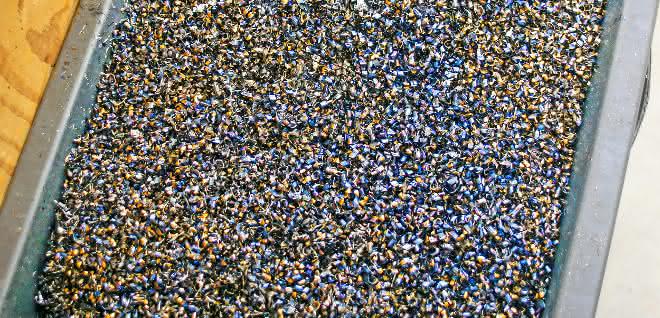
Start-ups in the machining services sector have to assert themselves against tough competition. They cannot afford to waste money on procurement. This is also the case for Bonertz Technik from Föhren, which was founded in 2014 and has now made the leap from a pure service provider to a manufacturer of innovative clamping devices for use in machine tools. When purchasing cutting tools, the company focuses primarily on performance, process reliability and good support. "When we founded the company in 2014, we only had one CNC machine and initially worked purely as a machining service provider," recalls Managing Director Robert Bonertz. The company gradually specialized more and more in demanding tasks. Bonertz Technik deals with materials that are difficult to machine - special alloys, high-strength steels up to 1,100 N/mm2 or super-hard materials with up to 60 HRC. Components that require complex clamping are also a specialty of Bonertz Technik. Examples of this are filigree structures that have to be machined out of solid material with a high proportion of machining. Satisfied customers enable the company to grow rapidly. Today there are four modern, high-precision 3- and 5-axis milling centers in the production area. The necessary infrastructure in areas such as work preparation, CAD/CAM programming and quality assurance is also in place.
Development of advanced clamping technology
"With many machining tasks, we were always annoyed by the inadequacies of the available clamping technology for clamping the components," recalls Managing Director Patrick Vilfan. This was particularly evident when the components to be machined had to be re-clamped due to frequent product changes. Due to the cumbersome handling, this took far too much time, which was detrimental to productivity. In addition, some of the clamping devices were very bulky and created interfering contours that hindered the machining process. Another disadvantage of the conventional clamping devices was their height, which limited the available travel in the Z direction.
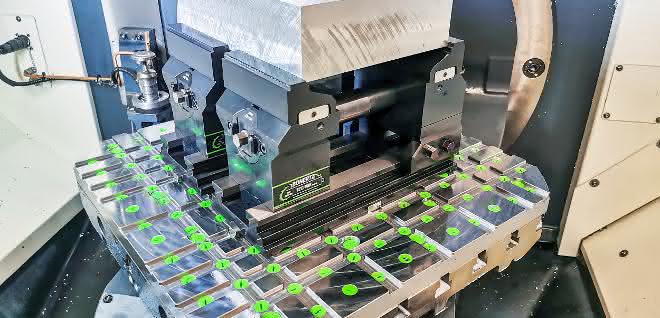
For this reason, those responsible at Bonertz Technik decided to produce better clamping devices. And not just for their own use, but also for marketing. Over time, various versions of 5-axis clamps and an innovative machine table were developed as an alternative to costly zero-point clamping systems.
Practicality in the foreground
"Practical considerations were at the forefront of our developments," explains Vilfan. In addition to high clamping force, an important feature was extensive modularity in the design. Depending on the design length, the base rails are equipped with a variety of interfaces to the machine table. The clamping range can be easily extended from 10 to 1,335 mm using intermediate pieces without any loss of clamping force. The maximum clamping force is 50 kN. The jaws, which are available in a wide range of variants, can be replaced without tools in just a few seconds. In practical use, the systems have resulted in set-up time savings of up to 90 percent. The developers paid particular attention to avoiding interfering contours. This is why the clamps are also available in several height variants between 130 and 210 mm.
"The contact with Bonertz Technik came about by chance a few years ago because they were a contract manufacturer machining components for one of our subsidiaries," recalls Klaus-Dieter Leick, application engineer at Mapal. He came into contact with Bonertz when they were having problems machining high-strength tool steels with trochoidal milling cutters from a competitor.
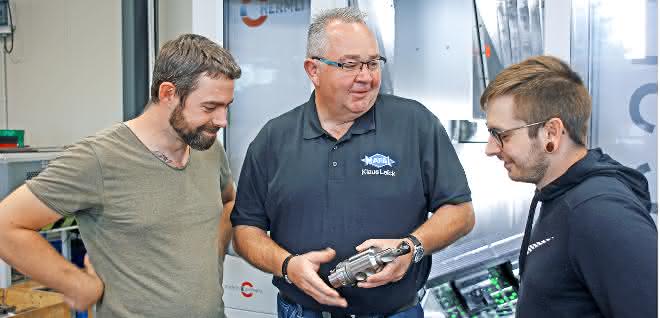
Specifically, the project involved solid carbide milling cutters for cutting depths of up to 3×D with diameters of 8 to 14 mm, the use of which revealed that the cutting forces were significantly too high in relation to the chip volume. "The resulting overloading of the spindle was clearly audible from the machine noise and could also be seen on the load diagrams of the control system," says Robert Bonertz. As a result, Klaus-Dieter Leick provided him with some Mapal solid carbide milling cutters to test the corresponding machining operations. The results were convincing.
"Thanks to the milling cutters from Mapal, the overload problems are now a thing of the past. In addition, the tool life has increased significantly - by up to 30 percent for some tasks," says Bonertz happily. Since then, the managing director has been aware of the performance of Mapal's standard tools. Bonertz Technik primarily requires solid carbide tools for steel machining, including milling cutters for roughing and finishing, trochoidal milling cutters, drills and deep drills as well as replaceable head systems for drilling and milling. Bonertz Technik mainly uses milling cutters in the diameter range from 2 to 20 mm and drills in the diameter range from 1.2 to 20 mm.
"After the first successful applications, we gradually used more and more tools from the Mapal portfolio," says Bonertz. After the trochoidal milling cutters, the company tested solid carbide milling cutters for finishing its clamping systems. The previously used tool had surface defects due to chatter marks. The tools from Mapal were convincing due to their better cutting behavior and the resulting surfaces.
"The process reliability that tools offer us is a very important aspect for us," explains Bonertz. Only then can the employee leave the system running after set-up and devote himself to other tasks without having to worry about interruptions or even damage in the meantime. The tools from Mapal are also excellent in this respect, confirms Bonertz. The managing directors are not only convinced by the technical factors - the economic aspects also play a role, of course: "We use replaceable head systems wherever possible." Different interchangeable heads can be used with just one holder. An interchangeable head is significantly cheaper than a corresponding complete tool including holder. "For the reasons mentioned above - quality, performance, process reliability and cost-effectiveness - around 80 percent of the solid carbide tools we use today come from Mapal," says Bonertz.
Convincing advice and support
"At Mapal, the quality of the advice and support matches the performance of the tools," says Patrick Vilfan. This is because support from the sales force is also an important aspect for Bonertz Technik. Klaus-Dieter Leick maintains constant contact and provides samples for testing when new requirements arise or when interesting new products are available. Mapal also takes the initiative, for example when a certain product from the standard range is not immediately available from stock. "In such cases, we immediately receive alternative suggestions for similar tools that can also be used to achieve the desired machining result," says Vilfan. This support has also contributed to Mapal becoming a preferred contact for new tasks.


You might also be interested in
Cutting solutions in 2D and 3D
Microstep showed 2D and 3D cutting solutions in action on sheet metal, tubes, profiles and container bases, including bevel cutting with plasma or waterjet and dynamic fiber laser cutting, as well as drilling, milling and marking demonstrations.
 read more...
Precision machining of bores
Paul Horn is presenting an innovative extension for the Supermini system in the field of ultra-fine machining at EMO 2023. The system has been supplemented by a variant with an ultra-fine ground cutting surface.
read more...Deep drill holes optimized with PCD
When the Schlote Group built a new plant in Harzgerode in 2017, production was geared towards series production of a single component right from the start.
read more...Production goes digital
EMO, the world's leading trade fair for production technology, invites the industry to Hanover from September 18 to 23.
read more...Vibration-free groove turning process
Adjustable damped boring bar
Paul Horn is exhibiting innovations and product enhancements at the EMO in Hanover. Among other things, the company is exhibiting a boring bar that can be adjusted to the vibration amplitudes that occur.
read more...Efficiency with digital twins
Digitalization and automation are the way to increase efficiency and flexibility in machining. The Tebis team will be presenting suitable solutions for mechanical engineering at EMO.
read more...Many highlights in Leipzig
Ceratizit will be presenting the highlights from its portfolio at Intec. In addition to the latest tools for milling, turning and drilling, automation solutions will also be a top topic at the tool manufacturer's stand.
read more...How smart robot simulation works
More intelligent, more efficient, easier to operate - robots are developing rapidly. Among other things, great care is required when setting them up and operating them in order to avoid cost-intensive downtimes. Robot simulation tools are...
read more...Milling, turning and grinding center
Milling, turning, grinding and gear cutting on one and the same machine - in a single clamping operation: Soraluce's multitasking machines are the answer to technically complex workpieces with tight tolerances that require various machining...
read more...