

Machining
New tasks for high-feed milling
Efficient production with short machining times - companies in the machining industry achieve this goal with high-feed milling.
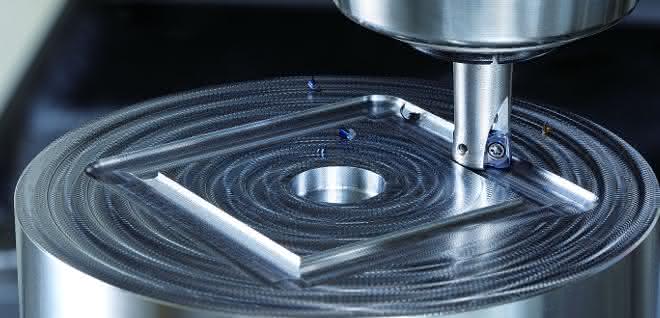
Steel and cast iron can be machined as well as heat-resistant alloys. With further developed indexable inserts and optimized coolant routing, machining can be accelerated even further.
High feed rates and shallow cutting depths - these properties characterize high-feed milling. This machining process was developed in the 1990s and was initially used for roughing pockets and cavities.
However, the process has now also become established for face milling and other variants. This is because high-feed machining is an effective method for increasing productivity, as it enables a high level of material removal within a short period of time.
Higher tooth feed
The machining method is based on the principle of thin and wide chips. These are produced by the flat approach angle of the indexable inserts of 9 to 17°. While the chip thickness (h) for a tool with an approach angle of 90° is just as large as the tooth feed (Fz), it is reduced with a smaller approach angle.
An example: If the chip thickness is 0.2 mm and the tooth feed is 0.2 mm/tooth at a 90° approach angle, the chip thickness is reduced to 0.178 mm at 45° and the tooth feed remains the same. If the setting angle is reduced to 15°, the feed rate can be increased from the previous 0.2 mm/tooth to 1.27 mm/tooth to achieve a chip thickness of 0.178 mm.
With such a drastic increase in the tooth feed rate by a factor of six, the machining time is reduced accordingly. In general, the metal removal rate for high-feed milling can usually be increased by a factor of two to three compared to corner milling.
Deflection of cutting forces
Another advantage of high-feed milling is the low load on the cutting edges. In general, increasing the cutting speed and feed rate during milling leads to higher cutting values. The service life of the indexable inserts decreases. High-feed milling, on the other hand, extends tool life by increasing the feed rate at relatively low speeds. The cutting forces are mainly applied axially in the direction of the spindle, which minimizes the tendency to vibrate.
Back in 1990, Tungaloy was one of the first developers in high-feed milling to launch the TXP series onto the market. This high-feed system was characterized by different insert sizes and an insert geometry with three cutting edges. As the demand for multi-edge inserts increased steadily, Tungaloy developed the DoFeed milling cutter with a negative four-edged insert in 2010. Since then, the high-feed milling cutter has been continuously expanded with new chip forming stages, cutting materials, coatings, additional tools and innovative clamping concepts. One of the outstanding features is the installation position of the indexable insert in the carrier. This means that two of the four cutting edges are permanently protected and therefore do not come into contact with chips during the cutting process. The geometry of the cutting edge also leads to a plus in terms of tool life.
Optimum chip removal
The DoFeed series is characterized by reliable chip removal. A large angle of inclination on the cutting edge ensures reliable chip flow. The optimized coolant jet guidance prevents chip compaction. The holder is available in different versions: on the one hand with centered coolant supply for milling deep pockets, blind holes and cavities, on the other hand with coolant supply to the cutting edge tip, for example for shoulder milling operations. If the coolant is supplied directly to the cutting edge, the cutting heat generated can be reduced and built-up edges can be avoided. The result: more uniform chips of perfect length, a significant increase in tool life and more stable processes, even when milling difficult materials.
The new AH3225 multi-layer coating is a PVD coating to protect the indexable insert. Three layers are applied to a carbide substrate to ensure optimum cutting edge integrity and prevent wear, oxidation, edge chipping and the formation of built-up edges. The special composition of the indexable insert increases tool life.
The products in the DoFeed series can be used very flexibly. Different machining operations such as face, corner, shoulder, pocket, ramp and circular drilling are possible. In addition, tool costs can be saved as the tool can also be used for drilling. High-feed milling cutters are not only suitable for roughing, but also for finishing components when using a wiper cutter. This means that no additional tool is required and there is no need to change tools. Another advantage is the ability to work close to the final contour. This means that the process is also perfect for 3D machining, where material is removed three-dimensionally at shallow cutting depths.
Molds and machine parts
The high-feed milling cutters from Tungaloy are suitable for machining casting molds and producing mold bases, flanges, machine parts, turbine blades, gear wheels and much more. DoFeed can also be used in less powerful machines due to its low cutting forces. The tool scores with high feed rates of up to 20 m per minute, greatly reduced machining times and maximum tool life. The double-sided indexable insert ensures maximum process reliability and efficiency. For these reasons, the high-feed milling cutter is of interest to numerous industries - starting with tool and mold making, which places high demands on contour machining.
In some cases, the finishing process can be connected directly, as semi-finishing processes are no longer necessary due to the close contour machining. Tungaloy's high-feed milling cutters are also suitable for the energy-generating industry, as they operate vibration-free even with long overhang lengths. Complex components can be manufactured with high metal removal rates.
In the aerospace industry, many components are manufactured from hard materials such as precipitation-hardened stainless steel or titanium alloys. Due to its properties, the high-feed milling cutter is also perfectly suited to these demanding manufacturing processes. By using special indexable inserts with a sharp chip breaker, it is not uncommon to achieve an increase in production rates of over 250 %.


You might also be interested in
In-house exhibition Bielefeld 2026
How DMG Mori thinks about the factory of the future
DMG Mori will be showcasing turning and milling expertise, automation solutions and additive manufacturing along the Machining Transformation (MX) at the Bielefeld 2026 in-house exhibition.
 read more...
Up to 50 percent higher cutting speeds
The current market situation is putting pressure on companies that rely on carbide tools: Rising raw material costs, volatile supply chains and limited predictability are putting pressure on the industry. Fette Werkzeugtechnik, a member of the LMT...
read more...A robot for all occasions
Industrial robots take on many tasks. Even milling with accuracies in the sub-millimeter range is now possible.
read more...High metal removal rate for high maneuverability
Large module gears for ship drives place high demands on machining. Switching from skiving to 5-axis simultaneous milling with high-feed tools considerably shortens the roughing process. Process parameters and a well thought-out tool selection are...
read more...Schunk shows flexible systems for electronics production
Schunk Electronic Solutions will be exhibiting modular, flexible systems for electronics production at Productronica 2025 - from stand-alone depaneling systems to fully integrated inline solutions.
read more...Hydraulic 4-jaw chuck for automated workpiece clamping
HWR Spanntechnik presents a hydraulically actuated 4-jaw chuck for automated workpiece changing. The clamping device is designed to enable short set-up times, precise clamping and high productivity in automation.
read more...Corner, face and plunge milling
Paul Horn is expanding the DA milling system for corner, face and plunge milling. With the DA65 variant, the system offers a larger cutting insert compared to the existing DA62.
read more...World premieres at the EMO 2025
From September 22 to 26, 2025, Grob will be presenting several innovations at EMO Hannover. The focus of the trade fair appearance will be on the latest 4- and 5-axis universal machining centers and the associated automation solutions.
read more...Flexible and efficient processing
New high-performance CNC series
Fanuc's presentation at EMO will focus on the new FS500i-A CNC series. The new CNC generation offers high user-friendliness, process optimization as well as digital and network technologies.
read more...