
Coating of precision tools
Tool coating in composite design
Coatings improve the performance of tools and are therefore essential in toolmaking. However, the trend is moving away from pure material refurbishment through coating towards application- and coating-oriented composite design. By Georg Erkens
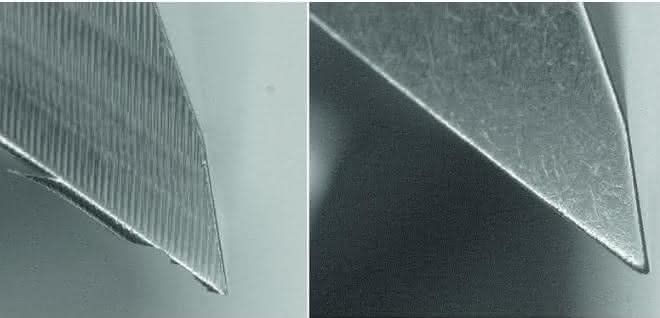
In the interplay between wear resistance and toughness, increasing demands on tool surfaces have shown the limits of material development, so that an additional element had to bring about a breakthrough: the so-called hard coating. Such "excellence coatings" are essential for modern tools and components to be used at their performance limits. However, to exploit the full potential of a coating, you have to look deeper: Targeted microstructuring of, for example, a cutting edge, i.e. adapting the shape to suit the intended application (form follows function), allows existing solutions to be aligned more specifically with requirements and raised to a higher performance level. We are currently at the beginning of a paradigm shift - away from pure material refurbishment through coating and towards application and coating-oriented composite design.
Tasks of a tool coating
Multifunctional coatings increase the service life, productivity and functional reliability of tools and components in a wide range of industrial sectors. They owe their development to the objective of maximum wear resistance in combination with maximum toughness. However, due to the ever-increasing demands on surfaces in tribocontact, this goal could not be achieved by material development alone. A composite body consisting of a design-optimized substrate and a plasma coating was and is the solution for many applications. If a material meets certain requirements for reasons of production, strength, rigidity or cost, but the stresses occurring overtax its natural surface, it must be coated. While this realization has meant that the coating was previously seen more as a vehicle for restoring the base material, the focus today and in the future is on the optimized combination of precision tool and component and coating. In addition to the coating-compatible design of the tool or component, a key aspect here is the surface quality and structuring as well as the design of the microgeometry prior to the actual coating. A wide range of process variants such as drag grinding, stream finishing, microblasting, wet blasting and nano machining - all using a wide variety of media - are available for the application-specific preparation of the tools to be coated, whether they are made of carbide, HSS or c-BN, for example. Just like classic polishing, line polishing or electropolishing, especially for components and molds.
By understanding the most important interactions and their effect on the cutting system, the performance of a precision tool can be specifically adjusted for the cutting task by means of adequate edge preparation, for example. [1]
In addition to carbides, the cutting material HSS is still highly relevant in industry. Even though the optimization of tools in the last two decades has been almost exclusively in the area of carbide and other high-hardness cutting materials, the adaptation of the microgeometry and coating of HSS tools is equally relevant. By optimizing the microgeometry and surface structure in combination with multifunctional MpC coatings (Multipurpose Coating), a significant increase in productivity can also be achieved for milling cutters made of high-performance high-speed steel.
Multitalented Multipurpose Coating (MpC)
The area of precision tools for high-performance machining must be seen as a pacemaker in the design and production engineering system consideration through to coating. Material selection, micro-geometry and surface structure with regard to coating and application are already taken into account when designing the tools. In the high-performance sector, hardly any tools are used that are not geometry- and surface-optimized and coated.
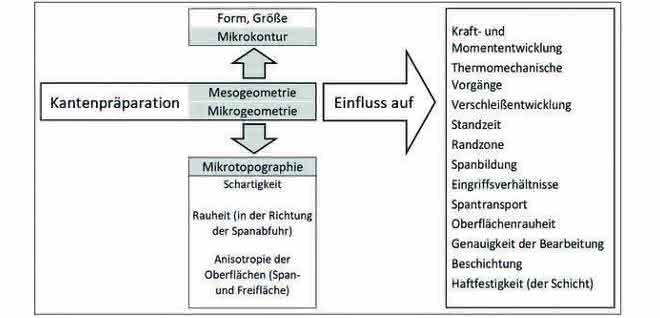
In line with this holistic approach, Surcoatec Deutschland, coating experts from Düren, have developed multipurpose coatings (MpC). These intelligent and self-adapting coatings are versatile, multi-alloyed and nano-structured. Thanks to their adaptive character, they are ideally suited to the requirements of different applications. They score points for their high temperature and phase stability, low thermal conductivity, high hardness combined with good toughness and low coefficients of friction. The specific production process and the unique concept are based on a phase mixture and the nano-structured layer design. This allows the adaptive and therefore multifunctional character of the coatings to be specifically adjusted.
As all-rounders, they are widely used for machining unalloyed, alloyed, stainless and high-strength steels, but also for so-called "exotic" difficult-to-machine materials such as Ni-based or Ti alloys. They can be fine-tuned for machining aluminum, non-ferrous metals and stainless steels by micro-alloying. Intelligent tool concepts consisting of coordinated micro-geometry, surface structuring and adaptive MpC coating therefore offer equally powerful solutions for these materials with a high tendency to adhere. The multifunctional use of tools makes it possible to streamline production processes and reduce the number of variants.
Customized tetrahedral amorphous carbon layers (ta-C)
The use of lightweight materials such as aluminum and composite materials is increasingly becoming the focus of production. Where classic hard material coatings are not sufficient and diamond coatings are actually "overdressed" or unsuitable for the tool materials, the ta-C coating, a tetrahedrally coordinated, hydrogen-free amorphous DLC (Diamond-Like Carbon) coating, fills the gap.
Due to the combination of high resistance to abrasion and low adhesion tendency, ta-C coatings are recommended for machining, for example, aircraft aluminum (AlZn5.5MgCu with high strength), soft aluminum with a tendency to adhere, highly abrasive aluminum alloys with a high Si content and composite materials. The micrometer-thin ta-C coatings adapt to the given tool contour and impress the user with their dimensional accuracy, integrity and precision. Sharp cutting edges of cutting tools are coated evenly and reliably.
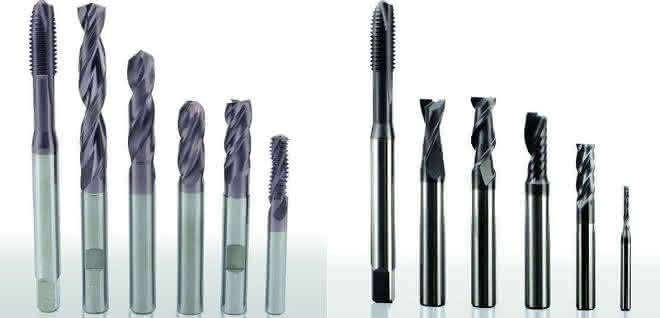
ta-C coatings are characterized by a high sp3 content or diamond content, which is 70 to 85 percent depending on the application-specific process control. Hardness values of 45-80 GPa, very low coefficients of friction, chemical inertness and a pressure or load-independent temperature stability of approx. 500 °C are further properties that have a positive influence on tool use. A unique production and process technology results in smooth coatings. The choice of carbide for coating tools with ta-C is not restricted, which is an additional benefit for users. Even tools and functional components made of HSS and materials with low tempering resistance can be coated with ta-C due to the low deposition temperature of < 200 °C.
Surface structuring as a design element
In the future, coating and surface structuring will be considered more than ever as a design element in the optimal design of coated composite bodies such as precision tools. In view of the rapid development of innovative manufacturing processes such as additive manufacturing, 3D metal printing by laser beam melting (LBM), selective laser sintering (SLS) or metal printing and subsequent microwave sintering and various other processes, completely new design possibilities are emerging for composite components designed to be suitable for coating. In many cases, the surface quality of printed metal components is still not good enough for many applications or for thin layers to be applied without sometimes complex post-processing. Processes such as the "Micro Machining Process" for optimizing surfaces and contours or post-processing using lasers will come into focus here. In the course of their future development, however, the additive processes themselves will certainly offer the possibility of optimizing in-situ surfaces in the micro and nano range and structuring them for the application, which will further perfect such designed components in combination with multifunctional layers. New constructive possibilities for plasma surface technology are opened up by the new innovative manufacturing processes.
Dr.-Ing. Georg Erkens, Managing Director Surcoatec Germany /ag
Literature:
Holsten, S.: Schneidkantenpräparation Ziele, Verfahren und Messmethoden. Page 25, Kassel University Press GmbH, ed. F. Tikal, 2009.


You might also be interested in
Sustainability Through Simulation
Digital material selection reduces CO2 emissions by 40 percent
The use of digital material simulations can significantly reduce CO₂ emissions during the development and manufacturing of components. A real-world project by Schunk and Cadfem demonstrates how data-driven material selection can yield savings of up...
 read more...
Clever solutions for sensitive gripping
Innovative systems and exciting world premieres? That's what visitors will find at productronica in Munich from November 18 to 21. In Hall B3 at Stand 301, vacuum specialist Schmalz will be showcasing efficient and future-oriented handling systems -...
read more...Proprietary plastic compounds for extreme conditions
Cables must reliably transmit energy, data and signals, even in extreme cold or heat or under heavy mechanical stress. Specially developed plastics ensure that the cables remain robust and resistant. Lapp produces its own plastic compounds.
read more...Efficiency comparison of 3D printing, CNC manufacturing and injection molding
3D printing, CNC manufacturing or injection molding? When designers are looking for the most suitable manufacturing process for an individual component, they often lose time and also quickly lose track. Igus is changing this with the Triboteile...
read more...Heat transfer and additive manufacturing
Conflux Technology enters the hypercar sector
Pagani has announced the signing of a six-year contract with Conflux to integrate Conflux heat exchangers into the transmission of its latest exclusive model, the Pagani Utopia, further advancing additive manufacturing in the hypercar industry.
read more...Metal foam and PFAS replacement improve environmental balance
Metal foam contains up to 90 percent air and has amazing properties. In the factory, it ensures greater sustainability and helps to improve the environmental balance in industrial production.
read more...PFAS alternatives with high performance
Igus wants to set an example for innovation and sustainability and will be presenting new products at HMI 2025, including PTFE-free materials and products made from recycled material.
read more...No splinters, no maintenance
New properties also apply to load carriers in logistics and intralogistics processes. Craemer's portfolio includes high-quality returnable load carriers that are hard-wearing, versatile, maintenance-free and recyclable.
read more...Tensile strength of 3D components
Voxelfill strategy overcomes inhomogeneous strengths in 3D printing
The company AIM3D has succeeded in demonstrating the advantages of the patented voxelfill process. Strength tests now prove that this process can overcome inhomogeneous strengths of 3D components in the X, Y and Z axes and thus comes close to...
read more...