
Clamping device
Change of strategy increases output
Tool manufacturer EWS Weigele has used new clamping technology to reduce set-up times and increase efficiency when realigning its production strategy for two components.
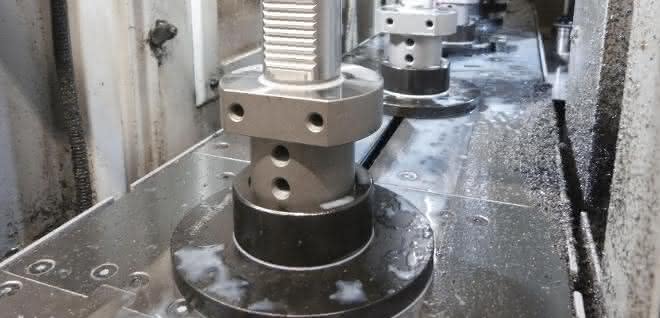
Increasing non-productive times, having employees set up too much and for too long at the machine and complicating processes - clamping devices can contribute to this very well. But this is not what EWS Weigele from Uhingen wants. Their aim is to design processes efficiently and automate machines where it makes sense. When realigning the production strategy for two components, one high-precision and one square component, the manufacturer of tool holders therefore relies on clamping devices from Hainbuch. The Toplus-premium chuck allows for human-free production with a reliable process. And the Inoflex 4-jaw chuck ensures that two components are now produced on one machine, eliminating the need to change chucks.
EWS invests in modern production lines to guarantee high quality and the optimum design of its products in terms of form and function. The process optimization and automation department was founded for this purpose in 2018. Aristeidis Kalagkanis heads this department and is responsible for the procurement of machines with all auxiliary equipment, clamping devices and tools as well as for linking robots. What had long been a thorn in his side was the machining process of a high-precision component, or more precisely, a base holder on a Hardinge machine.
"An employee inserted the parts by hand and clamped them manually in a self-built clamping device. They were then adjusted manually until the concentricity was right and then hard-turned. This takes a lot of time and was inefficient for us. We decided to change the machining process or rather the strategy for it. To streamline the hard turning and clamping process and also to automate it," says Kalagkanis.
EWS then asked Emag for a VL4 vertical turning machine with an integrated pick-up station and a measuring station. EMAG was to offer the clamping device at the same time. The requirements for this were: first and foremost, process reliability, followed by a concentricity of ≤5 μm and high rigidity. The offer fluttered into the house with a clamping device from a competitor of Hainbuch. This was the only way Emag could guarantee concentricity. However, according to Kalagkanis, the clamping devices were extremely expensive and EWS had nothing to do with this clamping device manufacturer. "What the farmer doesn't know, he doesn't eat or buy," says Kalagkanis with a grin.
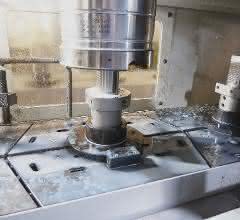
However, there has been a good partnership with Hainbuch for many years. Almost all lathes are equipped with the Spanntop nova or Spanntop mini chucks and the company is very satisfied with them. However, EWS had never approached Hainbuch with these precision requirements before. After internal consultation and at the request of the management, Hainbuch was approached. Renee Reuter, technical consultant at Hainbuch, took a look at the whole thing on site and presented the high-precision Toplus premium chuck with the premium clamping heads. In addition to the high precision, the large opening stroke facilitates the automatic loading of the machine. Even light contact with the workpiece during loading does not affect the premium. Despite its high precision, it is "robust" and the process remains stable. EWS was convinced and placed an order.
Quality is now also achieved automatically
"After everything had been delivered, set up and programmed, we noticed that parts were occasionally coming out that did not have the required concentricity. Together with Hainbuch, we checked the process and carried out various series of measurements. It was important for us that we received immediate support from Hainbuch. Mr. Reuter was always at our premises," says Kalagkanis.
"It turned out to be due to the workpiece geometry. The problem was that the tool holder has a round shank and toothing at the back. At the point where it is clamped, it is round but interrupted. As a result, the premium clamping head could not clamp around it. We manufactured new clamping heads with a stem so that we could clamp on the small front collar and have a support. And the accuracies of ≤5 μm were promptly achieved," adds Reuter.
The machine can now run unmanned for up to three hours and process reliability is also guaranteed. This is because the enclosing clamping, extra chip protection and flushing make the chuck insensitive to dirt. In addition, the front stop, which strikes the front of the workpiece, provides additional clean coverage. The pick-up station is loaded with 20 components, which takes just five minutes. The employees can then get on with other tasks. The familiar quality that was achieved manually is now also achieved automatically. In addition, the set-up time has been reduced to a minimum.
Kalagkanis explains why: "On the Emag, we manufacture components with batch sizes between 30 and 200 of a family with different diameters. We used to have to change and align the entire fixture. Now we just change the premium clamping head with the changing device in seconds, without aligning. We save around 15 minutes per job when retooling two to three jobs a day. What's more, this also makes retooling much easier for the employees."
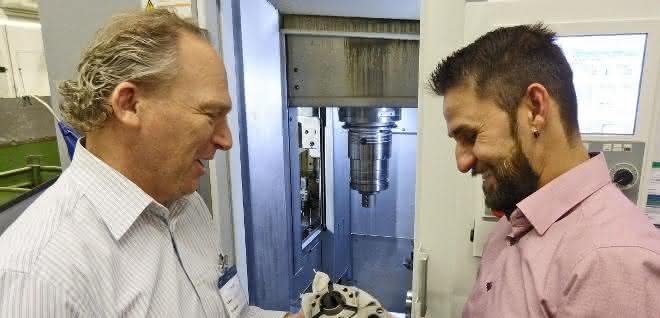
As a result of their intensive collaboration, Kalagkanis and Reuter stumbled across another optimization case. EWS produces many housings, most of which are cubic, but there are also a few round ones. The round ones run on a Hwacheon VT-550 lathe and the cubic ones on another machine. "The Hwacheon was equipped with a 3-jaw chuck, which has now been retired. We have also changed our strategy here. Mr. Reuter drew our attention to the 4-jaw chuck Inoflex in size 500. I wasn't even aware that Hainbuch had something like this in its portfolio. Now I can process round and cubic housings on the same machine without having to change the chuck. That's the biggest advantage," says Kalagkanis.
The square housings were also previously manufactured with a 4-jaw chuck, but without compensation, i.e. with two fixed and two adjustable jaws. EWS always had to align the two fixed jaws exactly to the center. To do this, the component was first measured and then the jaws were precisely adjusted. This is no longer necessary. Kalagkanis is also impressed by the stability and high holding force of the Inoflex. "In summary, I can say that we save a lot of time, everything is no longer so cumbersome and machine utilization is higher as a result. That's why we have also equipped a newly purchased DMG NLX 700 with the Inoflex in size 315," concludes Kalagkanis.


You might also be interested in
Housing and inserts for plenty of power
Lapp presented the expansion of its Epic Power series at SPS 2023: four new M23 circular connector inserts and three new M23 housings. The special feature: all housings can be combined with any of the four inserts.
 read more...
News and product updates from Smartgas
Portable gas analyzers for outdoor use
Smartgas is starting the second half of the year with a series of updates to existing products and a number of new products. Portable analyzers expand the range of applications, while new accessories such as protective housings and heating modules...
read more...Everything accurate in switch cabinet construction
To ensure smooth work processes, tools for processing enclosures and housings must function flawlessly and reliably. Häwa rounds off its punching range with the Multi-Press 500.
read more...Shafts and conversion parts
The Rodriguez range includes ball bushings including matching housings, shaft brackets, crossbars and supports.
read more...Cooling and temperature control units
Hygienic packaging sells safely
In few industries are the requirements for hygiene in the production process as strict as in the food sector - the health of consumers has top priority. This results in enormous challenges for all machines and components involved, especially in...
read more...Simple tool change in seconds
With the CMS, Schunk is launching a user-friendly, manual change system for quick component replacement. In addition to its simple and convenient operation, the CMS also stands out with its extensive range of optional modules and complementary end...
read more...Motion controller for small drives
Medium power range covered
Faulhaber has another housing-less and compact motion controller in its range, which is particularly suitable for integration in device construction and medical technology applications.
read more...Welding solutions in the name of resource efficiency
At the Welding & Cutting trade fair in Essen (September 11-15), Fronius will be focusing on the major drivers in welding technology. Quality requirements are increasing in all industries, but the required welding specialists are scarce. In...
read more...Safe solutions for cable installations
From thick power cables to thin sensor lines, cables and lines must be routed safely through systems and machines. A challenge that should not be underestimated, explains Jörg Sokat, Head of Product Management at Pflitsch.
read more...