
Servo presses
Technological edge through new system technology
Each additional forming stage enables greater complexity in the production of functional parts. Servo technology opens up new production possibilities. Arnold Umformtechnik has therefore invested in new press technology in order to be able to offer a wider range of parts. By Annedore Bose-Munde
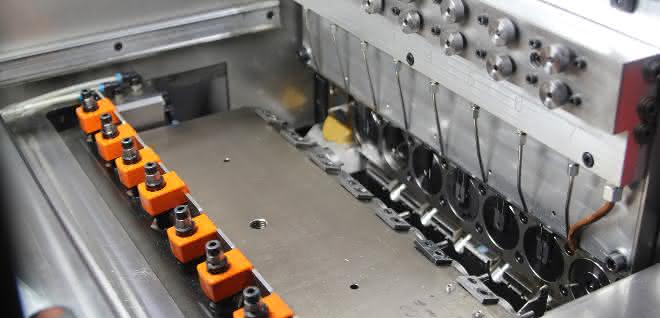
It is also an advantage to stand out from the market when manufacturing fasteners. And so the purchase of two new 7-stage servo presses from Nedschroef Machinery was definitely a strategic decision for Arnold Umformtechnik. The new system technology can be used to manufacture more complex functional parts and high-quality products.
"The new NC714 not only offers an additional forming stage, but also a number of technological advantages. For example, the cut-off quality provides a better initial state for forming. And with the shorter feed length, it is now possible to produce shorter parts," says Andreas Stern, listing some of the advantages. He has been working as a design engineer at Arnold Umformtechnik for six years and designs parts for the 5-, 6- and now also the new 7-stage press. He was also involved in the procurement process for the machine.
Tobias Kraus, who also works in this area, adds: "Previous machines worked with a flywheel drive. With the complete servo drive, we now have a completely new drive concept at our disposal. The machine can run at any speed without having to build up energy beforehand. Accordingly, the system also has the full pressing force at any speed."
Equipment features enable greater flexibility
The servo technology allows the speed to be individually adapted to the part during the process. The transfer also ensures uncomplicated transfer to the next forming stage. The high-speed cutting system works at 10 m/s. As a result, the wire section is hardly deformed and a uniform volume distribution is achieved for the subsequent forming process. Due to the high volume consistency and the cut-off quality, short lengths can also be produced.
Another feature of the press is that the seven stages can be reduced to six. In this case, the seventh stage is replaced by a roller unit. This allows threads, knurls, small recesses or other simple shapes to be produced inline, for example. This means that ultimately there are also cost benefits, as work steps are eliminated. The machine, which has a total pressing force of 1,100 kN, is equipped with an integrated inductive preheating system. This makes it possible to produce complex stainless steel molded parts. The die cooling and heating system also facilitates the production of stainless steel molded parts. This has a positive effect on the service life of the tools, as tool wear is significantly higher with stainless steel than with steel.
Expansion of the range of parts that can be produced
For Arnold Umformtechnik, the new press also means a stronger position on the market. "We can now produce components that we previously had to reject, such as stainless steel formed parts, and the sequential forming options give us a better understanding of the forming process. The results of the simulation can thus be better checked with regard to their reality," explains Tobias Kraus.
Special materials are also to be processed on the press due to its versatile lubrication options. For example, Arnold Umformtechnik is focusing on stainless steel and copper formed parts, which are becoming increasingly important, especially with regard to electromobility. "Parts that are sensitive to impact points are also to be produced on the Nedschroef NC714 due to the gentle discharge. In addition, short parts are to be produced due to the high volume consistency thanks to high-speed cutting, as well as transport-critical parts," says Andreas Stern.
Realize complex application-specific components
The two new systems have been in operation at the Forchtenberg-based fastener manufacturer since April 2018. And the experience with the press has been very good. "Errors during the forming process are detected more quickly so that the machine shuts down without destroying a tool. For example, the machine recognizes when a part is not inserted correctly and then stops," says Stern. During the first adjustment attempts during initial production, the ejector system also quickly detects tools that are not optimally adjusted. These can then be precisely adjusted for series production.
However, the new system technology also has another benefit. For example, parts that were previously produced on a precise but larger press can now be produced on this press with a price advantage. And last but not least, there are numerous possibilities for the realization of complex application-specific components and customer applications. For example, the new servo press can be used to produce complex steel parts and stainless steel molded parts, copper contact pins and bushes, stainless steel double collar bushes, wheel axles, hollow knurled parts, precise press-fit elements and drawing parts with a certain degree of complexity.
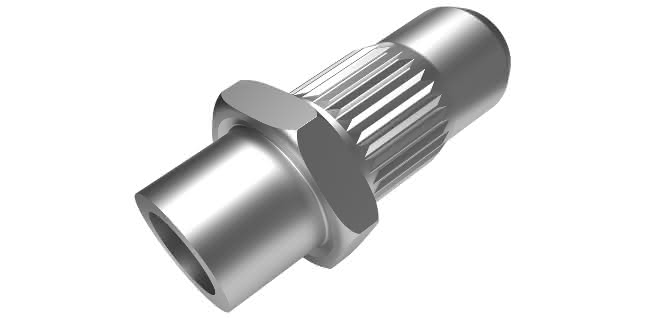
In addition to the normal range of parts that Arnold Umformtechnik manufactures for customers in the automotive and supplier sector, the new systems will now also focus more strongly on the electromobility application area. "At an expert forum to which customers and interested parties were invited, the expanded possibilities of the system were presented. Our customers accepted the offer. As a result, we have already been able to process a large number of new orders on the Nedschroef presses," says Stern.
New generation of machines opens up further market potential
The decision for the new technology was made step by step. During machine development, it was also important for Arnold Umformtechnik to incorporate its own ideas with regard to the system design, for example with regard to part separation. "The collaboration with the system manufacturer was characterized by trust and a constructive exchange based on partnership. The usual teething troubles were largely resolved quickly and successfully. We are also in constant contact with the manufacturer, who provides good support," says Stern.
However, the machine setters at Arnold also had to rethink their approach at first. Compared to a conventional press, the setting procedure on the new Nedschroef press is much more complex. The machine is also more extensive in terms of software. So it is definitely a challenge - both for the system manufacturer and for the system user. However, with the new technology, the Forchtenberg-based fastener manufacturer is now well equipped for future challenges.
The author: Annedore Bose-Munde is a freelance journalist.


You might also be interested in
New loyalty program at Conrad
With its platform economy, Conrad Electronic enables simple and fast procurement from a single source and acts as a solution provider to make it as smooth as possible for business customers to cover their technical needs.
 read more...
Supply chains for injection molded parts
How to move tools successfully
Supply chains are coming under pressure, manufacturers are disappearing from the market, successors remain open - for purchasers in the plastics industry, this has long been no exception, but a daily reality. Companies that buy in injection molded...
read more...Integrated pneumatic lifting pin
A pneumatically operated, self-locking ball support pin enables seamless integration into robot and handling systems.
read more...Flexible lever solution for electromobility
With electromobility, the number of lithium-ion batteries that need to be moved, dismantled or tested during vehicle servicing, take-back campaigns or recycling is growing. However, weighing around 700 kg, these power storage units place high...
read more...Innovation for a strong SME sector
Small and medium-sized suppliers face tough national and international competition. These companies can achieve the required flexibility in production with digitalized manufacturing and automation solutions. Financing models and after-sales service...
read more...Small helpers with a big impact
Spring-loaded thrust pieces and ball lock pins
Whether cup holders, light housings or clamping devices, Halder develops and manufactures standard parts for almost every application and offers a range of around 13,000 standard parts, including spring-loaded thrust pieces, which are used in...
read more...VDMA takes over sponsorship of Intec
With a great response and more than 17,800 trade visitors from 42 countries, Intec was able to draw a very successful balance in mid-March. Together with the supplier trade fair Z, the trade fair duo made a strong contribution to ensuring that...
read more...Small and medium-sized enterprises
Innovation and partnership for a strong SME sector
Mobility, Data & Semiconductor, Aviation & Space - manufacturers in these and other key sectors are dependent on a functioning network of suppliers in many areas.
read more...Safely transported in one easy step
The new threaded lifting pins with handle from Erwin Halder are ideal for transporting or positioning light and medium loads quickly and easily. They are quick and easy to assemble and disassemble and offer a high level of safety and a robust design.
read more...