
Screw connection
Connection technology for aluminum-steel mixed construction
With the Flowform, Arnold Umformtechnik developed and established a joining solution on the market several years ago that meets the increasing requirements in sheet metal joining. Now the company is presenting its further development. By Annedore Bose-Munde
The Flowform flow-hole and thread-forming screw enables a fully automated joint that is accessible from one side. With its polygonal tip geometry, the Flowform screw forms a flow hole and a thread that can accommodate a metric screw in the event of a repair.
With the Flowform Plus, a further development of the established Flowform, the company is now responding to growing customer requirements. The automotive industry is focusing on weight reduction against the backdrop of ever decreasingCO2 emissions. Thinner and higher-strength steels or aluminum are increasingly being used and mixed construction is on the rise. But the screw must also guarantee a reliable connection under changed boundary conditions. In short, the flow form had to be further developed to meet these new requirements.
"Depending on the sheet thickness, the application limit for joining steel applications with the conventional Flowform was a maximum of 600 MPa, with the Flowform Plus it is 1,000 MPa," says Heiko Miller. He is project manager for the further development of the Flowform Plus at Arnold Umformtechnik. Compared to the conventional Flowform, the dimensions have been reduced from 5 mm diameter and 20 mm length to 4 mm diameter and 20 mm length. Depending on the head and length, the conventional Flowform 5 weighs around 4 g, while the new Flowform Plus 4 weighs around 3 g. Extrapolated to the number of screws used in the body, this is significant: with 500 elements, the weight saving is 500 g with almost the same performance. In addition, the geometry of the flowform tip has been optimized and the heat treatment process adapted so that the performance of the connection remains almost the same.
Joining point validation provides safety
But when is the Flowform Plus the right joining element? Feasibility studies are carried out in the sheet metal joining laboratory using original material, for example. Here, the strength values for the bond and the limits for failure are determined. A joining point test goes into a little more detail: Here, the user has already defined certain material pairings. In addition to a recommendation, specific values are also expected here, for example which strength values are achieved at a joining point.
In principle, the Flowform Plus is designed for higher-strength steel sheets and thicker sheet combinations. "By using aluminum components, thicker joint combinations with several layers can also be created. In the past, this meant that the top and middle layers of three-layer joints were pre-punched. According to Arnold Umformtechnik, the use of Flowform Plus now allows thicker material combinations of up to 7.5 mm to be joined without pre-punching, depending on the joining materials," explains Miller.
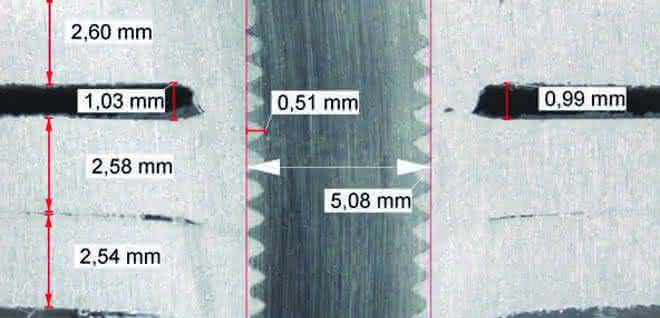
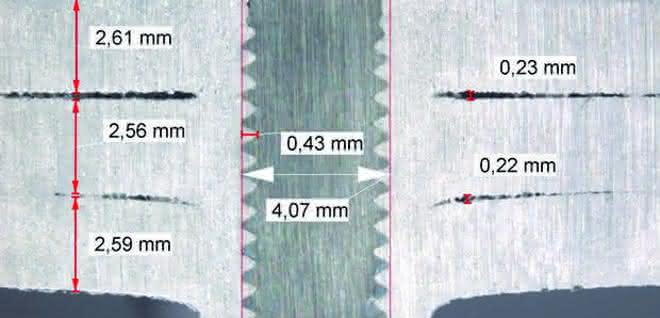
This is due to the lower material displacement caused by the reduction in diameter. This results in a smaller gap between the sheets and less friction surface due to the smaller dimensions. As the torque level is generally lower here, the connection can also be tightened with a lower tightening torque. According to the company, the joint strength is slightly lower than with Flowform 5, but good enough for the application.
With regard to the fastener, higher strength is achieved by selecting a suitable material in combination with a suitable heat treatment process. The smaller diameter of the Flowform Plus, and therefore the smaller head diameter, also makes the screw suitable for applications where only a small flange width is available. "We joined a three-layer sheet metal joint with 2.5 mm thick aluminum sheets with the conventional and with the new Flowform element. The result clearly showed less gap formation with the Flowform Plus. It was also possible to join without a pilot hole. In applications with adhesive, which is usually the case, the adhesive is also trapped if a pilot hole is avoided and therefore cannot escape to the pilot hole," says Miller. Joining without a pilot hole is also more cost-effective in terms of the cost efficiency of the process. The user does not need camera technology to check whether the screw hits the center of the pilot hole during the joining process, adds Nadine Schmetzer.
The new Flowform is used, for example, in car body shell construction in aluminum-steel mixed construction, for profile-intensive designs, for one-sided accessibility, for hybrid connections or for battery packs. Thanks to the smaller head diameter of the Flowform Plus, the design of the assembly can already be adapted at the customer's premises. This means, for example, that flanges can be made narrower and therefore more weight-optimized.
It is fundamentally important to Arnold's developers that an optimum connection solution is realized for the customer component. This is why customer service is just as important as coordination with the system supplier. "Involving everyone involved in the process at an early stage ultimately supports the implementation of optimized and cost-efficient processes," explains Miller.
Annedore Bose-Munde, specialist editor for business and technology


You might also be interested in
Friction stir welding as a key technology for future industrial joining solutions?
At the DMG MORI in-house exhibition, Hufschmied Zerspanungssysteme presented friction stir welding with process-optimized tools and series production potential for the industry.
 read more...
Tox Pressotechnik at the Blechexpo
Connecting sheet metal and electrically conductive components safely
Joining sheets of different thicknesses easily and reliably without additional elements - Tox Pressotechnik will be demonstrating how this can be achieved at Blechexpo with its clinching and eClinch technology.
read more...Production, machine tools and robots
High-precision welding for perfect sawing
Stihl uses Nimak's portal projection welding systems to manufacture guide rails for chainsaws.
read more...Tox servo press for clean room
The coast is clear here now
In sensitive sectors such as medical technology, the optical industry or electronics, cleanroom-compatible components are required for all processes. This also includes drives. With the servo presses from the Electricdrive Core series, Tox...
read more...Air purity class 5 according to ISO achieved
Tox has servo press certified for the cleanroom
In sensitive sectors such as medical technology, the optical industry or electronics, cleanroom-compatible components are required for all processes. This also includes drives. With the servo presses from the Electricdrive Core series, Tox...
read more...Manufacture of metal bellows couplings
Joining instead of gluing
When manufacturing metal bellows couplings, the connections between the bellows and hub are a critical point. The flared press-fit process can be used here.
read more...ArtiMinds presents automation solutions at automatica
ArtiMinds Robotics is presenting automation solutions from the field of advanced robotics at Automatica in Munich. The applications were programmed using the in-house software solutions ArtiMinds Robot Programming Suite (RPS) and ArtiMinds Learning...
read more...Plug-and-produce with smart subsystem
The mechanical engineering company KMS Automation standardizes pressing and joining applications with the Smart Function Kit from Bosch Rexroth. The mechatronic subsystem simplifies machine design, increases process quality and shortens...
read more...Integrated ERP system for watertight processes
Rubber-based seals are used in window frames and escalators. They are also a must in tunnel projects to prevent water damage. Sealable, a specialist in sealing and insulation solutions, relies on an ERP system from Pro Alpha, which covers everything...
read more...