
Connector standards
New standards for Single Pair Ethernet
On the occasion of the Hannover Messe, the companies Phoenix Contact, Weidmüller, Reichle & De-Massari, Belden and Fluke Networks announced a technology partnership for Single Pair Ethernet (SPE).
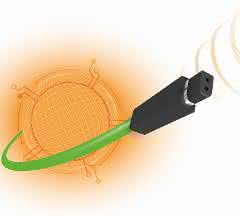
The companies develop and support the mating faces of IEC 63171-2 (office environment) and IEC 63171-5 (industrial environment), which were jointly introduced into the standardization process. The standards define IP20 and IP65/67 mating faces for single-pair and four-pair data transmission in single-pair Ethernet applications.
The companies are pooling their technological expertise to ensure a coordinated infrastructure for devices, connectors, cables and measurement technology. "Single Pair Ethernet is one of the megatrends in industrial data transmission," says Torsten Janwlecke, President Business Area Device Connectors at Phoenix Contact. The SPE does not redefine higher transmission speeds or distances, but forms the normative framework for reduced cabling to suit the application. "This reduced cabling brings completely new areas of application into focus."
Data cabling with just one wire pair enables transmission distances of up to 1000 m at transmission rates of 10 Mbps to 1 Gbps. This makes SPE ideal for infrastructure applications in mechanical and plant engineering, process technology and also for building infrastructure.
The big advantage: SPE is environment-neutral. Field devices, sensors and actuators can be easily integrated into the existing Ethernet environment at company level. There is no need for additional gateways and interfaces. "Unlike fieldbus protocols, Ethernet permeates all automation levels. It is more consistent, efficient and cost-effective than fieldbus systems," says Janwlecke.
From the automobile to production
The development of the single pair Ethernet has its origins in the automotive industry. There, the trend towards the development of smaller and more powerful devices is clearly noticeable. Pioneering technologies such as autonomous driving require a connection technology that enables the transmission of higher data rates in a small installation space. Other industries can also benefit from this approach. "Single-pair Ethernet makes work easier for plant manufacturers. Compared to four-pair Ethernet, installation is simpler and enables a noticeable reduction in space and weight," explains Jörg Scheer, Head of the Device & Field Connectivity Division at Weidmüller.
Simon Seereiner, Head of Product Management IE and SAI at Weidmüller, adds: "For new installations, users save on acquisition costs and can make the necessary cable routes more compact. The standardized mating faces also enable efficient cabling of several communication devices that share a common cable and interface. This means that users can continue to use the existing cabling and connect up to four devices instead of one."
Power supply of up to 60 watts via the network
Thanks to the standardized interfaces, one- and four-pair cabling concepts can be combined with each other, as can IP20 and IP6x solutions. The two-wire technology also allows end devices to be supplied with power of up to 60 W via the same wire pair (Power over Data Line - PoDL). "Our cooperation in standardization creates security," says Janwlecke. "Based on standardized interfaces, users around the world can build efficient network and cabling structures from the sensor to the control and enterprise level all the way to the cloud." Scheer adds: "Digitalization is increasing intelligent networking in all areas of life. Continuous data transmission is also becoming more relevant in the industrial environment. For this reason, Ethernet cabling is already replacing traditional fieldbus systems in many cases."
Berry Medendorp, Senior Director, Global Industrial Marketing at Belden, explains: "In order to replace existing fieldbus systems, cost-effective, miniaturized and standardized components are required. Single pair Ethernet cables play a key role in transmission technology. The simple structure, smaller dimensions, significant weight reduction and simple connection technology also make this technology interesting in automation, building cabling, railroad technology and many other applications."
"Certification of installed Ethernet cabling is the most effective way to ensure error-free operation. This is independent of the number of conductor pairs in the cable," says Mark Mullins, Global Communications Manager and founding member of Fluke Networks. "In this way, customers can ensure that their investment in high-quality cabling and components pays off. Since our inception, we have worked with more than 30 standards bodies to define the future of cabling. Our goal is to define effective standards that also allow for the development of tools that customers can use to certify and, if necessary, troubleshoot this exciting new technology."


You might also be interested in
Helu makes its first trade fair appearance under a new brand name
Helu Kabel will be presenting itself as Helu for the first time at Hannover Messe 2026, showcasing system solutions, Heluchain cables and new industrial luminaires.
 read more...
Strategic realignment with brand relaunch
In future, Helukabel will trade as Helu
The Helukabel Group is parting with part of its name: in future, the company will only operate under the Helu brand. With this step, the specialist for electrical connection technology is underlining its strategic development from a classic cable...
read more...Modular plant construction for corrugated board
Insight into the production of corrugators at BHS Corrugated: Automated, modular and equipped with Helukabel components.
read more...Best quality for the steel
Conditions in the steel industry are harsh and inhospitable. The machines used must be able to withstand the demanding environmental conditions in order to deliver the best quality at all times.
read more...If the standard cable is not sufficient
Lapp offers cables for countless applications - but not for all of them. From time to time, the developers have to modify a standard cable or develop a special cable.
read more...Slight decline in sales, strong investments
The Lapp Group has not been spared from the weakening global economy. However, the company only recorded a slight loss in the past 2024 financial year.
read more...Electrical connection technology
Cables and wires for industrial automation
Heukabel offers system solutions for cable routing from a single source. The subsidiary EKD Systems specializes in tailor-made cable drag chains made of steel, stainless steel and plastic, which are used in moving machines and systems as well as in...
read more...Lapp relies on Ultramid from BASF
Mobile charging of electric vehicles
The automotive industry is currently undergoing the biggest transformation in its history. The boom in battery electric vehicles in particular is presenting the industry with major challenges. Lapp, as a supplier of cables and connection...
read more...Cable handling application
At this year's Motek, ArtiMinds Robotics is showcasing a robot-based automation solution for the sensor-assisted assembly of flexible cables in connector housings.
read more...