
Connection technology
Interview: Preparing the environment for innovation
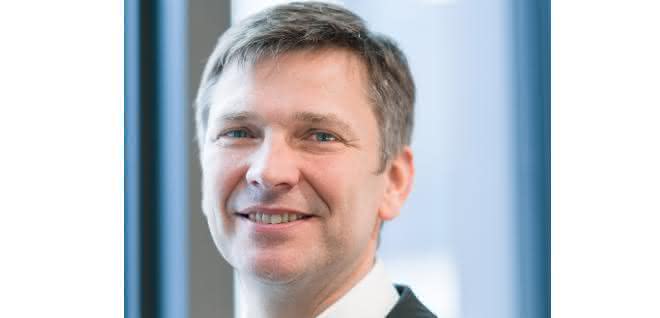
Has everything already been invented in connection technology? Not at all, disagrees Georg Stawowy, Director of Technology and Innovation at Lapp. The specialist for integrated cable and connection systems presented many solutions at the SPS, some of them surprising, such as the smart cable drum or predictive maintenance for Ethernet cables. In this interview, Stawowy explains how the company creates such innovations.
Predictive maintenance is one of the great promises of Industry 4.0. What ideas does Lapp have for this?
Cables perform essential functions in factories. If the factory were an organism, the cabling would be the circulatory and nervous system. You realize how important they are at the latest when a connection fails, resulting in an expensive production standstill. That's why our customers are very interested in predictive maintenance solutions for cabling. Several solutions have already been presented, but these were mostly based on additional "sacrificial wires" in the cable.
We, on the other hand, wanted a solution that did not require any changes to the cable. We presented the result at the SPS in our FutureLab. Our predictive monitoring box is inserted into the Ethernet cable. It has no effect on the data transmission, but measures the quality of the signals and uses this to calculate the "Lapp Predictive Indicator". If it falls below a certain value, this indicates an impending fault and the cable should be replaced.
The predictive maintenance system uses a deep learning approach based on millions of measured values that we have collected in our test center. As our system does not require any changes to the cable, it is also possible to retrofit existing systems without having to replace the cables and there is no additional connection effort.
What new business models does digitalization offer you in terms of logistics and delivery capability?
A problem that many of our customers are familiar with: The fitter needs a cable, but the drum is empty and no one has thought to reorder a new one in time. The manual approach with Kanban cards is difficult here because the individual parts cannot be counted and it is often difficult to estimate how many meters are actually left on the drum. The solution is the smart cable drum that we developed together with Schildknecht. A sensor registers the number of revolutions and uses this to calculate the meters of cable unwound and the remaining quantity on the drum.
Together with our customers, we are now developing business models for this technology. The ERP system could automatically trigger an internal message or directly order a new drum if the remaining length falls below a certain value. However, there are also completely different benefits: For example, it is not a problem to integrate a GPS receiver, in which case an automatic theft warning would also be easy to implement - this is particularly interesting for large drums on construction sites.
Many experts see direct current as the energy supply of the future. Do you?
It's clear that direct current is the future. More and more electrical generators and consumers are working with direct current, and enormous amounts of energy could be saved if it were not always necessary to switch back and forth between direct and alternating current. Lapp has been driving this topic forward for several years in the DC-Industry research project, and we will also be involved as a sponsored partner in the successor DC-Industry2. We then want to take a closer look at the long-term stability of insulation materials for cables and wires.
We have been researching this topic for some time in cooperation with Ilmenau Technical University. Initial results indicate that the same cable ages differently if it is operated with direct current instead of alternating current. Lapp is the first company in the connectivity industry to offer cables specifically for industrial direct current applications as standard.
Faster and faster seems to be the motto for Ethernet cables. Do we really need ever higher speeds?
In some applications it is, for example when large amounts of data are transmitted from high-resolution cameras. But the question is justified: Cat.6 or Cat.7 cables are often oversized for connecting sensors. Single-pair Ethernet cables are an interesting alternative. The achievable data rates are more than sufficient for connecting sensors in the vast majority of cases. Instead of four pairs of wires, they only have one pair, which saves up to 75 percent time when connecting the wires. With the large number of sensors needed in the smart factory, this quickly adds up to enormous savings. Of course, a cable with two cores also costs less than one with eight. These cables are also thinner and suitable for confined spaces. Lapp already has single-pair Ethernet cables in its range, and suitable connectors and devices that can use the new standard will soon be available.
The industry is changing faster and faster, companies have to become more innovative and faster all the time. What are you doing to keep up?
First of all, you need competent and creative people. But that alone is not enough, you also need to create an environment that fosters creativity and enables good ideas to become real innovations. We took an important step in this direction this year by introducing a new innovation process called "Innovation for Future", which is designed to facilitate radical and disruptive innovations in particular.
We have found that the tried-and-tested stage-gate process, in which goals are set and worked through, is not ideal for development projects where the goal is still vague because you are entering uncharted territory. The basis for "Innovation for Future" is always a triad: a technical solution, a business model and interest from at least one potential customer.
But the role of management is also changing. It must act as an enabler - as a motivator, provider of ideas, supporter, networker, decision-maker and resource manager. By resources, I don't just mean money, but also time. The two examples of predictive maintenance and smart cable drums mentioned above were created in this way. Our aim is to realize one such idea per year.


You might also be interested in
ebm-papst is growing again thanks to AI and data centers
ebm-papst returned to a growth trajectory in fiscal year 2025/26. Air Technology, data center applications, and artificial intelligence are driving revenue and investment.
 read more...
SPE on the Verge of a Market Breakthrough
Single Pair Ethernet (SPE) has moved beyond the conceptual phase and is increasingly being implemented in industrial settings. The focus here is not only on higher data rates and simplified cabling, but above all on the issue of system integration...
read more...More than 900 exhibitors already registered
Around six months before the start of the trade fair, more than 900 companies have registered for SPS 2026 in Nuremberg. The trade fair focuses on industrial AI, cyber security and digital transformation.
read more...Virtual PLCs in practice: How vPLCs make production systems more flexible and scalable
The increasing networking of IT and OT is fundamentally changing industrial automation. The IT/OT Integration Summit shows how modern technologies can make production environments more efficient, flexible and future-proof. The event will focus on...
read more...Sales growth in a turbulent market environment
Thanks to innovations and a focus on strategic industrial markets, Sick was able to moderately increase its sales in the 2025 financial year. In a turbulent market environment, the company was able to maintain its position and gain market share with...
read more...Siemens presents new AI agent
Siemens is launching 'Eigen Engineering Agent', an AI for automation technology. The solution is integrated into the TIA Portal, has been tested with over 100 companies and is designed to significantly accelerate engineering processes.
read more...Schaeffler keeps sales almost stable
Schaeffler generated revenue of EUR 23.5 billion in 2025 and increased EBIT before special items to EUR 936 million. At 266 million euros, free cash flow was significantly above the prior year and forecast. Net income remained negative due to high...
read more...Advancing artificial intelligence together
Helukabel is stepping up its activities in the field of artificial intelligence and is now a member of the IPAI. The innovation and collaboration platform for companies, research facilities, institutions and administration has set itself the goal of...
read more...New impetus for ifm sales
Two new positions were filled at ifm at the start of 2026: Markus Wolf becomes Managing Director Sales Germany, Sven Quant takes over the position of Central Managing Director in the Process Sensors division within the ifm Group.
read more...