
"Technical cleanliness"
Cleanliness: keep at it all the time!
Assembly and technical cleanliness - a contradiction? At two trade fairs in Stuttgart - Motek and parts2clean in October 2018 - representatives of the Cleaning Excellence Center Leonberg (CEC) looked around on the topic of "Technical Cleanliness" (TecSa) - with different results.
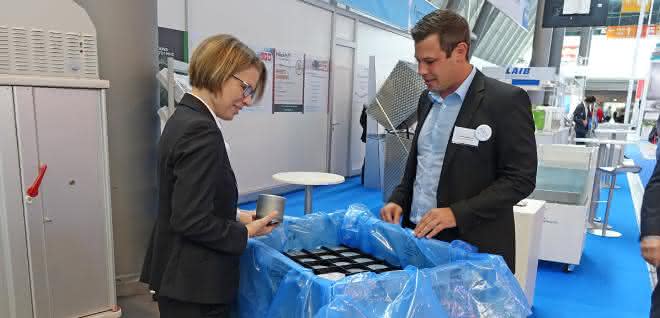
At Motek, CEC Chairman Ralf Nerling had the impression that the topic of TecSa is a "nuisance", as taking VDA 19.2 into account in assembly technology only causes additional costs. VDA 19.2, the standard work for technical cleanliness, contains recommendations for maintaining component cleanliness during the assembly of sensitive assemblies. Component cleanliness was the central topic at the parts2clean (p2c) trade fair. In cooperation with the trade fair organizer Deutsche Messe, the CEC had a large process stand with the entire
process of component cleanliness and its quality assurance. Members of the CEC created two mind maps, "Cleaning" and "Testing", which were met with remarkable interest - this system can be downloaded from http://www.cec-leonberg.de.
The process stand was divided into three sectors: 1. deburring and cleaning including process chemistry, 2. logistics with transport and storage including airlock systems to the cleanliness laboratory and 3. testing of component cleanliness and the associated equipment such as particle extraction, filter drying, gravimetry, light-optical analysis - all in the ISO7 cleanroom.
Discussions with visitors and exhibitors revealed that points 1 and 3 are handled intensively and successfully. Point 2 was identified by everyone as a weak point in the entire cleanliness chain - i.e. the distance between the end of the cleaning process and the further use of the hopefully still clean component.
Why is it so difficult to integrate the technologically less demanding area of "logistics" to the necessary extent? A great deal of effort is put into cleaning and packaging, which is then wasted on the transportation and storage route and especially during unpacking. The difficulty lies in the many external positions where insufficiently informed and inadequately trained workers supervise the transportation, storage and unpacking processes.
It would be useful to know how impurities arise, how to avoid them and the effects of particles on the functionality of the end products. The training of employees and those involved is associated with costs, which could be an obstacle for some companies. In addition, one-off training is not enough - ongoing instruction and further training are essential to maintain the standards that have been introduced.
What is the future task in order to be able to manage the entire process from deburring to final assembly economically with regard to TecSa? The requirements for component cleanliness should be kept at an economically justifiable level: avoid the fine and therefore cost-intensive range up to 200 micrometers particle size as far as possible, make 200 to 400 micrometers achievable as a medium range with standard measures and consider 400 to 600 micrometers as desirable, as this is where the costs are lowest.
"Knowledge of the effects of particles on the functionality of end products would be useful".
Further measures: The production environment where increased cleanliness is required should be made inaccessible to normal traffic in order to prevent dirt particles from being stirred up. Draughts through open windows and gates should be prevented, for example by means of access and barrier gates. People working in sensitive areas should wear suitable clothing in accordance with cleanliness requirements. And last but not least: ongoing training of the people involved in the clean production process is essential. CEC e.V./pb
_________________________________________________________________
The Kompetenzzentrum Industrielle Bauteile- und Oberflächenreinigung Leonberg e.V., or Cleaning Excellence Center (CEC) for short, is a competence network for technical cleanliness (TecSa) based in Leonberg(www.cec-leonberg.de). The network was founded in June 2011 with the support of the Stuttgart Region Economic Development Corporation, the trade fair operator of "parts2clean" and the town of Leonberg. CEC members include technology companies as well as medium-sized and small businesses from all areas of industrial cleaning. The current chairman is Dipl.-Ing. Ralf Nerling([email protected]).


You might also be interested in
Filtration and sound attenuation in circuits
In liquid or air circuits, filter housings and silencers protect measuring devices, ensure particle-free vacuum and pneumatic systems, keep cooling circuits clean and reduce noise.
 read more...
KSS ultrafine filtration for grinding oils
Modular concept for pure oil
In order to grind economically, reliably and with the highest quality, extremely clean grinding oils are required. Filter manufacturer Vomat offers the metalworking industry high-performance and customized concepts for the filtration of cooling...
read more...Up to 95 percent less flue gas thanks to direct extraction
The requirements for occupational safety measures and safety technology are also constantly increasing in welding technology. The Technical Rules for Hazardous Substances (TRGS) stipulate that welding fumes and harmful substances must be extracted...
read more...Everything accurate in switch cabinet construction
To ensure smooth work processes, tools for processing enclosures and housings must function flawlessly and reliably. Häwa rounds off its punching range with the Multi-Press 500.
read more...Cooling and temperature control units
Hygienic packaging sells safely
In few industries are the requirements for hygiene in the production process as strict as in the food sector - the health of consumers has top priority. This results in enormous challenges for all machines and components involved, especially in...
read more...Efficient and sustainable
Rotary screw compressors are the reliable backbone of industrial compressed air generation. The innovative CSD/CSDX series from Kaeser Kompressoren with its numerous features produces them efficiently and saves energy costs. This also reduces theCO2...
read more...Healthy air during welding
Welding produces fumes and gases that are hazardous to health. Extraction is necessary to comply with the occupational exposure limits and is even mandatory when welding high-alloy steels.
read more...Wire mesh filters in medical technology
In hardly any other industrial development sector are the demands placed on products as high as in medical technology. After all, human lives depend on the performance and reliable quality of medical devices.
read more...Energy efficiency and sustainability in the smallest of spaces
With the StingR ultra-fine filter system, Lehmann-UMT has created a solution for the energy-efficient and precise treatment of fluids during tool grinding for extended tool life and high tool quality.
read more...