
Torque motors
For ultra-precision
By optimizing the Idam torque motor series SRV, Schaeffler has eliminated interference forces and torques of the motor, which cause tilting of the axis or the clamping surface in the micrometer range with conventional designs in rotary axes and rotary tables.
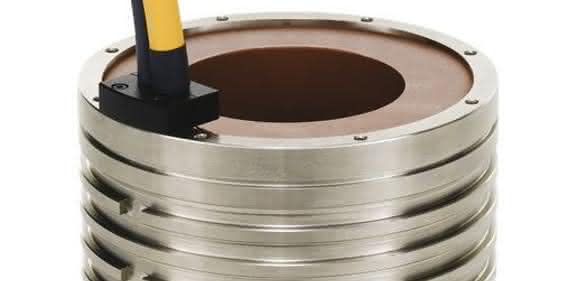
These tilts impair the surface quality of precision machining and lead to additional costs due to the need for reworking. For example, the phenomenon of short-wave surface defects can occur on workpieces when machining with rigid and direct-drive rotary axes in ultra-precision milling, grinding and gear cutting machines. Accuracy deviations of less than one micrometer up to a few micrometers lead to quality problems on high-precision workpieces in mould making, lens end machining or gear cutting parts of the highest quality. The deviations are caused by pulsating axial and radial forces from the magnetic fields of the torque drive, which act as interference forces and torques on the bearing via a lever arm. The error period is usually due to the number of poles, particularly in the case of sliding stars.
The phenomenon is not new, but surface qualities are now so high that these phenomena can become visible on the machining marks. In addition, the requirements for shape tolerances and surface qualities have increased in some industries to such an extent that the effort required for reworking is no longer tolerated. The engineers at INA - Drives and Mechatronics, a direct drive specialist within the Schaeffler Group, developed a "double" motor structure as a solution, in which the interference forces and torques occurring in the motor are balanced internally, thus effectively avoiding surface defects in ultra-precision manufacturing. The torque motors based on this principle are interchangeable with standard torque motors on the market despite their more complex design. Air gap diameters of 89 to 460 millimetres and magnet heights of 25 to 200 millimetres are planned for the new series. pb


You might also be interested in
Predictive Maintenance in the Powertrain: Stöber Is Gradually Expanding Its Approach
Step by step, the company is continuing to develop predictive maintenance: from monitoring to predictive maintenance to smart powertrains.
 read more...
Eric Goos Appointed to the Board of Sumitomo Drive Technologies
Sumitomo Drive Technologies EMEIA continues to expand its leadership team: Eric Goos has been appointed to the board and will serve as managing director of Cyclo Drive Germany GmbH.
read more..."As rebar gets thicker, automation has to keep up."
Larger wire diameters, greater performance, higher efficiency: How can rebar processing machines be adapted to changing market requirements using new drive technology and an open automation architecture? A user report.
read more...Synapticon and Generative Bionics Partner Up
Synapticon and Generative Bionics have entered into a partnership to develop propulsion systems for humanoid robots. The goal is to establish a European supply chain for the development, manufacturing, certification, and integration of the...
read more...ebm-papst is growing again thanks to AI and data centers
ebm-papst returned to a growth trajectory in fiscal year 2025/26. Air Technology, data center applications, and artificial intelligence are driving revenue and investment.
read more...Preventing Interference from Harmonics
Harmonics are underestimated sources of interference in electrical power grids. Particularly in wastewater treatment plants and water treatment facilities, harmonic distortion leads to poorer power quality and associated costs: additional heating of...
read more...Drives for Extreme Conditions
Standard solutions quickly reach their limits under extreme conditions. Together, Ultra Motion and Faulhaber develop custom-designed actuators for deep-sea, space, and other demanding applications that place the highest demands on reliability and...
read more...Triton Partners takes over Flender
Global investment firm Carlyle has signed an agreement to sell Flender, a provider of mechanical drive technology, to Triton Fund 6, advised by Triton. The terms of the transaction were not disclosed and is expected to close in the fourth quarter of...
read more...New roller conveyor cover from Hema
Rolls faster & lasts longer
Hema brings speed to roller blinds: With the expansion of the product family for roller conveyor covers, the specialist for machine and equipment protection has improved travel speed by 30 percent.
read more...