
Energy Technology
Preventing Interference from Harmonics
Harmonics are underestimated sources of interference in electrical power grids. In wastewater treatment plants and water treatment facilities in particular, harmonic distortion leads to poorer power quality and associated costs: additional heating of transformers and cables, false tripping of protective devices, reduced service life, and even plant shutdowns. Anyone who wants to ensure the availability and efficiency of their processes therefore cannot do without harmonic management.
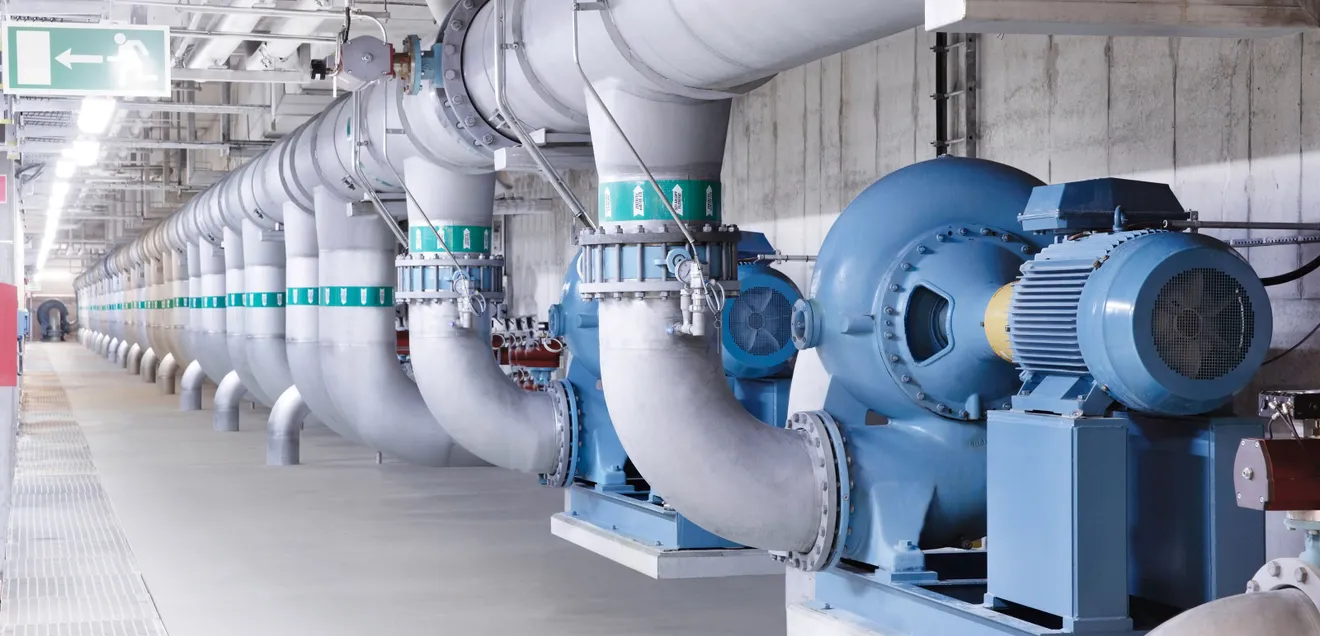
Nothing is perfect, not even the distribution and supply of electrical energy. In alternating-current grids, voltage is illustrated by a uniform sine wave, which represents the regular alternation of polarity. In reality, however, these waves are anything but perfect. Sine waves containing so-called harmonics impair the efficiency and reliability of the power grid. Therefore, they must be avoided as much as possible.
As more and more devices and machines that generate harmonics are connected to the power grid, the impact on the grid and consumers is also increasing. The consequences are manifold and begin with the cables themselves. They heat up due to the additional load, which can lead to cable damage and unwanted magnetic fields. Motors, generators, and capacitors can also overheat due to the additional current flow caused by harmonics. In transformers and chokes, harmonics cause iron losses. Voltage drops can occur across coils. Even power outages caused by harmonics are possible—often with serious consequences for the infrastructure.
Given the risks to machinery and equipment, it is in the interest of all operators—whose equipment, as consumers, is part of the power grid—to minimize the generation of harmonics as much as possible. Many grid operators specify limit values for harmonics. On the one hand, this is intended to keep the interference emitted by machines that generate harmonics within acceptable limits. On the other hand, it is also intended to define the immunity of machines operated in grids with harmonics.
However, identifying and addressing harmonics is not easy, because problems do not always manifest immediately or in a clearly visible way. Often, operators are largely unaware of this phenomenon, so they do not even consider harmonics as the cause of the problems that arise.
The Importance of Variable Frequency Drives
The purpose of variable-frequency drives is to precisely match the electrical energy consumed to the requirements of the process by controlling the motor speed. This approach can save a great deal of energy, but at the same time, it can lead to the generation of harmonics. Operators must therefore not overlook the impact of harmonics on the power grid and the devices connected to it. If care is taken during the planning of new systems or a retrofit—such as retrofitting existing equipment with variable frequency drives—to ensure that the system generates as few harmonics as possible, costs can be saved in both the short and long term. For example, a low harmonic content means that cables do not need to be oversized. The power buffer of the transformer—one of the most expensive components in the power grid—can also be sized smaller.
Where low harmonic content is of great importance, plant operators should therefore use frequency converters that ensure low THDi values. The focus here is on so-called AFE frequency converters. AFE stands for Active Front-End. This is a technology for rectifying current that uses insulated-gate bipolar transistors (IGBTs) instead of diode rectifier bridges. The input IGBTs in such frequency converters can be controlled with exceptional precision. This capability ensures that the current drawn from the grid remains sinusoidal. Harmonics are avoided, and the voltage waveform follows a nearly perfect sine curve.
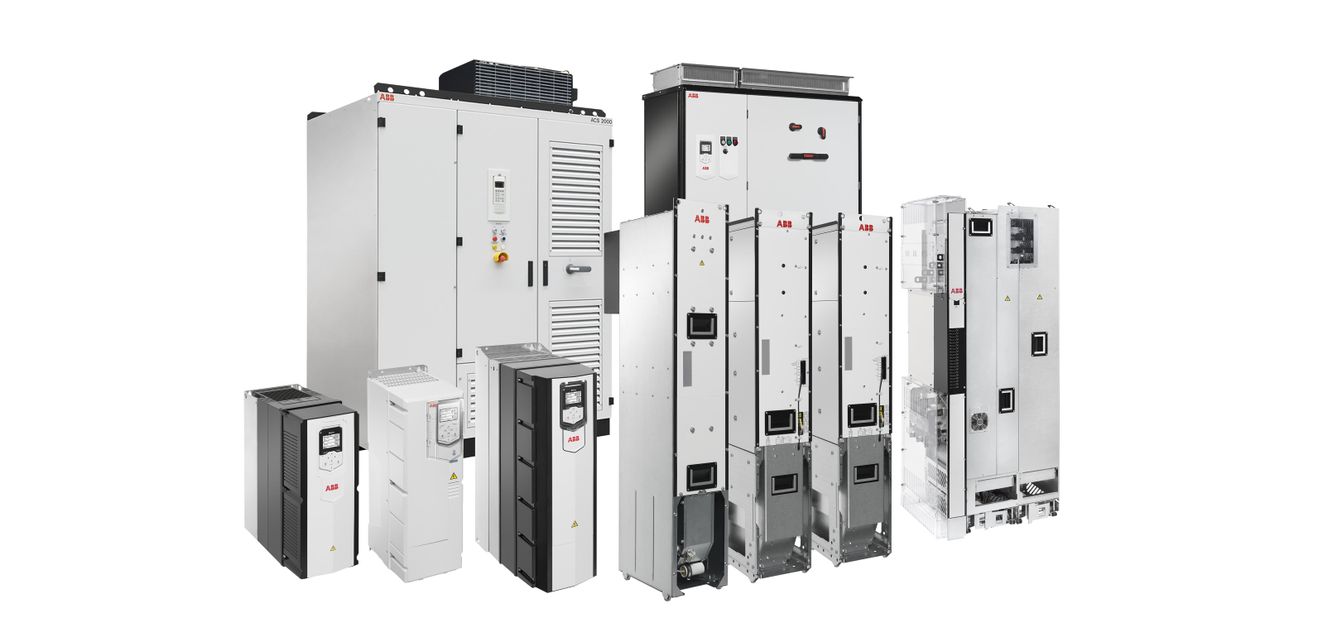
Another factor reduces the impact of AFE frequency converters on the power grid: An integrated LCL filter (inductor-capacitor-inductor) connected before the front-end IGBTs also removes high-frequency interference. Taken together, these technologies enable THD values of typically 3% to be achieved. In conventional frequency converters with an integrated choke—a widely used solution for harmonic suppression—the THDi value can reach up to 40%.
Effectively Reduce Harmonics
With its Ultra-Low Harmonic Drives (ULHD), ABB offers a wide range of frequency converters featuring AFE technology. These industry-specific devices prevent the oversizing of components such as generators, transformers, switchgear, and cables, and can also prevent components from overheating during retrofit projects. In addition, they ensure clean power grids with low THDi values and compensate for reactive power. Since utility companies often impose penalties on customers with high reactive power consumption, these solutions help avoid additional costs.
By combining various advanced technologies, Ultra-Low Harmonic Drives offer many advantages. They lower total cost of ownership, keep the power grid clean, and reduce the risk of disruptions. This helps prevent damage to equipment while also reducing the space required for installation.
In a perfect world of energy supply, there would be no harmonics. However, even in everyday operational practice, THDi values can be reduced to such an extent that there is no longer any risk to the equipment and power quality issues are minimized. By using ultra-low harmonic drives, operators gain advantages in terms of both costs and system safety.
Florian Groß, Product Manager for Drive and Control Technology, ABB Motion Germany


You might also be interested in
Practical training in drive technology
ABB Motion University: Learn, try, apply
The ABB Motion University in Mannheim has presented its training program for drive technology. The courses are designed to be practice-oriented so that participants can apply the knowledge they have acquired directly in the implementation, operation...
 read more...
Drive technology 2025
Drive technology is the heart of every production process. Nothing moves without it, and no machine can do without drive technology components. From frequency converters, electric motors and gearboxes to clutches and brakes. Who offers which...
read more...Frequency inverter in booksize format
With the Nordac Pro SK 500P, Nord Drivesystems has a control cabinet inverter that is available in variants in a power range from 0.25 to 22 kW, which can be assigned to different requirements in different industries.
read more...Drive technology 2024
Drive technology is the heart of every production process. Nothing moves without it, and no machine can do without drive technology components. From frequency inverters, electric motors and gearboxes to clutches and brakes. Who offers which...
read more...Regulated under all circumstances
CG Drives & Automation, supplier of inverter solutions, announces modular Emotron frequency inverters for renewable energies.
read more...48 V electronics in a modular system
Thanks to a well thought-out modular concept, powerful and robust power boards can be used in a wide range of applications with plug-in control boards.
read more...More efficiency and safety
The new M1 frequency inverter from Omron is designed to improve production processes. At Gruppo Romani, an Italian manufacturer of porcelain stoneware tiles, the M1 frequency inverters were used to modernize a press feeding system.
read more...No more complex test systems
In order to prevent faults during commissioning in advance, KEB Automation offers detailed firmware simulation models of its own inverters for download in the Twinstore.
read more...Inverters and synchronous motors
Energy-efficient drives
Nord Drivesystems presents the Nordac Pro and Nordac On inverter families as well as the IE5+ high-efficiency synchronous motors.
read more...