

Lightweight construction
Hybrid parts through friction stir welding
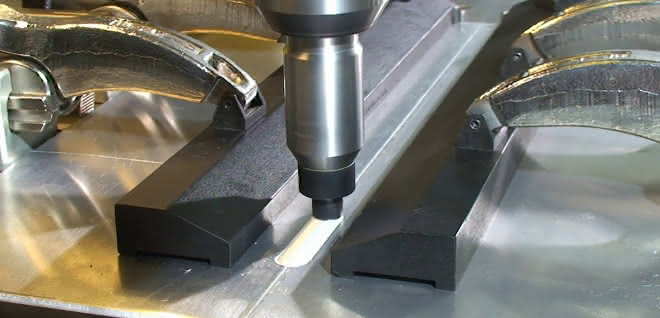
Lightweight and resilient components are the result of a newly developed process from the Materials Testing Institute at the University of Stuttgart. The researchers have developed a process based on friction stir welding that can be used to produce hybrid sheet metal blanks. In this process, aluminum and steel sheets of different thicknesses are welded together with high strength.
The basis of the new process is friction stir welding. In the welding process, a rotating tool (stirring) moves along the gap to be joined with a great deal of force (rubbing), thus joining the sheet metal blanks. According to Martin Werz from the Materials Testing Institute (MPA) at the University of Stuttgart, conventional arc welding of steel and aluminum produces brittle intermetallic joints. "Friction stir welding, on the other hand, produces high-strength and stable hybrid blanks," says Werz. These are also known as "Hybrid Tailor Welded Blanks". Werz explains the advantages of the process: "We can butt weld and overlap the sheets at the same time and thus achieve a larger cross-sectional area, which in turn ensures greater strength and consequently also greater formability." The seam is so stable that the hybrid blanks can even be deep-drawn. "Our weld seam holds even with complex geometries such as curves," says Werz.
Advantages for automotive production
The automotive industry in particular could benefit from the new process. Werz: "The advantages of thin sheets made of high-strength steels and aluminum sheets with a slightly higher thickness and the resulting higher buckling stiffness can be used in a component by combining both materials in a resource-saving way." Buckling stiffness is the resistance of a component to an elastic load perpendicular to the surface. This means that the material yields like a spring and returns to its original shape at the end of the load without having suffered a "dent".
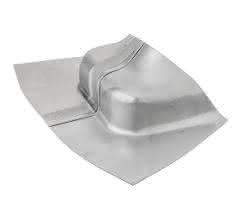
"Until now, hybridization in car body construction has only been achieved by assembling components made from different materials. Thanks to our developments, we are already making it possible to combine aluminum and steel in individual components. This opens up additional degrees of freedom in structural optimization, which can be used to reduce weight," says Werz. The expert also assumes that the weight of body shells can be reduced by around 10 percent by using hybrid blanks in car manufacturing - with the same level of safety. Less weight in turn leads to lower fuel consumption and reduced emissions.
In this video, the process of friction stir welding is explained briefly and clearly.
According to documents from Leichtbau BW / ag


You might also be interested in
Sustainability Through Simulation
Digital material selection reduces CO2 emissions by 40 percent
The use of digital material simulations can significantly reduce CO₂ emissions during the development and manufacturing of components. A real-world project by Schunk and Cadfem demonstrates how data-driven material selection can yield savings of up...
 read more...
Clever solutions for sensitive gripping
Innovative systems and exciting world premieres? That's what visitors will find at productronica in Munich from November 18 to 21. In Hall B3 at Stand 301, vacuum specialist Schmalz will be showcasing efficient and future-oriented handling systems -...
read more...Proprietary plastic compounds for extreme conditions
Cables must reliably transmit energy, data and signals, even in extreme cold or heat or under heavy mechanical stress. Specially developed plastics ensure that the cables remain robust and resistant. Lapp produces its own plastic compounds.
read more...Efficiency comparison of 3D printing, CNC manufacturing and injection molding
3D printing, CNC manufacturing or injection molding? When designers are looking for the most suitable manufacturing process for an individual component, they often lose time and also quickly lose track. Igus is changing this with the Triboteile...
read more...Heat transfer and additive manufacturing
Conflux Technology enters the hypercar sector
Pagani has announced the signing of a six-year contract with Conflux to integrate Conflux heat exchangers into the transmission of its latest exclusive model, the Pagani Utopia, further advancing additive manufacturing in the hypercar industry.
read more...Metal foam and PFAS replacement improve environmental balance
Metal foam contains up to 90 percent air and has amazing properties. In the factory, it ensures greater sustainability and helps to improve the environmental balance in industrial production.
read more...PFAS alternatives with high performance
Igus wants to set an example for innovation and sustainability and will be presenting new products at HMI 2025, including PTFE-free materials and products made from recycled material.
read more...No splinters, no maintenance
New properties also apply to load carriers in logistics and intralogistics processes. Craemer's portfolio includes high-quality returnable load carriers that are hard-wearing, versatile, maintenance-free and recyclable.
read more...Tensile strength of 3D components
Voxelfill strategy overcomes inhomogeneous strengths in 3D printing
The company AIM3D has succeeded in demonstrating the advantages of the patented voxelfill process. Strength tests now prove that this process can overcome inhomogeneous strengths of 3D components in the X, Y and Z axes and thus comes close to...
read more...