
Compressed air stations
Control system increases efficiency
Higher-level control systems increase the efficiency of compressed air stations. The latest generation of devices monitor and control, and provide data for various applications. As a result, energy costs are reduced while comfort and operational reliability are improved. There are additional application options such as predictive maintenance and life cycle management.
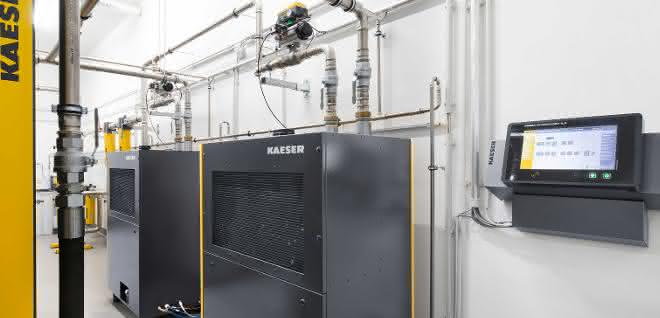
Efficiency, reliability, careful use of resources and energy savings are driving developers and users to continually optimize existing compressed air solutions. Modern compressed air stations are comprehensive systems with compressors, cooling systems, dryers and filters. Even the individual components have secondary systems such as ventilation or cooling water systems. In addition, modern compressed air stations are often integrated into heat recovery processes in order to achieve the best possible energy benefits. The range and number of individual components in a complete compressed air system can therefore be quite extensive.
Such a complex system requires a kind of organizing hand. This is where cross-machine control systems such as the Sigma Air Manager 4.0 from Kaeser come into play. They monitor the individual components and coordinate them optimally.
Up to now, their use has already made some optimization possible. For some time now, higher-level control systems have been able to optimize various compressors with different internal controls so that they always deliver the specified operating pressure while making the best use of energy. However, there were also points where there was still significant potential for improvement. For example, communication between components and the control system still offered many opportunities for development and refinement. Some compressors do not have integrated controls that recognize and transmit their status, but are only equipped with so-called potential-free contacts that only allow the basic status of the compressor (running/not running) to be transmitted.
In addition, the wide range of different bus systems that are incompatible or not very compatible with each other makes it difficult to pass on all the necessary information about the status of the systems. Modern bus systems based on Ethernet enable simpler integration and the transmission of a great deal of data. Systems that are already equipped with modern internal control systems are therefore already using Ethernet as a means of communication to network with other systems.
Latest generation of management systems
The latest generation of control systems are now true management systems. These act in exactly the same way as a higher-level control system, but can do even more. They determine the data of the connected components and measuring points via Ethernet and are able to transfer and evaluate them to a central control system without any restrictions. The way in which a device determines the data offers various possibilities for use. The management system optimizes the compressed air system. For example, the compressors and treatment components are always switched on and off or run at partial load in such a way that the compressed air quantity and quality correspond to the current demand - always with a view to operational safety and efficiency. In addition, the management systems monitor all relevant peripheral parameters such as the temperature and pressures in the compressor and compressed air treatment or the ambient conditions. This means that it is also possible to check whether the cooling system for the compressors is working properly or whether the ambient conditions meet the necessary requirements. If heat recovery is operated, all relevant parameters are also integrated into the management system.
Predictive maintenance
Maintenance is also a key factor in generating compressed air as cost-effectively as possible. Poorly maintained systems with dirty coolers or filters, for example, also have a lower specific output. New management systems therefore also take the maintenance parameter into account and include it in the overall optimization. Predictive maintenance not only saves energy but also costs and improves the value retention of the entire system.
More complex monitoring also makes it possible to look ahead. This monitoring can be carried out both in-house and by an external service provider. Providers of compressed air system solutions enable operators to monitor their systems remotely. Not only are the operating parameters for compressed air generation monitored, but the system is also repeatedly checked with regard to life cycle management. This allows changes in demand to be detected at an early stage and the compressed air station to be optimized accordingly. In addition to controlling the system itself, the management systems enable important data to be recorded, forwarded and evaluated for documentation in accordance with ISO 50001. They record data on air consumption or heat recovery and automatically convert it into costs, which can then be allocated to the individual items. The use of these functions, including visualization, is web-based with standard browsers.
But what to do if the existing system does not meet the latest standards? Even then, the use of management systems is possible. This is because they allow the integration of old systems. Management systems such as the Sigma Air Manager 4.0 optimize the compressed air supply. You do not need any additional software to monitor costs. This management system not only controls the compressors according to compressed air consumption, but also monitors and controls the entire system and its peripheral systems from an economic point of view. It also improves the data evaluation options and enables predictive maintenance as well as remote monitoring and life cycle management. This provides greater operational reliability with more precise information about your own system and reduces operating costs overall.


You might also be interested in
Filtration and sound attenuation in circuits
In liquid or air circuits, filter housings and silencers protect measuring devices, ensure particle-free vacuum and pneumatic systems, keep cooling circuits clean and reduce noise.
 read more...
KSS ultrafine filtration for grinding oils
Modular concept for pure oil
In order to grind economically, reliably and with the highest quality, extremely clean grinding oils are required. Filter manufacturer Vomat offers the metalworking industry high-performance and customized concepts for the filtration of cooling...
read more...Up to 95 percent less flue gas thanks to direct extraction
The requirements for occupational safety measures and safety technology are also constantly increasing in welding technology. The Technical Rules for Hazardous Substances (TRGS) stipulate that welding fumes and harmful substances must be extracted...
read more...Everything accurate in switch cabinet construction
To ensure smooth work processes, tools for processing enclosures and housings must function flawlessly and reliably. Häwa rounds off its punching range with the Multi-Press 500.
read more...Cooling and temperature control units
Hygienic packaging sells safely
In few industries are the requirements for hygiene in the production process as strict as in the food sector - the health of consumers has top priority. This results in enormous challenges for all machines and components involved, especially in...
read more...Efficient and sustainable
Rotary screw compressors are the reliable backbone of industrial compressed air generation. The innovative CSD/CSDX series from Kaeser Kompressoren with its numerous features produces them efficiently and saves energy costs. This also reduces theCO2...
read more...Healthy air during welding
Welding produces fumes and gases that are hazardous to health. Extraction is necessary to comply with the occupational exposure limits and is even mandatory when welding high-alloy steels.
read more...Wire mesh filters in medical technology
In hardly any other industrial development sector are the demands placed on products as high as in medical technology. After all, human lives depend on the performance and reliable quality of medical devices.
read more...Energy efficiency and sustainability in the smallest of spaces
With the StingR ultra-fine filter system, Lehmann-UMT has created a solution for the energy-efficient and precise treatment of fluids during tool grinding for extended tool life and high tool quality.
read more...