
Control network security
How anomalies go online
Industrial companies have to live with the fact that there are always new gaps in IT and OT infrastructures. In addition, there are causes of disruption that go beyond cyber security. Instead of relying purely on hazard prevention, seamless network condition monitoring is therefore required in order to be able to react effectively to potential disruptions in Industry 4.0. Industrial anomaly detection provides the technology required for this.
If companies can learn anything from the Spectre, Reaper and WannaCry threats, it is that no IT defense system in the world can completely secure the perimeter of their own industrial network. Last year, Bitkom estimated that the activities of cyber criminals and their own employees cost companies around 55 billion euros a year.
This figure does not yet take into account the disruption vectors that arise independently of cyber attacks. Even in small production cells today, there are often over 50 different components from different manufacturers with a variety of functionalities and configurations. This complexity promotes disruptions due to network problems, communication errors, capacity bottlenecks, network degradation and device conflicts. However, manufacturing environments depend on functioning real-time communication. Even small interruptions can lead to production disruptions. Audits repeatedly show that control network operators neither have an overview of their integrated components nor do they know the communication structure. According to a recent study by analyst firm Forrester Consulting, only 18% of the large companies surveyed have identified all the endpoints in their network. The remaining 82 percent lack digital transparency. All stakeholders agree that networks in I4.0 environments are an integral part of business success - and must be managed accordingly. However, this is not possible without digital transparency.
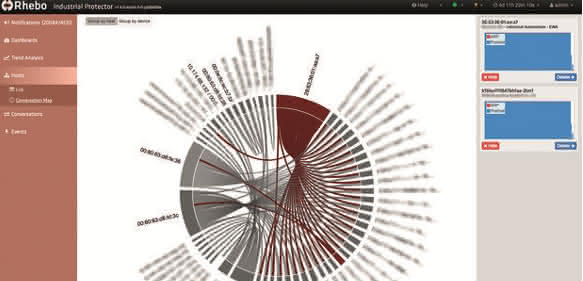
Companies need sovereignty over their control networks for effective network management. And this begins with seamless network mapping using industrial anomaly detection. The mapping answers the crucial questions for administrators: Which actors are operating in the control network? Who communicates with whom, how and how often? How high is the network load over time? What exactly is communicated in the control network? Surprisingly, a German automotive company found unknown participants in the control network as well as faulty data packets and unclear communication interruptions.
Analyze activities in the tax network
Analysis using industrial anomaly detection creates transparency about which components (assets) are active in the control network and what specific activities (events) are taking place between them. Using deep packet inspection technology, the individual communication packets are read out at content level and details of the communication structures become visible. This knowledge enables effective control network management, which always aims to ensure the continuity of real-time processes and the productivity of the entire system.
During operation, industrial anomaly detection as a network condition monitoring tool identifies malware attacks as well as network or system wear, faulty data packets, creeping changes, capacity bottlenecks and, last but not least, human errors. This means that all factors that could lead to disruptions or even failures in production are seamlessly detected and reported to administrators in real time. This expansion of the scope results in a complete picture of the control network dynamics, but also an increase in anomaly reports. Administrators are therefore supported by a risk assessment and filter options for the anomaly reports. For example, if a new network subscriber accesses a process-relevant device, this anomaly is shown with a high risk score. In addition, anomalies can be subjected to separate monitoring. If an anomaly recurs, it is automatically displayed in the context of its first occurrence. These network condition monitoring functions guarantee that administrators can immediately assess anomaly reports and evaluate the network quality and prioritize countermeasures.
With this complete visualization of all changes in the control network, industrial anomaly detection also functions as an information provider for other areas of the company. The data can provide important details for process optimization, preventive maintenance, quality assurance and general IT security. Interfaces (e.g. REST-API, Syslog, IEC 104) ensure smooth forwarding to the respective teams in the company, enabling full data integration within the company.
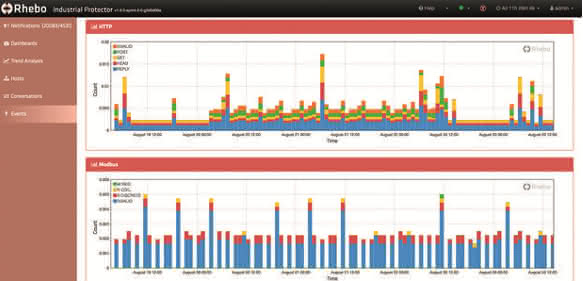
As industrial anomaly detection monitors the control network without feedback, anomalies are not automatically blocked. The administrators retain decision-making authority. Policy filters can also be used to filter anomaly messages according to individually definable parameters and forward them to other backend systems. For example, administrators can have messages relevant to cyber security automatically forwarded to the firewall's threat list. Anomaly messages that show a change in the performance of an end device, on the other hand, may be of interest for maintenance.
In this way, network condition monitoring not only creates transparency and security by means of industrial anomaly detection. It also supports operational processes in order to sustainably increase continuity and productivity. am


You might also be interested in
Filtration and sound attenuation in circuits
In liquid or air circuits, filter housings and silencers protect measuring devices, ensure particle-free vacuum and pneumatic systems, keep cooling circuits clean and reduce noise.
 read more...
KSS ultrafine filtration for grinding oils
Modular concept for pure oil
In order to grind economically, reliably and with the highest quality, extremely clean grinding oils are required. Filter manufacturer Vomat offers the metalworking industry high-performance and customized concepts for the filtration of cooling...
read more...Up to 95 percent less flue gas thanks to direct extraction
The requirements for occupational safety measures and safety technology are also constantly increasing in welding technology. The Technical Rules for Hazardous Substances (TRGS) stipulate that welding fumes and harmful substances must be extracted...
read more...Everything accurate in switch cabinet construction
To ensure smooth work processes, tools for processing enclosures and housings must function flawlessly and reliably. Häwa rounds off its punching range with the Multi-Press 500.
read more...Cooling and temperature control units
Hygienic packaging sells safely
In few industries are the requirements for hygiene in the production process as strict as in the food sector - the health of consumers has top priority. This results in enormous challenges for all machines and components involved, especially in...
read more...Efficient and sustainable
Rotary screw compressors are the reliable backbone of industrial compressed air generation. The innovative CSD/CSDX series from Kaeser Kompressoren with its numerous features produces them efficiently and saves energy costs. This also reduces theCO2...
read more...Healthy air during welding
Welding produces fumes and gases that are hazardous to health. Extraction is necessary to comply with the occupational exposure limits and is even mandatory when welding high-alloy steels.
read more...Wire mesh filters in medical technology
In hardly any other industrial development sector are the demands placed on products as high as in medical technology. After all, human lives depend on the performance and reliable quality of medical devices.
read more...Energy efficiency and sustainability in the smallest of spaces
With the StingR ultra-fine filter system, Lehmann-UMT has created a solution for the energy-efficient and precise treatment of fluids during tool grinding for extended tool life and high tool quality.
read more...