
Screwing strategy
Joining plastic
The plastic direct screw connection has proven itself in the field of mechanical connection technology and has been used successfully for more than 30 years. Users can get to grips with screw connections in plastic with the Koala process from Desoutter.
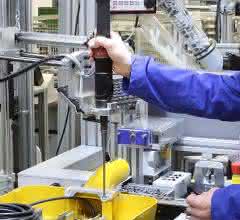
The material properties that plastics achieve depend primarily on the subsequent processing method. Compared to metal screw connections, the preload force in thermoplastics is essentially created by the deformation of the plastic. This means that it makes sense to take a close look at the processing, design specifications and properties of the material to be fastened. The joining technology of plastics is closely related to overall product development; all necessary process steps must be coordinated with the material properties, shaping and assembly as early as the design phase.
Reliable fastening is fundamentally linked to the reproducibility of the fastening results and the precision of the screwdriver. This requires a suitable choice of tool and assembly location. In direct fastening, the thermal properties of thermoplastics are used to form the nut thread with low stress and without cracks. Manual tightening is not recommended here because it is not continuous and the speed is far too low. Depending on the fastening class and tightening form, the tools must be able to measure control and/or control variables directly or indirectly. The higher the fastening class and the degree of automation, the higher the requirements for the tool used and the documentation capability. pb


You might also be interested in
Sustainability Through Simulation
Digital material selection reduces CO2 emissions by 40 percent
The use of digital material simulations can significantly reduce CO₂ emissions during the development and manufacturing of components. A real-world project by Schunk and Cadfem demonstrates how data-driven material selection can yield savings of up...
 read more...
Clever solutions for sensitive gripping
Innovative systems and exciting world premieres? That's what visitors will find at productronica in Munich from November 18 to 21. In Hall B3 at Stand 301, vacuum specialist Schmalz will be showcasing efficient and future-oriented handling systems -...
read more...Proprietary plastic compounds for extreme conditions
Cables must reliably transmit energy, data and signals, even in extreme cold or heat or under heavy mechanical stress. Specially developed plastics ensure that the cables remain robust and resistant. Lapp produces its own plastic compounds.
read more...Efficiency comparison of 3D printing, CNC manufacturing and injection molding
3D printing, CNC manufacturing or injection molding? When designers are looking for the most suitable manufacturing process for an individual component, they often lose time and also quickly lose track. Igus is changing this with the Triboteile...
read more...Heat transfer and additive manufacturing
Conflux Technology enters the hypercar sector
Pagani has announced the signing of a six-year contract with Conflux to integrate Conflux heat exchangers into the transmission of its latest exclusive model, the Pagani Utopia, further advancing additive manufacturing in the hypercar industry.
read more...Metal foam and PFAS replacement improve environmental balance
Metal foam contains up to 90 percent air and has amazing properties. In the factory, it ensures greater sustainability and helps to improve the environmental balance in industrial production.
read more...PFAS alternatives with high performance
Igus wants to set an example for innovation and sustainability and will be presenting new products at HMI 2025, including PTFE-free materials and products made from recycled material.
read more...No splinters, no maintenance
New properties also apply to load carriers in logistics and intralogistics processes. Craemer's portfolio includes high-quality returnable load carriers that are hard-wearing, versatile, maintenance-free and recyclable.
read more...Tensile strength of 3D components
Voxelfill strategy overcomes inhomogeneous strengths in 3D printing
The company AIM3D has succeeded in demonstrating the advantages of the patented voxelfill process. Strength tests now prove that this process can overcome inhomogeneous strengths of 3D components in the X, Y and Z axes and thus comes close to...
read more...