

Assembly work cells
Precisely coordinated
electronic components in five precisely coordinated work cells using nine robots.
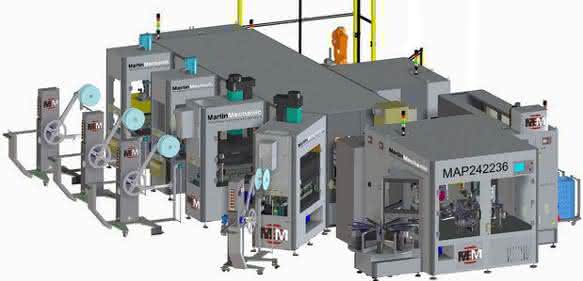
A new system from Martinmechanic, which has been developed for overmolding electronic components, is the size of a stately family home. In the MAP242236, five precisely coordinated work cells work hand in hand on a floor area of 130 square meters, with a total of nine Stäubli robots at work. The manufactured components are used to assemble the housings of circulating pumps for the electronics industry. Seven four-axis Scara TS 80 robots are used for this because of their long reach at maximum speed, another four-axis Scara TS 60 robot and a six-axis TX 200 robot. Three workpiece carrier circulation systems and four punching units have also been integrated into the cell.
Belt cycle time of 20 seconds
The automation system consists of pre-assembly, assembly for the injection molding machine, a cooling cell, the test cell and the palletizing cell. Five robots are used in pre-assembly alone for the production of punched sheets and contact plates. The two servo-electric presses have a punching force of 40 tons, the two pneumohydraulic presses 20 kilonewtons. Because work is carried out in parallel, two workpiece carrier circulation systems are used to eliminate the entry and exit times of the workpiece carrier. Each belt has a cycle time of 20 seconds.
So the robot always has something to do. Because if it can't deposit on the first belt, it goes straight to the second and vice versa. The strip material for the four different sheet metal parts is unwound via reels. Once the components have been punched out, the robot always places them in parallel in the workpiece carriers, each with two cavities, which travel on the circulation belt. The complete setting pattern consists of the punched sheet, contact sheet, the contact unit vaporized with gold for optimum conductivity, the solder pin and five copper discs. The latter are fed in via a conveyor bowl.
Overmolded parts carefully cooled down
The six-axis robot uses its quadruple gripper to remove two complete setting patterns from the workpiece carrier in order to insert them precisely into a pendulum table of the vertical injection molding machine. The injection mold is located on the underside of the machine and closes automatically so that the injection process can begin; it takes just 16 seconds.
The six-axis robot places the overmoulded finished parts in the rotary indexing table of the cooling cell, which continues to its second and third stations, where the temperature is lowered in each case. This prevents the material from warping. Only at the fourth station of the rotary indexing table are the overmolded copper discs punched out to their final dimensions in the middle after the cooling process. This enables maximum precision to be achieved.
Bad parts are rejected immediately
To avoid rejects as far as possible, parts that are not in order should be detected and rejected as early as possible. Image processing, which is installed above the parts to be inspected, is used to check whether the sprue in the center of the copper disc has been completely removed and whether there is any overmolding. A Scara robot picks up the overmolded parts and sorts out bad parts directly via a separate discharge belt. The good parts are deposited on the third workpiece carrier circulation system, which serves as a buffer between the cooling and test cell. Another Scara robot now places the good parts in the rotary indexing table of the test cell, which in turn has eight stations and cycles in 40 seconds - it works on five components simultaneously. These are first turned and prepared in the assembly direction. A high-voltage test is carried out at the second station. To do this, the test head is lowered onto the solder pins to perform a short circuit test. Parts that do not pass this test are ejected from the ongoing process by the robot.
Two capacitors are fed to the component at the third station. The Scara robot removes one capacitor at a time from the carrier tape and inserts it into the contact pin bending station. The contact pin is carefully pre-bent and deflected so that the capacitor can be pressed into the housing. The contact pin is then pressed into the contact fork. At the fourth, fifth and sixth stations, the contact pins of the respective capacitors are welded to the contact fork. The low-voltage test measures the voltage and discharge current at the seventh station. If the values meet the manufacturer's specifications, they are given their specific data matrix code at the eighth and final station.
Siemens controls "fail-safe"
The components then return to the first station of the rotary indexing table, where they are removed by the robot and placed twelve at a time in a blister. Finally, a palletizing and depalletizing cell from Martinsystems' standard range takes over the blister handling.
The carefully devised PLC control of the entire system is handled by a Siemens S7-1515F; the "F" stands for "fail-safe". The operator uses the mobile, wired KTP700 panel for this purpose. The entire system took twelve months to develop and build. pb


You might also be interested in
ebm-papst is growing again thanks to AI and data centers
ebm-papst returned to a growth trajectory in fiscal year 2025/26. Air Technology, data center applications, and artificial intelligence are driving revenue and investment.
 read more...
SPE on the Verge of a Market Breakthrough
Single Pair Ethernet (SPE) has moved beyond the conceptual phase and is increasingly being implemented in industrial settings. The focus here is not only on higher data rates and simplified cabling, but above all on the issue of system integration...
read more...More than 900 exhibitors already registered
Around six months before the start of the trade fair, more than 900 companies have registered for SPS 2026 in Nuremberg. The trade fair focuses on industrial AI, cyber security and digital transformation.
read more...Virtual PLCs in practice: How vPLCs make production systems more flexible and scalable
The increasing networking of IT and OT is fundamentally changing industrial automation. The IT/OT Integration Summit shows how modern technologies can make production environments more efficient, flexible and future-proof. The event will focus on...
read more...Sales growth in a turbulent market environment
Thanks to innovations and a focus on strategic industrial markets, Sick was able to moderately increase its sales in the 2025 financial year. In a turbulent market environment, the company was able to maintain its position and gain market share with...
read more...Siemens presents new AI agent
Siemens is launching 'Eigen Engineering Agent', an AI for automation technology. The solution is integrated into the TIA Portal, has been tested with over 100 companies and is designed to significantly accelerate engineering processes.
read more...Schaeffler keeps sales almost stable
Schaeffler generated revenue of EUR 23.5 billion in 2025 and increased EBIT before special items to EUR 936 million. At 266 million euros, free cash flow was significantly above the prior year and forecast. Net income remained negative due to high...
read more...Advancing artificial intelligence together
Helukabel is stepping up its activities in the field of artificial intelligence and is now a member of the IPAI. The innovation and collaboration platform for companies, research facilities, institutions and administration has set itself the goal of...
read more...New impetus for ifm sales
Two new positions were filled at ifm at the start of 2026: Markus Wolf becomes Managing Director Sales Germany, Sven Quant takes over the position of Central Managing Director in the Process Sensors division within the ifm Group.
read more...