
Multimedia framework
Open source for embedded systems
The open source multimedia framework GStreamer makes it possible to equip embedded systems with extensive video functions. Among other things, several video sources can be combined with each other and text overlays can be inserted.
Modern vision applications contain a large number of different elements. Each individual function block must be well selected, configured and validated before it is then connected to other components in applications that are as durable as possible. In addition to the lowest possible barrier to entry into a new technology, the longevity of the architecture and the largest possible number of low-cost or free features should round off the package.
The GStreamer project meets many of these requirements and is becoming increasingly popular, also in the field of resource-optimized embedded systems. GStreamer is a pipeline-based multimedia framework and, like many other open source projects, has its roots in the scientific field. The project was presented to the public at the end of 1999 and has since been maintained and actively developed by a growing community of developers.
Application examples
GStreamer is used in many embedded systems that have to meet current requirements in terms of function, quality and performance. Sophisticated implementations in modern analysis or monitoring applications often require a picture-in-picture application. The framework offers all the elements "out of the box" to read in static images or video streams and display them as a picture-in-picture application.
Many measuring devices require the display of measured values combined with continuously updated status information. The GStreamer framework offers a wide range of options for inserting graphics and text overlays into multimedia content, combining them with each other or displaying them as menu elements. In this way, appealing and informative user interfaces can be designed.
As an open source project, GStreamer is also maintained and further developed by the community. Users can participate in the development results or help shape the implementation of the functionality by making their own contributions to the community. Developers who want to use the framework and require external support can, in addition to the support provided by the community, fall back on specialized service providers to adapt the tool to specific projects or implement extensions. GStreamer is available under the LGPL license and can be used in accordance with the specifications of this open source license.
Use of pipelines for maximum flexibility
GStreamer is based on the pipeline model and offers the possibility of combining one or more multimedia sources with each other, modifying, filtering, encoding or decoding them using suitable filters and, after processing, feeding them into one or more data sinks. The pipeline can be branched and thus offers a wide range of options for further processing content.
Each filter element also represents a data sink for receiving the data and a data source for providing the data for the following filter element or the data sink.
This representation of the pipeline is greatly simplified and is intended to illustrate the basic principle of GStreamer. For example, multimedia files, an image that is delivered directly from the camera to the pipeline or a data stream that is received via the network can be used as a data source. Filter blocks are used to filter content, split or merge data streams, encode or decode data, superimpose other information on existing content or modify it in other ways.
If embedded Linux is used as the operating system for the embedded application, GStreamer can be used very easily to create prototypes of new or modified functions. The command line is used in a terminal to start GStreamer and to string together and use the individual elements. In GStreamer, the elements of the pipeline are called "elements". A plug-in usually comprises several elements. For example, there is a plug-in for "vaapi" or "rtp". A typical entry in the command line could look like this:
gst-launch-1.0
videotestsrc \
! video/x-raw-yuv, framerate=30/1, width=800, height=480 \
! vaapih264enc \
! mp4mux \
! filesink location=testfile.mp4
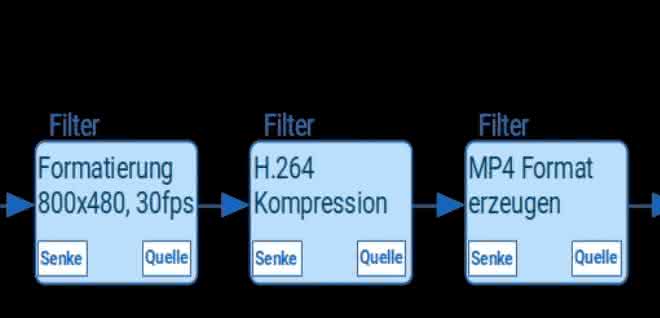
This command generates a test image using the test image generator, formats the image to 800x480 pixels and a frame rate of 30 FPS, encodes this video content in H.264 format, generates the MP4 format from the compressed content and saves the result in a file. In function blocks of a GStreamer pipeline, the function shown would look like Figure 4.
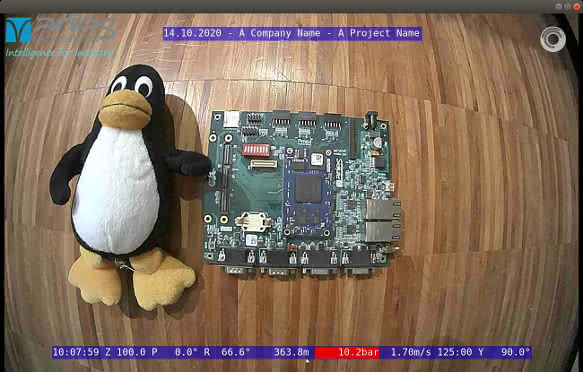
With the videotestsrc element, it is possible to provide test videos in many different formats for a pipeline. If these are then combined with the media players available in Linux distributions, initial prototypes of a later video track or another application can be realized using only standard Linux on-board resources, without having to configure a camera sensor or switch on a display beforehand.
In practice, plug-ins are used as shared libraries to provide a variety of video and audio functions. Plug-ins help to realize data sources and sinks, add overlays as text or images, encode and decode many common audio and video formats, display streams and images and much more.
Codecs and hardware acceleration
Many formats for files, streams and codecs are natively supported by hardware acceleration in CPU derivatives, graphics or audio cards. These architectures offer functions for encoding and decoding popular formats such as H.264, H.265 or MJEPG in the CPU or chipset. This is particularly interesting for the resource-saving implementation of embedded systems, as the use of these accelerator blocks places little or no load on the hardware. In practice, this helps to realize leaner systems, save time, money and resources for the product and also reduce the development risk. Using the command line can be the preferred solution for quickly testing the feasibility of a desired functionality. For final products and releases, GStreamer is used in C#, C++, Python, Perl and other environments. The GStreamer framework itself is available as source code and can also be used as a precompiled binary on Android, iOS and Windows.
Aries Embedded already supports its customers in many smart vision projects. This often begins with advising customers on the CPU or FPGA architecture to be used, and continues with the development of hardware, software and IP through to the qualification and delivery of complete systems in series production.
Andreas Widder, Managing Director of Aries Embedded


You might also be interested in
Filtration and sound attenuation in circuits
In liquid or air circuits, filter housings and silencers protect measuring devices, ensure particle-free vacuum and pneumatic systems, keep cooling circuits clean and reduce noise.
 read more...
KSS ultrafine filtration for grinding oils
Modular concept for pure oil
In order to grind economically, reliably and with the highest quality, extremely clean grinding oils are required. Filter manufacturer Vomat offers the metalworking industry high-performance and customized concepts for the filtration of cooling...
read more...Up to 95 percent less flue gas thanks to direct extraction
The requirements for occupational safety measures and safety technology are also constantly increasing in welding technology. The Technical Rules for Hazardous Substances (TRGS) stipulate that welding fumes and harmful substances must be extracted...
read more...Everything accurate in switch cabinet construction
To ensure smooth work processes, tools for processing enclosures and housings must function flawlessly and reliably. Häwa rounds off its punching range with the Multi-Press 500.
read more...Cooling and temperature control units
Hygienic packaging sells safely
In few industries are the requirements for hygiene in the production process as strict as in the food sector - the health of consumers has top priority. This results in enormous challenges for all machines and components involved, especially in...
read more...Efficient and sustainable
Rotary screw compressors are the reliable backbone of industrial compressed air generation. The innovative CSD/CSDX series from Kaeser Kompressoren with its numerous features produces them efficiently and saves energy costs. This also reduces theCO2...
read more...Healthy air during welding
Welding produces fumes and gases that are hazardous to health. Extraction is necessary to comply with the occupational exposure limits and is even mandatory when welding high-alloy steels.
read more...Wire mesh filters in medical technology
In hardly any other industrial development sector are the demands placed on products as high as in medical technology. After all, human lives depend on the performance and reliable quality of medical devices.
read more...Energy efficiency and sustainability in the smallest of spaces
With the StingR ultra-fine filter system, Lehmann-UMT has created a solution for the energy-efficient and precise treatment of fluids during tool grinding for extended tool life and high tool quality.
read more...