
Warehouse automation
How AMR is revolutionizing fulfillment
Automation in intralogistics continues to gather pace. In addition to automated guided vehicles (AGVs), autonomous mobile robots (AMRs) are taking on more and more transportation tasks for a wide range of applications.
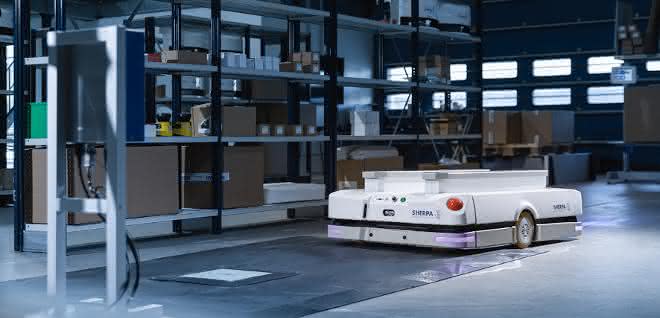
According to the market analysis "The Mobile Robot Guide" by Interact Analysis, the average annual growth of the industry is more than 50%. Fueled by booming e-commerce, AMRs are finding their way into more and more fulfillment centers. But which intralogistics environments and processes exactly are AMR suitable for? And what role will the energy supply play in the efficient operation of the systems in the future?
With the use of autonomous mobile robots (AMR), logistics companies are responding to the challenges of the supply chain in times of e-commerce, a shortage of skilled workers and increasing cost pressure. Whether manual transport processes in the warehouse, subtasks of complex picking processes or moving pallets and heavy payloads - AMRs are flexible and are taking over more and more intralogistics workflows. In contrast to AGVs, they score points with their autonomous navigation, simple integration without interfering with the existing infrastructure and their scalability. With the help of artificial intelligence or machine learning, the systems decide independently which task to perform and when. Thanks to AI, the systems automatically adapt their transport routes to changes in the warehouse layout. These properties make them particularly interesting for the complex tasks required in modern fulfillment centers.
AMR plays out its advantages in the fulfillment center
For online retailers, the key to success lies in customer satisfaction. In addition to the shopping experience, fast and smooth order processing is a central component. Fulfillment centers and operators such as 3PL play a crucial role in this. From the moment the order is placed until it is handed over to a shipping service provider, they handle all logistics processes from goods receipt and order acceptance to packaging, shipping, warehouse management, customer data management, returns management and payment processing. Fulfillment centers are under great pressure to design their processes efficiently. Consumers expect free delivery, which is why the costs incurred for the fulfillment process cannot be passed on to the end customer. It is therefore important to automate the non-value-adding transport processes and use employees for "finishing".
AMRs can develop their full potential in this environment. The robots cover complex transportation networks within a warehouse and perform transportation tasks quickly and flexibly. This includes the transportation of loading aids such as containers, cartons and trays, the safe transport of pallets and the picking up of roll containers and shelf structures at floor level. AMRs are ideal for supplying goods according to the goods-to-person principle and can support employees in all warehouse areas with order picking activities. Collaborative approaches based on the person-to-goods principle are also possible.
Energy supply is currently still a weak point
As sophisticated as AMR's technology is for accomplishing its tasks, the energy supply of its batteries is often outdated. When the energy level of a robot's lithium-ion battery is running low, it leaves its workflow and moves to a separate area where it is charged using plug-in or sliding connections. During the charging process, which can take several hours, the robot is absent from the process. To maintain the productivity of the center, it must therefore be replaced by another robot. Real 24/7 continuous operation of an autonomous robot that does not navigate on inductive conductor lines cannot be realized in this way. In addition, there are failures due to violent damage to the charging infrastructure and regular maintenance measures. This means that the energy supply is a real productivity killer and must be actively managed by the warehouse operator on an ongoing basis.
Inductive charging technology as the key to future viability
A new approach is being taken with AMRs equipped with inductive point charging systems such as etaLINK from Wiferion. Instead of driving to fixed charging stations,
the robots receive the amount of energy they need for their transportation tasks fully automatically during their workflow at frequently frequented stations in what is known as "in-process charging". This allows the vehicles to complete their transportation tasks in 24/7 continuous operation without interrupting the logistics processes for charging breaks. The etaLINK system is extremely flexible to install. The charging pads can be attached to walls, the floor, driveways, parking spaces or loading and unloading stations in just a few hours. New placements due to changing layouts can be quickly implemented in just a few simple steps.
This results in numerous advantages that make the use of AMR even more economical and logistics even more productive. For example, the fleet size can be up to 30% smaller than when using AMRs with conventional battery charging technologies while maintaining the same high level of productivity, as there is no need to compensate for downtime due to charging breaks. In addition, AMRs with inductive charging systems are often cheaper, as some of the batteries can be designed smaller. Eliminating the charging zones frees up valuable space in the fulfillment center, as there is no need to set up cost-intensive additional charging zones that can be used for value-adding processes. The etaLINK system from Wiferion also guarantees a maintenance-free energy supply for the vehicles, as it does not require any mechanical plug or sliding contacts. This completely eliminates the need to clean oxidized plugs or replace broken cables.
Another advantage: the etaLINK system supports all common battery types. Thanks to the variability of the system voltage, different vehicle types can share a common charging point. This reduces the number of different charging systems. As a result, other electrically powered vehicles such as AGVs, pallet trucks and forklifts can also be supplied with energy via a decentralized charging infrastructure.
Due to their numerous advantages, autonomous mobile robots will be an essential part of workflow optimization in fulfilment centers in the future. Inductive charging will play a central role as a key technology to unlock the full potential of the systems. Continuous operation of the robots is only possible with in-process charging. And because they are maintenance-free, fulfillment center operators no longer have to actively look after their charging infrastructure and can concentrate fully on their core tasks.


You might also be interested in
Helu makes its first trade fair appearance under a new brand name
Helu Kabel will be presenting itself as Helu for the first time at Hannover Messe 2026, showcasing system solutions, Heluchain cables and new industrial luminaires.
 read more...
Strategic realignment with brand relaunch
In future, Helukabel will trade as Helu
The Helukabel Group is parting with part of its name: in future, the company will only operate under the Helu brand. With this step, the specialist for electrical connection technology is underlining its strategic development from a classic cable...
read more...Modular plant construction for corrugated board
Insight into the production of corrugators at BHS Corrugated: Automated, modular and equipped with Helukabel components.
read more...Best quality for the steel
Conditions in the steel industry are harsh and inhospitable. The machines used must be able to withstand the demanding environmental conditions in order to deliver the best quality at all times.
read more...If the standard cable is not sufficient
Lapp offers cables for countless applications - but not for all of them. From time to time, the developers have to modify a standard cable or develop a special cable.
read more...Slight decline in sales, strong investments
The Lapp Group has not been spared from the weakening global economy. However, the company only recorded a slight loss in the past 2024 financial year.
read more...Electrical connection technology
Cables and wires for industrial automation
Heukabel offers system solutions for cable routing from a single source. The subsidiary EKD Systems specializes in tailor-made cable drag chains made of steel, stainless steel and plastic, which are used in moving machines and systems as well as in...
read more...Lapp relies on Ultramid from BASF
Mobile charging of electric vehicles
The automotive industry is currently undergoing the biggest transformation in its history. The boom in battery electric vehicles in particular is presenting the industry with major challenges. Lapp, as a supplier of cables and connection...
read more...Cable handling application
At this year's Motek, ArtiMinds Robotics is showcasing a robot-based automation solution for the sensor-assisted assembly of flexible cables in connector housings.
read more...