

Sustainability
PFAS-free polymer membranes for the semiconductor industry
PFAS chemicals are widely used in many industries due to their stability and resistance to water and grease. In the production of semiconductors, for example, membranes containing PFAS are used in various process steps. Researchers at the Fraunhofer Institute for Applied Polymer Research IAP have now developed a sustainable alternative in the form of a new type of PFAS-free membrane.
PFAS chemicals are toxic, they pollute water and soil and accumulate in humans and animals through food and consumer products. In February 2023, the European Chemicals Agency (ECHA) therefore published a proposal to ban the manufacture, use and placing on the market, including import, of PFAS in the European Economic Area. The semiconductor industry is critical of the impending PFAS ban: according to many manufacturers, there has been no alternative to the long-lasting perfluorinated and polyfluorinated chemicals to date, and the production of most semiconductor products would then no longer be possible.
Chemically stable with small pore diameter
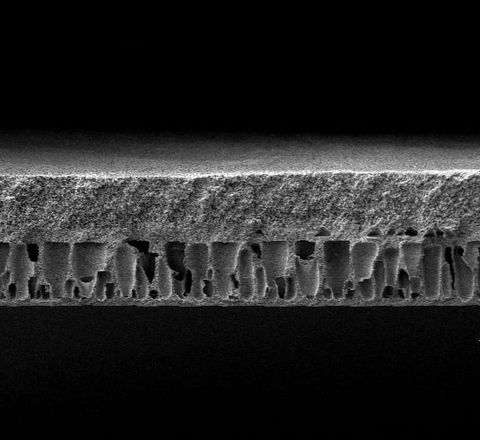
Researchers at the Fraunhofer IAP in Potsdam have now succeeded in developing a PFAS-free membrane made from conventional, specifically stabilized polymers that can replace PFAS membranes for a supplier to the semiconductor industry. The membrane made from the polymer polyacrylonitrile (PAN) is characterized by high chemical and mechanical stability. It also has an extremely small pore diameter of around seven nanometers. This is necessary to separate particulate impurities from the production process and to filter and recycle the operating fluids required for the process, such as acids and solvents.
"When chips are manufactured, countless process steps such as sawing, cleaning and planarization take place in order to apply the structures to the wafers. All of these operations generate particulate impurities that have to be separated during each process, otherwise they would damage the production of the nanometer-sized structures," explains Dr. Murat Tutus, engineer at the Fraunhofer IAP and head of the "Membranes and Functional Films" department. "We were able to chemically modify the polymer with another component that we patented and stabilize it for harsh process conditions," says the researcher.
Fields of application possible in various industries
As the membrane can be adjusted via the pore size and permeability, it can be easily adapted to different applications in other industries. The advantage of adapting a membrane is that existing systems can continue to be used and employees do not need to be trained. Dr. Tutus and his team see great potential for their developments, particularly in the pharmaceutical and chemical industries.


You might also be interested in
New platform facilitates chip design
Siemens opens access to EDA software in Europe
Siemens is cooperating with the Chips JU within the framework of EuroCDP and is facilitating access to modern EDA software for chip design, development and innovation for European companies. The aim is to strengthen start-ups, SMEs and research...
 read more...
Europe is increasingly losing touch in chip research
The research and development of semiconductor technologies is increasingly taking place outside Europe, particularly in Asia. This is shown by evaluations of semiconductor patents by EconPol Europe.
read more...Semiconductors and industrial robots
Yamaha Robotics joins forces in Europe
Yamaha Robotics bundles its European office with its subsidiary YME to expand semiconductor back-end processes (SEMI), SMT and FA solutions in Europe and to strengthen sales and services.
read more...Servo technology with integrated intelligence
The new Sigma-X high-end servo system from Yaskawa meets the technical requirements of modern semiconductor production with smart features such as automatic load adjustment, vibration suppression and synchronized axis control.
read more...European semiconductor industry united
Merck, Siemens, Intel, Trumpf and Zeiss focus on cooperation
Europe can only expand its technological leadership in the semiconductor industry through close cooperation - companies such as Merck, Siemens, Intel, Trumpf and Zeiss agree on this. In Darmstadt, they discussed Europe's importance for AI and...
read more...Save costs with 3D printers
Trumpf's 3D printing technology makes manufacturing systems for the semiconductor industry more precise and efficient. Semiconductor manufacturers can reduce waste and save costs with AM technology.
read more...On the way to integrated semiconductor...
It's about the building blocks of the future
"Europe can only achieve true sovereignty in semiconductor production through a fully Europeanized value chain." A statement by Tobias Wölk, Product Manager Automation Technology & Active Components at Reichelt Elektronik.
read more...Mitsubishi Electric invests in the future
Further production building in Owariasahi City
Due to the growing importance of the Japanese region of Owarisahi in Aichi, Mitsubishi Electric Corporation is increasing its planned investments and announcing the construction of a second production building.
read more...Efficient robot monitoring
Microchips are installed almost everywhere - whether in smartphones, washing machines or cars. With increasing digitalization, the demand for semiconductors has been growing rapidly in all areas of the economy for years.
read more...