
Semiconductor manufacturing
Servo technology with integrated intelligence
The new Sigma-X high-end servo system from Yaskawa meets the technical requirements of modern semiconductor production with smart features such as automatic load adjustment, vibration suppression and synchronized axis control. It enables more compact machine designs, precise motion sequences and permanently optimized system availability.
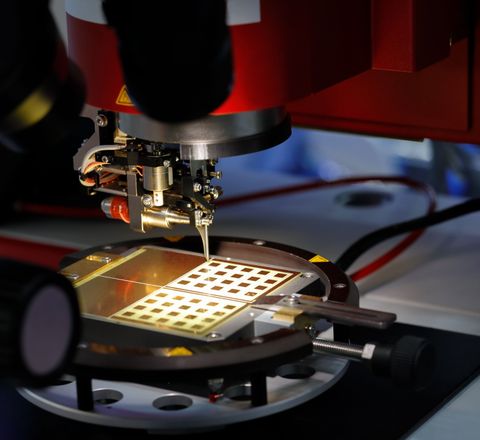
In order to meet the requirements of industry-specific standards such as SEMI S2 and S8, machines in semiconductor production must work with particular precision. This also places high demands on the servomotors used, especially in pick-and-place applications such as PCB assembly, wafer handling or processes such as wet etching. Reliability and availability are important here, as failures can quickly become expensive. Maintenance should therefore be as simple and quick as possible. A long component service life also plays a key role in making the investment cost-effective.
In crimp pressing/crimping, for example - a joining process in which two components are joined together by plastic deformation - the servo systems are challenged in several ways: They have to maintain the exact pressure at all times and distribute it to several synchronized axes. It is also necessary to be able to stop the movement in any desired position - while maintaining process stability throughout the entire production cycle.
In coating, as a second example, rotating tables are sprayed evenly with liquid at high speed. In order to achieve a precise result, a targeted adjustment and reduction of the speed ripple is necessary. In addition, customized solutions can also be implemented for other specific applications and requirements.
Sigma-X high-end servo system
The new Sigma-X high-end servo system from Yaskawa supports these specific requirements with smart features such as optimized torque compensation, automatic load adjustment, vibration suppression and synchronized axis control. The aim of the further development was to enable machine manufacturers and users to further increase the competitiveness of their machines and maintain their technical lead over the competition: The very compact servomotors make machines even more compact in design. At the same time, the versatile tuning functions are very easy to learn and use.
The system automatically detects mechanical vibrations and resonances in the machine and counteracts them. The acceleration sensors integrated in the new servomotors can now detect undesirable machine conditions at an early stage. The servo drive also provides the user with a wide range of helpful information, such as electrical consumption data, current power and temperature reserves, maintenance cycle indicators and vibrations. This allows the performance of the machine to be permanently analyzed and optimized while ensuring maximum availability.
New smart features
The new smart features are designed to reliably optimize operation and control while increasing productivity and improving system availability. Yaskawa has therefore further improved the intelligent functions compared to the previous Sigma-7 servo series: for example, Sigma-X can now control the torque more precisely. Vibration suppression is particularly important for polishing in wafer production and processing. Sigma-X is also used in other specific applications such as wafer handling, wire bonding, wafer wet etching, path tracking, grinding polishing, wafer dicing and cutting machining.
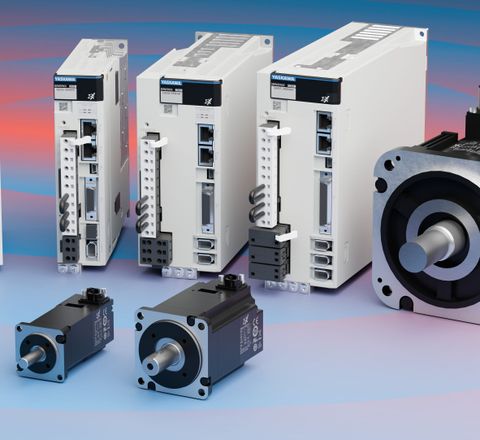
The Yaskawa servo packs can suppress even more vibration frequencies than before. This function has been available since Sigma-V, and with the Sigma-7 series two vibration frequencies can be suppressed simultaneously. This eliminates the need to increase the rigidity of the mechanics and reduces material costs. A further function can compensate the speed ripple using several actual values parameterized as input signals. This function is activated as standard for Yaskawa motors. For all other motor types, this function can be activated and adjusted using the SigmaWin+ software.
In applications where the load (moment of inertia) fluctuates greatly due to the operating status and machine position, such as robots and transfer devices, positioning normally takes longer. With the load fluctuation compensation control function, positioning takes the same amount of time as long as the load fluctuations are within ±500% of the set reference value.
The Yaskawa servo pack can detect errors in movement patterns, and this enables preventive maintenance. Several tracks of a specific movement pattern are recorded. These are analyzed, stored in the Servopack and continuously compared with the current movement. Above a certain threshold value, the Servopack triggers an alarm.
The high-end servo systems of the Sigma series from Yaskawa are suitable for many areas of application - not only in semiconductor production systems, but also in packaging machines, wood processing or digital printing machines, for example. It is possible to replace existing Sigma 7 systems. The new system is currently available in 200 V from 50 W to 15 kW. Models with 400 V are to follow soon. Servo amplifiers for the simultaneous connection of up to three servo motors are now available, as are models with special firmware for use in gantry systems. Analog/pulse as well as EtherCAT and Mechatrolink-4/III are offered as interfaces. All servo drives have STO (Safe-Torque-Off) on-board as functional safety. The Sigma-X components are technically coordinated and integrated into the new iCube control platform. The corresponding iC9226 controller works with the Triton industrial chip from Yaskawa and can control up to 64 servo axes synchronously. It can be programmed using the iCube Engineer software tool and can be equipped with or without an integrated FSoE Safety Master.
Martin Hoop, Business Develop Manager Motion, Mehmed Handaganic, Account Manager Sales, Yaskawa Europe


You might also be interested in
Drives for Extreme Conditions
Standard solutions quickly reach their limits under extreme conditions. Together, Ultra Motion and Faulhaber develop custom-designed actuators for deep-sea, space, and other demanding applications that place the highest demands on reliability and...
 read more...
Triton Partners takes over Flender
Global investment firm Carlyle has signed an agreement to sell Flender, a provider of mechanical drive technology, to Triton Fund 6, advised by Triton. The terms of the transaction were not disclosed and is expected to close in the fourth quarter of...
read more...New roller conveyor cover from Hema
Rolls faster & lasts longer
Hema brings speed to roller blinds: With the expansion of the product family for roller conveyor covers, the specialist for machine and equipment protection has improved travel speed by 30 percent.
read more...Family-owned company invests 28 million euros in Nuremberg site
Anyone talking about German industry at the moment is often talking about uncertainty: a weak economy, high costs, global upheavals. A different story is being told in Nuremberg.
read more...Why stator and rotor laminations are becoming a performance factor
Why the future of robotics depends not only on software, but also on high-precision stator and rotor laminations inside the motor.
read more...New drives and image processing for networked production
B&R, the Machine Automation Division of ABB, will be presenting new solutions for machine and plant engineering at the all about automation trade fair in Wels. The focus will be on drive technology and industrial image processing.
read more...Around 9 percent increase in incoming orders
In the 2025 financial year, Bosch Rexroth generated sales of around 6.5 billion euros. The company thus succeeded in maintaining its business at the previous year's level despite the persistently difficult environment. Order intake recorded...
read more...Increased demand for control and drive...
Sieb & Meyer expands production capacities in Lüneburg
Sieb & Meyer AG is expanding its production space in Lüneburg by 1,800 m² in response to continued high demand in the wake of strong sales growth in the 2025 financial year and increasing investment in AI infrastructure.
read more...Hanover Fair starts
Topics such as digitalization and sustainable production will shape Hannover Messe 2026, and a number of prizes will also be awarded during the trade fair.
read more...