

Drive systems for AGVs
Drive with aspiration
Automated guided vehicles should be fast, energy-saving, powerful and quiet. In addition, the entire system must be as compact as possible - including the drive train. The Black Forest-based gearbox and motor manufacturers Framo Morat and Dunkermotoren have developed such compact drive systems, thus contributing to greater productivity and efficiency.
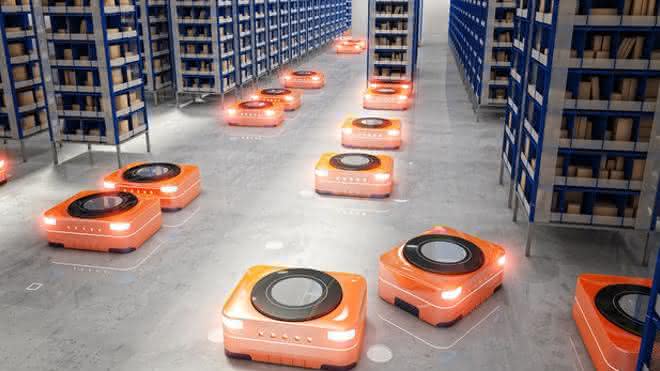
Automated guided vehicles (AGVs) are extremely economical and productive. For example, they distribute picked goods in spacious warehouses and shipping halls. Often referred to as Automatic Guided Vehicles (AGV), they are also used to transport individual parts and prefabricated components to other assembly and processing stations in assembly and production halls. They usually work autonomously. They use sophisticated sensor technology to orient themselves in their surroundings. Their routes and destinations are programmed and stored in a built-in computer. The electrical power for the drive is provided by accumulators carried in the vehicle.
AGVs are particularly economical when they can cover long distances and travel times without having to repeatedly recharge the energy storage units they carry. This places special demands on the design and construction. In particular, the vehicles and their components must be light and compact. Manufacturers demand high power density and energy efficiency from the drive system. Especially in the increasingly smaller shuttle vehicles for distribution systems in warehouses, there is little space available for the drives. The usual drive units with axially aligned electric motors and multi-stage spur and planetary gearboxes cannot be integrated due to their overall length.
In response to the requirements of AGV manufacturers, Eisenbach-based gearbox manufacturer Framo Morat and Bonndorf-based motor manufacturer Dunkermotoren have developed and realized a particularly compact DC drive system. A special feature is the hub gear designed by Framo Morat. As Wolfgang Sühling explains, this gearbox design is being used for the first time in a traction drive for AGVs. Sühling heads up the development of customer-specific drives at the Eisenbach-based gearbox manufacturer. "In addition to the compact design, this gearbox design has other decisive advantages, especially for the wheel and toothed belt drives frequently installed in shuttle vehicles," he says.
Gearbox and bearing must withstand high loads
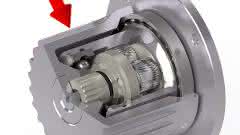
In conventionally designed wheel or belt drives in which a planetary gear or spur gear unit is used, large radial loads act on the bearing due to the load introduction into the projecting shaft. The rolling bearings installed in the gearbox must be able to withstand this.
However, the usual shaft bearing arrangements with deep groove ball bearings or preloaded tapered roller bearings have some decisive disadvantages. "With deep groove ball bearings arranged close together, radial loads acting on the projecting shaft end lead to high bearing loads. Due to the bearing clearance in conjunction with the short bearing distance due to the design, the output shaft and individual gearbox components, such as the planet carriers, are also skewed. As a result, the gearboxes wear quickly and do not guarantee the required service life and reliability. The skewed position also causes increased noise emissions. Although tapered roller bearings preloaded in pairs can easily support larger radial loads, they have greater bearing losses than deep groove ball bearings, especially in the partial load range. They are also larger and heavier than deep groove ball bearings," Sühling continues. This is why the gearbox specialists in the Black Forest were looking for an alternative to the usual spur and planetary gearboxes flange-mounted on the electric motor.
Compact design copes with radial forces
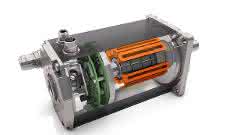
In the hub gearbox that has now been realized, standard deep groove ball bearings absorb the high radial loads. "The name of this gearbox type already indicates the special design features. The entire gearbox can be accommodated in a narrow wheel hub," says Sühling. The input and output shafts are arranged coaxially in this gearbox design. The radial forces are transmitted via the hollow shaft almost centrally between the two ball bearings. The small distance between the ball bearings has a positive effect on the bending stiffness of the hollow output shaft. It hardly bends at all.
A planetary gearbox transmits the torques between the input and output shafts. It ensures the required transmission ratios between the input and output sides. These are usually between 20 and 30 for the attached, electronically controlled DC motors from Dunkermotoren. The gearbox runs very quietly due to the insignificant inclination of the planet carrier.
High efficiency and effectiveness
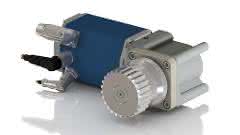
To make the entire drive package particularly compact, a bevel gear connects the DC motor to the input shaft of the hub gearbox. "This combination allows us to achieve a small installation space and high energy density," says Stefan Tröndle, Product Manager at Dunkermotoren in Bonndorf. "The combination of our brushless, electronically controlled DC motors with over 90 percent efficiency and the very smooth-running, low-loss bevel gearboxes and planetary gearboxes enables us to achieve a very high level of efficiency for the entire drive system and therefore a high level of energy efficiency. This drive system therefore makes a decisive contribution to the particularly economical operation of the shuttle vehicles."
The drive units are configured according to the individual requirements of the AGV manufacturers. The modular system ensures short delivery times and cost-effective investments. The two drive manufacturers combine the respective drive system from standardized, modular components. Dunkermotoren offers electronically commutated DC motors from the BG series for this purpose. Depending on the version, these operate with 10 to 24 V DC voltage. At 24 V supply voltage, they provide 1,100 W drive power in the long term and up to 2,600 W for short periods.
In addition to the versions with integrated commutation, there are also variants with integrated speed control or with positioning electronics. Complete travel profiles can be stored in the electronics, for example. CANopen, Profibus or EtherCAT ensure data communication with higher-level control systems. Dunkermotoren offers suitable brakes as modular components. The Safe-Torque-Off (STO) function is available as an option. This ensures safe operation of the drives to prevent danger to property and people in critical situations. The hub gearboxes designed by Framo Morat are based on gearbox components from the standard series with nominal output torques of up to 350 Nm. The Eisenbach-based gearbox manufacturer designs the outer contour of the output shaft and the torque support individually according to the customer's requirements, for example with a standard toothing for toothed belts, with a customer-specific shaft-hub toothing or as a smooth shaft with flange holes for a wheel rim.


You might also be interested in
Motors, gearboxes and encoders: Faulhaber expands Ø 16 mm portfolio
Faulhaber is expanding its portfolio with new DC motors from the SXR and GXR family, a 16 mm planetary gearbox and the IEX3 magnetic encoder for compact drive solutions.
 read more...
New drive solutions for industrial automation and robotics
Faulhaber presents drive solutions with the new GXR and SXR motor family, which offer high efficiency and flexibility in combination with powerful gearboxes and encoders. These optimized components open up new possibilities for applications in...
read more...Marco Altherr becomes new Chief Financial Officer
The Supervisory Board of Ziehl-Abegg has appointed Marco Altherr as the company's new Chief Financial Officer (CFO). Altherr will take up his post in May 2025.
read more...Hydrogen storage in metal hydride
With its focus on storage systems for green hydrogen in solid form (metal hydride), GKN Hydrogen presents itself as a pioneer in safety and efficiency for the industry. GKN Hydrogen offers safe storage systems for green hydrogen and focuses on two...
read more...INDUSTRIAL Production Products of the year...
2nd place, Robotics category: EGS Automation
The SUMO automation systems from EGS Automation - economical standard solutions for automating a wide range of processes in plastics and metalworking - took second place in the robotics category in the competition for Product of the Year 2024.
read more...More productivity with Drive Intelligence
The trends in automation are productivity, sustainability and connectivity. Baumüller is launching new products on the market that address these trends, including new tools for smart energy monitoring, condition monitoring in the drive and new...
read more...Intelligence in Motion
At SPS, Koco Motion will be showcasing its expertise in customized drive solutions based on DC and BLDC motors, stepper motors, servo motors, linear drives and controllers.
read more...Nomination Products of the Year 2024
EGS Automation: SUMO automation systems
The SUMO automation systems from EGS Automation, economical standard solutions for automating a wide range of processes in plastics and metalworking, have been nominated in the Robotics category in the competition for Product of the Year 2024.
read more...Transport technology from the modular system
Many transport tasks can be realized with the help of linear technology. Pre-configured solutions are available to simplify the interaction between the linear unit, motor, gearbox and controller. This minimizes the effort required for research and...
read more...