
Ball screws
Machine element for precise positioning
For decades, ball screws have been the preferred machine element in machine tools for moving slides precisely and quickly. However, like any mechanical element, ball screws are also subject to constant wear. If they have to be replaced at the end of their service life, long delivery times often result in high downtime costs for the affected machine.
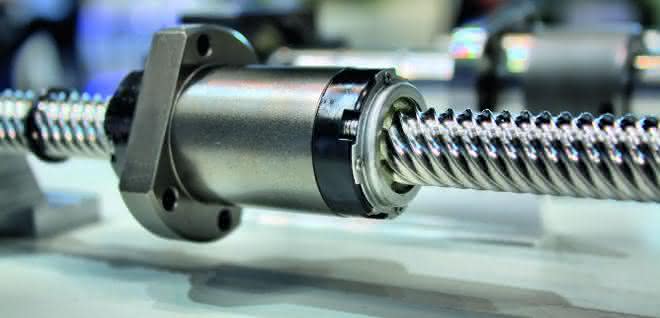
When purchasing new CNC machines, decision-makers usually devote a great deal of attention to the machine equipment. The aim is to acquire the optimally equipped machine to make their own production even more efficient and flexible. Whether CNC control, additional work axis or automatic parts handling - every detail is meticulously examined to see whether this or that option promises added value.
While the focus of interest is on the performance of the machine to be purchased, it is very often overlooked that this is only available for a certain period of time. The reason for this is the wear and tear of mechanical parts in daily use. This wear is noticeable in dimensional, surface and shape deviations of the workpieces.
Service life calculation and delivery times
In the case of ball screws installed in machine tools, their service life can be calculated quite well using sophisticated calculation programs. This data can form the basis for forward-looking procurement management in order to procure replacements in good time for ball screw spindles that reach their wear limit over time.
But this is only half the battle when it comes to having the right ball screw in house for the overhaul date. A real hurdle is the sometimes very long delivery times of between four weeks and 12 months, which makes timely procurement a game of chance. It is therefore not a bad idea to purchase a set of ball screws at the same time as a new machine and keep them in stock so that they are immediately available for servicing.
This rule can be deviated from if the supplier of the machine tool has a well-stocked warehouse and guarantees that a ball screw will be supplied from stock even after many years of purchasing the machine. However, it may well happen that the machine tool manufacturer gets into financial difficulties and can therefore no longer keep the promise made at the time due to bankruptcy.
There are therefore a number of reasons why it is not possible to replace the ball screws quickly, which leads to expensive downtimes for the affected machine. Thanks to its large stock, Dr. Tretter says it is able to supply the right ball screw in many cases without long waiting times.
To ensure that this works, not only finished ball screws are kept in stock. Rolled spindles are produced by the meter and supplemented with stocked nuts. Whirled spindles are manufactured individually according to drawings, while ground spindles are even available from stock in many types.
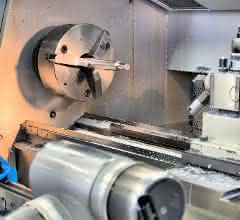
This approach is particularly interesting for special machine manufacturers, as it allows machines to be realized without any dimensional constraints. In addition, the appropriate spindle can be selected to suit the intended use. For example, rolled ball screw spindles are always recommended when positioning with the utmost precision is not required. This is the case in logistics, for example. The accuracy of 52 µ to 300 mm that can be achieved with rolled ball screws is completely sufficient for the automatic handling machines used here. The remaining play also disappears completely when loads are moved vertically. Incidentally, rolled ball screws are cold-formed, which is why they have no interrupted fibers and therefore have a very resistant surface structure. In terms of price, the running meter is available from 120 euros, while a ground ball screw costs 1200 euros for the same length.
Cost-effectiveness combined with high accuracy
Whirled ball screws are a higher-quality variant compared to the rolled versions. They are specifically used where expensive, ground ball screws would be uneconomical. With an accuracy of 23 µ to 300 mm, they are significantly more precise than rolled ball screws and are therefore suitable wherever this accuracy is required.
If even this level of accuracy is no longer sufficient, ground ball screws are the right choice. These have an accuracy of 12 µ per 300 mm, which makes them ideal for use in high-precision machine tools. The raceway for the balls is induction-hardened to 60 to 64 HRC, while the core is soft, so that the ball screw behaves elastically and yet has a high wear resistance. In order to meet the high demands of machine tool manufacturers, a ball screw must run absolutely backlash-free. This is achieved, for example, by pre-tensioning using a double nut. If little installation space is available, zero backlash can also be achieved by using balls that fit together exactly.
The special trick is to measure the diameter of each ball produced individually to the nearest thousandth of a millimeter and to assemble exactly identical balls in sets. From these sets, those balls are then put together that produce a clearance of exactly zero millimetres or a preload. Alternatively, it would be possible to fill in balls without taking their precise diameter into account and then determine the residual clearance. To eliminate this, one ball is then exchanged for another that has a larger diameter by the clearance.
When installed, the filled balls run in a circuit within the ball roller nut, which is why the barrel runs very smoothly and the wear is distributed across all the balls. The different ways in which the balls are moved in the circuit are interesting.
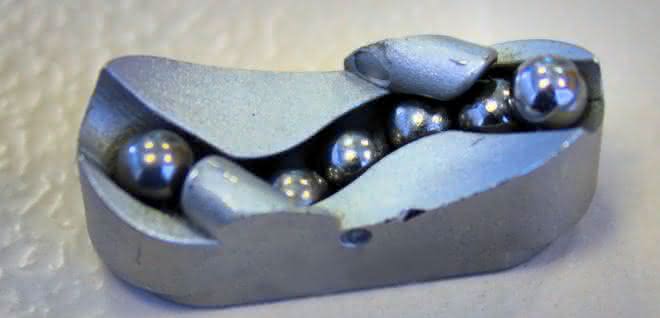
In the so-called deflector system, a ball recirculates over an entire thread. At the end, the balls are returned to the start of the thread by a deflector. In the deflector tube system, this return movement takes place via a deflector tube, whereas in the end cap deflector system, return holes in an end cap are responsible for this.
Expert knowledge for individual requirements
Depending on the load to be moved, its acceleration and the desired service life, the experts at Dr. Tretter are able to use calculation programs to calculate the necessary size of ball screw to meet the requirements. They also help to select the right ball screw drive by determining the positioning accuracy, the maximum travel speed and the desired service life.
The Dr. Tretter consultants also provide tips on which materials the ball screw must be made of to ensure that it functions smoothly in the environment in which it is used. For example, corrosion protection is essential in the food industry, while plastics must not be used in vacuum and cleanroom technology to prevent particles from being released.
A ball screw should only be installed by specially trained experts, as ball screws are absolute precision parts that can be damaged if handled incorrectly. For example, dropping the ball screw once can render it unusable. Under no circumstances should the nut be removed for assembly, as this can cause balls to come out of their orbits and the ball screw must therefore be returned to the factory for assembly.
Machine designers must ensure that the ball screw only absorbs axial forces. Under no circumstances should a ball screw serve as a guide for the table. A coupling must be provided for torque transmission in order to avoid bending moments.
Machine operators must also ensure that the spindle is lubricated regularly. Under normal conditions, it is sufficient to check or refill the grease once a year. If it is a maintenance-free ball screw drive, this is of course not necessary.


You might also be interested in
Conrad continues to grow
Conrad Electronic now generates 80% of its sales with business customers and has successfully developed from a traditional technology retailer into a B2B procurement platform. The company aims to become Europe's leading procurement platform for...
 read more...
AI finds its way into automotive customer service
In addition to computer solutions for vehicle diagnostics, Getac now also offers AI-based digital tools that support customer contact in service operations.
read more...SMC: "Preferred Supplier" from Bosch
The technology and service company Bosch has recognized SMC for the performance of its automation technology in factory and process automation and awarded it the status of "Preferred Supplier" in the material group "Standardized Pneumatic Devices".
read more...Combined ERP forces
The medium-sized ERP providers Step Ahead Software, Godesys and Informing merge to form the Step Ahead Group.
read more...Cybersecurity for asset-intensive companies
Forge Cybersecurity Platform, the new software platform from Honeywell, has been developed for the cybersecurity of asset-intensive companies and critical infrastructures. The platform is available in three versions.
read more...Automated machine tool as a success factor
Industry 4.0 is the hot topic of the moment. For small and medium-sized companies and contract manufacturers, it holds great potential for increasing production efficiency step by step. The focus here is on efficient and user-specific automation...
read more...Nemo hand vacuum lifts all materials
A new addition to the Eurotech portfolio is the battery-operated Nemo vacuum cleaner, which is suitable for handling almost all surfaces.
read more...Future-oriented cobot projects
Three pillars of successful cobot initiatives
What is important if cobot projects are to be future-oriented? Automation and robotics expert Omron has identified three aspects for human-machine collaboration.
read more...Short-stroke linear actuator instead of pneumatic cylinders
The new short-stroke linear actuator from Ketterer Antriebe and halstrup-walcher is characterized by high dynamics and a large stroke in a compact size. Thanks to the integrated electronics, the drive is easy to control compared to pneumatic...
read more...