

Virtual commissioning
Simulate production systems
Modern production machines are not only equipped with more computing power and store more measurement data than ever before, they are also becoming increasingly complex. This can lead to delays during commissioning and errors during operation. Virtual commissioning provides a remedy.
Among other things, the digital transformation in mechanical engineering has ensured that the software on production systems is playing an ever greater role - and is becoming increasingly complex. Together with the wide range of variants resulting from increasing demands on flexibility and the resulting greater modularity of machines and systems, this is increasingly leading to delays in commissioning and errors during operation.
Virtual commissioning provides a remedy. Instead of time-consuming tests on the physical system, the software is tested and optimized using simulation models - often at a time when the physical system is not yet available.
Exploiting the full potential
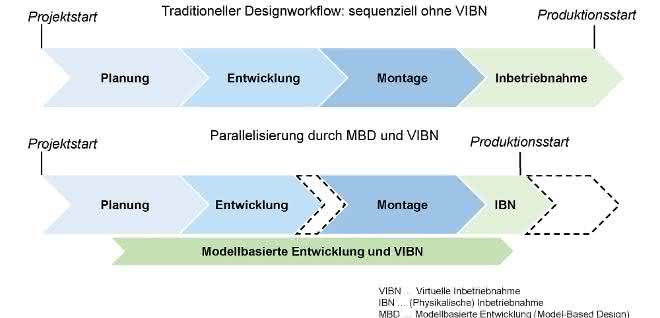
Although virtual commissioning and the associated use of simulation models are widespread in mechanical and plant engineering, it is often forgotten that simulation models can fulfill a much broader range of benefits. The development approach of model-based development, i.e. model-based design, places the model at the center of the entire development process. Models are created as early as the planning phase for the machine or system and are continuously developed from the design stage through to commissioning. The resulting parallelization can shorten the lead time from the start of the project to the start of production (Fig. 1). Simulation models play a role as the basis for digital twins over the entire service life of the system. This is particularly important when comparing the benefits of the model with the effort required to create and optimize it.
In general, the question of return on investment (ROI) should be asked at the outset and a transparent list of the expected savings and costs should be drawn up. Savings are, for example
- Downtime costs of the machine during operation,
- Additional costs due to delays in physical commissioning,
- travel expenses for service calls,
- material and energy consumption during physical commissioning.
Expenses include, for example
- Personnel costs for creating and maintaining the models,
- Building up know-how in the team,
- License costs for simulation tools,
- additional costs for comparison between machine and simulation model using measurement data.
The following points have proven to be useful for getting started with virtual commissioning and model-based development in general:
- Start with reduced complexity of the simulation model and successive expansion throughout the project.
- Modeling or virtual commissioning of a sub-component of the machine or system in the first project (achieve quick wins).
- Gradual introduction of model-based development and replacement of established development processes (change management).
The modeling
The effort required for modeling depends on several components. The detailed modeling of the individual components, for example drives, sensors, etc., of a system provides the most accurate results - but at the expense of modeling and simulation time. A 3D behavior model of the entire system can be helpful for the verification of logical software parts, but is not suitable for the evaluation of physical results, for example the accuracy of a position control or the correct design of the drives.
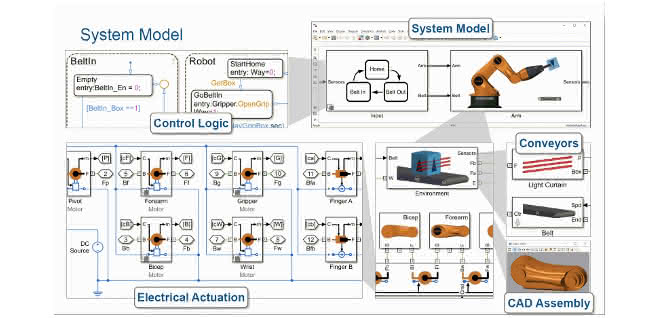
Simulation environments such as Simulink therefore offer different modules for modeling, which map the individual aspects accordingly. For example, logical state models and step chains are modeled in Stateflow, while Simscape offers the option of importing 3D CAD data as a physical model.
The simulation model of the machine or system created in this way (Fig. 2) is then used in several steps throughout the entire development and commissioning period in order to continuously verify the interaction between the mechanical, electrical and software systems:
Desktop simulation: The behavior model of the machine is simulated together with the algorithms that will later run on a PLC or an industrial PC, for example sequence controls, control technology or AI algorithms. This involves running through different scenarios that would not be possible on the physical machine or would only be possible with great effort.
Code generation: Source code in various languages is generated from the simulation model at the touch of a button, which is then transferred to the industrial control system and executed there in real time. Optionally, the documentation for the software can also be generated. Model-based development with Simulink supports the common industrial control platforms.
Hardware-in-the-loop: The portion of the simulation model that represents the physical and logical behavior of the machine or system is also used to automatically generate real-time-capable code that runs on real-time hardware connected to the PLC via common industrial protocols (Figure 2). This simulates the behavior of the system to the industrial controller so that different tests can be carried out under real-time conditions.
This workflow has not only been established in the automotive industry for years, but is also used successfully in mechanical engineering by leading companies such as Krones, Metso and Tetra Pak.
Model use beyond virtual commissioning
The models developed for virtual commissioning also offer decisive added value beyond the development and commissioning phase. They are increasingly being used as so-called digital twins - i.e. virtual representations of the running system - over the entire service life of the machine. Typical applications here include predictive maintenance or the prediction of quality fluctuations based on a comparison of measured and simulated data. The digital twin is usually embedded in the IT infrastructure of the production plant. Tools such as Simulink offer corresponding options for the use of models on edge or cloud systems.
In times of increasingly complex systems, virtual commissioning helps mechanical engineering to virtualize commissioning to a large extent, thereby saving time and costs. With the help of model-based development, the simulation models created in this way are used throughout the entire development phase - and increasingly beyond in the form of digital twins. With the gradual introduction of virtual commissioning and the appropriate software tools, this step usually pays off in the very first project.
Philipp Wallner, Industry Manager at Mathworks / ag


You might also be interested in
ebm-papst is growing again thanks to AI and data centers
ebm-papst returned to a growth trajectory in fiscal year 2025/26. Air Technology, data center applications, and artificial intelligence are driving revenue and investment.
 read more...
SPE on the Verge of a Market Breakthrough
Single Pair Ethernet (SPE) has moved beyond the conceptual phase and is increasingly being implemented in industrial settings. The focus here is not only on higher data rates and simplified cabling, but above all on the issue of system integration...
read more...More than 900 exhibitors already registered
Around six months before the start of the trade fair, more than 900 companies have registered for SPS 2026 in Nuremberg. The trade fair focuses on industrial AI, cyber security and digital transformation.
read more...Virtual PLCs in practice: How vPLCs make production systems more flexible and scalable
The increasing networking of IT and OT is fundamentally changing industrial automation. The IT/OT Integration Summit shows how modern technologies can make production environments more efficient, flexible and future-proof. The event will focus on...
read more...Sales growth in a turbulent market environment
Thanks to innovations and a focus on strategic industrial markets, Sick was able to moderately increase its sales in the 2025 financial year. In a turbulent market environment, the company was able to maintain its position and gain market share with...
read more...Siemens presents new AI agent
Siemens is launching 'Eigen Engineering Agent', an AI for automation technology. The solution is integrated into the TIA Portal, has been tested with over 100 companies and is designed to significantly accelerate engineering processes.
read more...Schaeffler keeps sales almost stable
Schaeffler generated revenue of EUR 23.5 billion in 2025 and increased EBIT before special items to EUR 936 million. At 266 million euros, free cash flow was significantly above the prior year and forecast. Net income remained negative due to high...
read more...Advancing artificial intelligence together
Helukabel is stepping up its activities in the field of artificial intelligence and is now a member of the IPAI. The innovation and collaboration platform for companies, research facilities, institutions and administration has set itself the goal of...
read more...New impetus for ifm sales
Two new positions were filled at ifm at the start of 2026: Markus Wolf becomes Managing Director Sales Germany, Sven Quant takes over the position of Central Managing Director in the Process Sensors division within the ifm Group.
read more...